Taxonomy & naming
The species was described by the German ichthyologist Ernst Ahl in 1926 as Pseudotropheus macrophthalmus, from material collected near Langenburg (modern-day Lumbira, at the northern end of Lake Malawi); the two syntypes are held in the Berlin museum. The specific epithet, from the Greek for "large eye," simply records a feature Ahl noted in his types.
For decades the fish sat inside the sprawling genus Pseudotropheus, and older literature and hobby labels still call it Pseudotropheus macrophthalmus. Eschmeyer's Catalog of Fishes now lists it as valid in Tropheops, following the genus-level work of Konings (2016) and the molecular revision of Li et al. (2016) that elevated several former Pseudotropheus species-complexes — Tropheops among them — to full genera. The Tropheops group is the "tropheops complex," a cluster of deep-bodied, steep-foreheaded grazers that an experienced eye can usually pick out at a glance.
Naming is genuinely messy here, and keepers should know it. Tropheops contains many similar, sometimes undescribed forms that have been confused with one another for years and are frequently traded under provisional names — "red cheek," "chitimba blue," and the like — so a fish sold as Tropheops macrophthalmus may or may not be this species in the strict sense. Treat trade labels as a starting point, not a determination.
Morphology
This is a modestly sized mbuna. The IUCN assessment gives a maximum of about 4.7 in total length, and in the wild most individuals are smaller; tank-raised fish on rich diets can run a little larger and heavier than their lake counterparts.
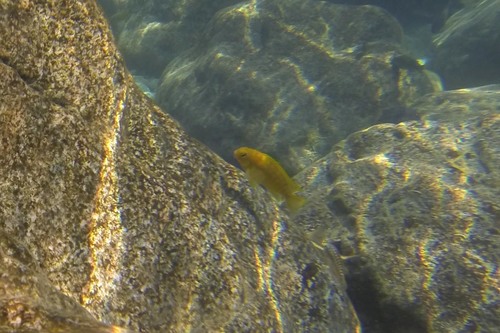
The body is the classic Tropheops shape — fairly deep and laterally compressed, with a steep forehead and a blunt, rounded snout set over a small terminal-to-subterminal mouth built for scraping. Colour is strongly sex-linked, as in most mbuna: dominant males turn blue, often with a metallic or lavender cast and darker barring, while females and juveniles are typically a plainer yellow to ochre. That dimorphism, combined with the comparatively subdued juvenile colour, is part of why Tropheops have never been as commercially popular as the flashier yellow labs and zebras.
Pinning down field marks is complicated by the species' geographic variation. Across its range it appears as numerous local forms — documented variants include those from Chirwa Island, Chitande Island, Chizumulu Island, Kirondo, Linganjala Reef, Lumbira, Makonde, and Mdowa — that differ in the male's blue tone and pattern. Separating it cleanly from congeneric Tropheops in a shop tank is often not possible on colour alone.
Habitat
Tropheops macrophthalmus is a Lake Malawi endemic with a restricted, northern distribution. The IUCN assessment places it in the northern part of the lake and at Chizumulu Island (but not neighbouring Likoma): on the western shore it occurs between Mdoka and Chirwa Island, and on the eastern shore between Matema and Kirondo. That makes it a regional specialist rather than a lake-wide generalist — a meaningful distinction when thinking about its exposure to localized threats.
The fish belongs to the mbuna guild: the rock-dwelling cichlids of Malawi's rocky and intermediate shoreline. It is most associated with rocky substrate, but it also uses shallow, sheltered intermediate habitat, including sediment-rich areas where rock gives way to sand. Most activity is in the well-lit upper few metres where algal growth on the rocks is densest, though some local forms — the 'chitimba blue,' for instance, photographed by Ad Konings in the deeper part of Chitimba Bay — range somewhat deeper.
The water it lives in is alkaline and well-buffered and remarkably stable. Lake Malawi's clear surface waters run roughly pH 7.7–8.8, around 75–82 °F — the well-buffered envelope shared by the whole mbuna community.
Feeding
Ecologically, Tropheops macrophthalmus is part of the aufwuchs economy that drives the entire mbuna radiation. "Aufwuchs" is the German term cichlid people borrow for the carpet of short filamentous algae, diatoms, biofilm, and the tiny invertebrates living within it that coats sunlit rock. Tropheops are specialized epilithic (rock-surface) algal grazers: they comb and scrape this growth with their broad, slightly subterminal mouths. The IUCN account describes the species as feeding on blue-green algae picked from the rocky substrate.
They are not rigid herbivores, though. The same account notes the species also feeds on plankton when it is available in sufficient quantity — a flexibility documented across the genus. Work by Genner and colleagues on coexisting Lake Malawi rock cichlids treated the Pseudotropheus (Tropheops) complex as specialized epilithic algal herbivores while a related Maylandia complex behaved as more generalist algae-and-plankton feeders, and McKaye and Marsh long ago described mbuna switching to plankton during blooms.
That trophic specialization has a behavioural consequence with real explanatory power. In Genner, Turner and Hawkins's study of resource control, territorial Tropheops males preferentially drove off other fish with diets most like their own while tolerating ecologically different intruders — a pattern of interspecific territoriality thought to help so many similar grazers partition a crowded reef and coexist. The fish's place in the community, in other words, is defined as much by who it chases off its patch of rock as by what it eats.
Mating
Socially, this is a typical territorial mbuna. Dominant males hold and defend feeding-and-breeding territories centred on rock; in the lake these territories form dense, multispecies mosaics across the shoreline, and where a male's patch includes a sandy bottom he will sometimes excavate a shallow burrow. Aggression is real but, by mbuna standards, moderate — keepers consistently describe Tropheops as territorial "average" mbuna rather than the relentless terrors that genera like Melanochromis can be, a characterization that matches the field picture of a fish defending a patch rather than patrolling the whole reef.
Females tell the other half of the story. In the wild they usually occur singly and do not hold territories, moving across the reef rather than guarding a fixed spot. A male displays over his territory to a passing female, and courtship leads to spawning on his patch of rock or sand — the prelude to a brooding strategy that, unusually for a substrate-bound grazer, frees the female to wander.
Breeding
Reproduction follows the Malawi haplochromine template: Tropheops macrophthalmus is a maternal (ovophilous) mouthbrooder. After courtship the female lays a small clutch — on the order of a few dozen eggs, in line with similarly sized mbuna — and takes the eggs into her mouth, where they are fertilized and incubated. She carries the developing young through hatching and releases free-swimming fry after several weeks, with no paternal care.
Brooding females are a regular sight on the reef but, tellingly, do not appear to shelter among the rocks the way many mbuna do; they remain mobile and inconspicuous while carrying. Because the parent is not tied to one patch of substrate, the strategy lets the species spread and colonize freely — a recurring theme in the lake's explosive cichlid diversification and part of why a fish this localized still splinters into so many island and reef forms.
In the aquarium
Tropheops macrophthalmus turns up in the hobby mostly as wild-collected or specialist-bred stock — sometimes under trade names such as "Tropheops Chitande Yellow" or "Tropheops Gold" — and it is a fish for someone who already keeps mbuna rather than a first cichlid. It earns a quiet reputation among Tropheops enthusiasts as a subtly handsome, comparatively well-behaved mbuna that grazes algae in the shallows — appealing, but not a beginner's impulse buy.
Water should mirror the lake: alkaline, well-buffered, well-oxygenated, and clean. A pH comfortably above 7.5 (the fish tolerates the high-8s), high carbonate and general hardness, temperatures around 75–79 °F (75–79 °F), and aggressive filtration with low nitrates suit it. Aquascape with abundant rock arranged into broken-up territories and sightline breaks; experienced Tropheops keepers report that keeping rockwork at a fairly even height across the tank, rather than in one tall pile, noticeably reduces fighting. A four-foot tank is a realistic floor for a small group, with a six-foot tank far better for a proper colony and for housing multiple males.
The usual mbuna management applies: stock as a group rather than a pair, skew the sex ratio toward females so no single female is harassed, and avoid mixing in genuinely vicious species. Diet should be algae- and vegetable-based; mbuna fed protein-heavy carnivore foods are prone to the digestive disorder hobbyists call "Malawi bloat." The single biggest pitfall, though, is identity: because Tropheops are so easily confused and so often sold under ad-hoc names, hybridization in mixed tanks is a real risk, and crossing look-alike forms quietly erodes exactly the diversity that makes these fish interesting. Keep this species only with confidently identified stock.
Conservation
On its own account, Tropheops macrophthalmus is currently in good standing. The IUCN Red List assessed it as Least Concern (Konings & Kazembe, assessed 19 June 2018; errata version 2019), with a stable population, and it is not listed by CITES. The assessors did, however, flag two species-specific concerns worth taking seriously given its narrow northern range: sedimentation degrading the rocky habitat it depends on, and collection by the ornamental-fish trade. For a rock-grazing endemic confined to a stretch of shoreline, both pressures are localized and habitat-specific rather than abstract.
Those threats sit inside a lake that is, as a whole, under growing strain. The basin review by Chavula et al. (2023, Journal of Great Lakes Research 49(6):102241) catalogues the pressures on Lake Malawi/Niassa/Nyasa: heavy and increasing fishing — most visibly the long decline of the commercially vital chambo (Oreochromis) tilapias — alongside sediment and nutrient loading washing off deforested catchments, an estimated warming of roughly +33 °F in shallow waters that strengthens stratification and tends to lower productivity, and the risk posed by invasive species. The IUCN's wider Lake Malawi work, completed in the same era, found a meaningful fraction of assessed fish species at elevated extinction risk, chiefly from overfishing.
The honest read is that the species itself is not currently threatened, but the guild it belongs to is the one most exposed to the lake's two most local stressors. Catchment-derived sediment is precisely what smothers the epilithic algae and clogs the rocky crevices that a shallow-water grazer like this one needs, and shoreline development concentrates that runoff in the sheltered habitats it favours. A Least Concern listing today is not a guarantee of an undisturbed tomorrow for a fish this geographically restricted.