Taxonomy & naming
Mylochromis ericotaenia was described in 1922 by the British ichthyologist Charles Tate Regan, as Haplochromis ericotaenia, in his account of the cichlid fishes of Lake Nyasa (the name then used for Lake Malawi). The parenthetical authority, (Regan, 1922), records that the species has since been moved out of the original genus Haplochromis. Eschmeyer's Catalog of Fishes lists it as valid as Mylochromis ericotaenia (Regan 1922), following Konings (2016).
The genus Mylochromis was erected by Regan in 1920, with Mylochromis lateristriga as its type species; the name (Greek mylo-, 'grinder') refers to the enlarged, obtuse middle pharyngeal teeth of that type species. For some decades many of these long-snouted Malawi sand-cichlids were placed in the genus Maravichromis, raised by Eccles and Trewavas in 1989, but Derijst and Snoeks (1992) showed Maravichromis to be a junior synonym of the older Mylochromis, and that conclusion has held. Mylochromis ericotaenia is one of roughly two dozen valid Mylochromis species, all endemic to Lake Malawi.
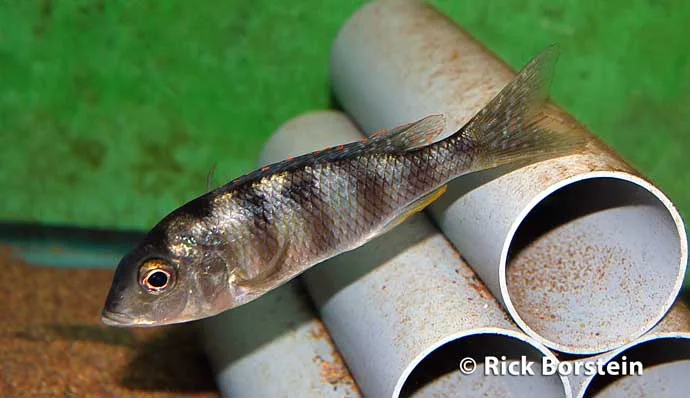
The specific epithet ericotaenia comes from the Greek ereiko, 'to break,' and taenia, 'band,' and refers to the blackish lateral band that is more or less broken up into a series of spots running from the nape to the middle of the caudal-fin base — the very feature that separates it at a glance from relatives with a continuous diagonal stripe. The species has no established common name in the hobby.
Morphology
Mylochromis ericotaenia is a medium-large haplochromine reaching about 8 in total length (FishBase). It has the elongate, moderately compressed body and pointed snout typical of the sand-dwelling Mylochromis, built for nosing into loose substrate. The diagnostic marking is the lateral band described in its name: rather than a clean, unbroken diagonal stripe, the dark flank marking is fragmented into a chain of discrete blotches that runs obliquely from the nape down to the base of the caudal fin. This 'broken band' is the most reliable way to tell it apart from congeners such as Mylochromis lateristriga, which carry a solid, well-defined stripe.
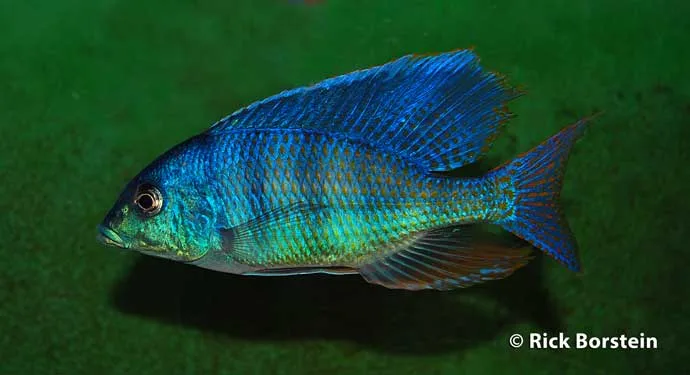
As in other Mylochromis, the pharyngeal dentition reflects a diet of substrate invertebrates. Detailed published notes on sexual dimorphism for this species are limited, but the genus follows the standard Malawi haplochromine pattern in which breeding males develop bright nuptial coloration — typically blue-grey body tones with metallic highlights — while females and non-breeding males remain a cryptic tan-grey patterned with the species' characteristic broken band. Outside breeding, dominant males can appear comparatively drab.
Habitat
The species is endemic to Lake Malawi and, unusually, is recorded specifically from the far northern and southern ends of the lake rather than continuously along its shores (FishBase). It is a demersal fish of open sandy substrate, foraging over the sediment floor in inshore waters. No published minimum or maximum depth has been recorded for it specifically; its association is consistently with sand rather than with rock or vegetation.
Lake Malawi offers an exceptionally stable, alkaline, well-buffered environment. Lake-wide open-water measurements give pH around 7.7–8.6, surface temperatures of roughly 75–82 °F, and very stable buffering, with conductivity typically 210–260 µS/cm. This is one of the most chemically constant large lakes on Earth, and sand-dwelling haplochromines such as Mylochromis ericotaenia are adapted to those steady conditions and show no tolerance for soft or acidic water.
Feeding
Mylochromis ericotaenia is a benthic sand-sifting forager. FishBase records that it feeds on invertebrates and probably on phytoplankton, gleaned over the sandy bottom. The long snout characteristic of the genus is used to probe and dig into loose sediment, flushing out small invertebrates that are then taken and processed by the pharyngeal jaws. This places it among the many Malawi haplochromines that exploit the lake's open sand floor — a productive but physically demanding niche that rewards a probing snout and an efficient sediment-processing mouth.
No dedicated dietary study has been published for this species, so the picture is drawn from FishBase's account and the well-documented feeding ecology of the sand-dwelling Mylochromis as a group. The estimated trophic position is that of a benthic invertivore rather than a piscivore — distinguishing it from elongate, predatory congeners such as Mylochromis gracilis that hunt small fish over sand.
Mating
Like all Lake Malawi haplochromines, Mylochromis ericotaenia is a polygynous maternal mouthbrooder with no lasting pair bond. Breeding males establish and defend territories on the sandy substrate, where they court passing females with lateral displays and intensified nuptial coloration. In the sand-dwelling Mylochromis the male typically prepares a spawning site — a shallow depression or cleared patch of substrate, sometimes against a flat stone — and attracts females to it.
Specific courtship observations for Mylochromis ericotaenia have not been published, so the account here is inferred from the consistent reproductive biology of the genus and of Malawi sand-cichlids generally. Males are the brightly coloured, display-active sex; females visiting a territory remain cryptically patterned. Spawning takes place over the male's prepared site, after which the female assumes sole care of the brood.
Breeding
Breeding follows the standard Malawi haplochromine template. The female lays her eggs over the male's site and immediately takes them into her mouth; fertilisation occurs in the buccal cavity, typically cued by the egg-spot markings on the male's anal fin. She then broods the developing eggs and larvae for the usual three to four weeks, fasting throughout, before releasing free-swimming fry.
No clutch counts or fry-development data have been published specifically for Mylochromis ericotaenia. Given its maximum size of about 8 in TL and the genus-typical mouthbrooding biology, a brood on the order of a few dozen eggs would be consistent with Malawi haplochromines of comparable size, though this is inferred from congeners rather than directly measured for this species and should be treated as an estimate. The species is not part of the established aquarium-breeding literature, so the documented record of its reproduction is essentially limited to what can be generalised from the flock.
In the aquarium
Mylochromis ericotaenia is rarely if ever encountered in the aquarium trade. It lacks a trade name, a body of keeping experience, or a breeding history of its own, and is best regarded as a wild-biology species rather than a hobby fish. The husbandry notes below are extrapolated from the requirements of comparable large sand-dwelling Malawi haplochromines and should be read as such.
A fish that reaches around 8 in and forages over open sand needs a long tank with substantial horizontal swimming space and a deep bed of fine sand to allow natural snout-probing behaviour; coarse gravel is unsuitable. A tank length of at least 59 in and a volume in the region of 105 US gal would be a sensible floor for a single male with two or three females. Rockwork is secondary for a sand-dwelling species and is best kept to modest structure around the margins, leaving open substrate dominant.
Water chemistry must hold the Lake Malawi pH and temperature: pH roughly 7.8–8.6 and 75–81 °F, with a general hardness of 10–20 °dH or higher as a keeping target and good conductivity, achieved with lake-salt or carbonate buffering on soft tap water. Stability is critical — dips toward neutral or acidic pH are implicated in Malawi bloat, the bacterial enteritis that is the most common cause of death in captive Malawi cichlids. Regular partial water changes and a varied invertebrate-based diet (quality cichlid pellets supplemented with frozen or live invertebrates), while avoiding mammalian fats, follow standard practice for the group. Realistically this is a fish to admire in the wild-biology literature rather than one with an aquarium track record to draw on.
Conservation
The IUCN Red List assesses Mylochromis ericotaenia as Least Concern (LC), assessed on 20 June 2018 by Ad Konings and Jacqueline Kazembe and published in 2018 (amended 2019; e.T61011A155048074). The assessment reflects a species that is endemic to Lake Malawi but not currently subject to any documented major threat sufficient to qualify it for a threatened category. It carries no CITES listing.
That Least Concern status should be read against the wider trajectory of Lake Malawi. The lake is warming and becoming more strongly stratified, which reduces the deep mixing that brings nutrients to the productive surface layer and so depresses the invertebrate productivity on which sand-foraging haplochromines depend. Heavy artisanal and semi-industrial fishing in the shallow inshore zones, together with catchment deforestation and the sedimentation it drives, alters exactly the sandy inshore biotopes this species occupies. None of these pressures currently justifies a threatened listing for Mylochromis ericotaenia specifically, but they form the backdrop against which the long-term security of Lake Malawi's vast endemic cichlid flock — this species included — must be judged. The 2018 lake-wide Red List assessment found that around nine percent of Lake Malawi's fish species are at high risk of extinction, underlining that lake-level pressures are real even where individual species remain Least Concern.