Taxonomy & naming
The species was described by the British ichthyologist Charles Tate Regan in 1922, in his account of the cichlid fishes of Lake Nyasa (the older name for Lake Malawi), originally as Haplochromis fuscotaeniatus. The unique holotype, a single specimen, sits in the Natural History Museum, London. Eschmeyer's Catalog of Fishes records the current valid combination as Nimbochromis fuscotaeniatus (Regan, 1922), following the placement of these predatory haplochromines in the genus Nimbochromis by Eccles and Trewavas in their 1989 revision of Malawian cichlid genera.
The genus name is evocative: Nimbo- comes from the Latin nimbus, a rain-cloud or storm, a nod to the dark, cloud-like melanin blotches that smear across the body of these fish. The species epithet is plainer but just as descriptive — fuscus, dark or dusky-brown, joined to taeniatus, banded or striped. Put together the name reads, fairly, as "the dark-striped stormcloud cichlid." In the trade it is almost always just the "fusco," sometimes "Haplochromis fusco," a holdover from the days when most of these fish were lumped in Haplochromis.
Nimbochromis is a small genus of roughly half a dozen species, all Malawi endemics and all ambush predators: the widely kept livingstonii and polystigma, plus linni, venustus and others. Among them fuscotaeniatus is something of an outlier — its body is more elongate and its pattern more linear than the rounded blotches of its congeners, and experienced keepers have long noted that in shape, color and temperament it looks and behaves closer to the genus Tyrannochromis than to a typical Nimbochromis. Indeed, the Tyrannochromis nigriventer of Eccles and Trewavas was described as a close relative of fuscotaeniatus, and Ad Konings has expressed reservations about keeping fuscotaeniatus within Nimbochromis at all, noting that its inclusion warrants further consideration. That resemblance, for now, is an observation about appearance and habit, not a formal reclassification; the catalogues keep it in Nimbochromis.
Konings' reservation turns on a specific claim about breeding biology. He noted that in Nimbochromis livingstonii the eggs are fertilized on the open substrate and only then taken into the female's mouth — the classic haplochromine sequence built around a male's anal-fin egg-spots — whereas fuscotaeniatus was reported to fertilize its eggs only after they were already inside the female's mouth, a genuinely different mechanism that would set it apart from its Nimbochromis relatives. That report, however, traces to a single 1982 note (Dorenstouter) whose accompanying photograph is of uncertain identity, and later reviewers have flagged the claim as unconfirmed rather than established. The genus question is therefore open on real but thin evidence, not settled.
A further wrinkle involves that close relative Tyrannochromis nigriventer: the two species resemble each other closely in body proportions and dentition, but the pigment pattern of fuscotaeniatus is distinctly less regular than the figured nigriventer holotype, breaking into the irregular blotches typical of other Nimbochromis, where nigriventer instead shows a broader, continuous ventero-lateral brown patch without that blotchiness. Compounding the confusion, ecological notes published under the name 'Tyrannochromis macrostoma' in some popular Malawi cichlid guides of the late 1980s in fact describe T. nigriventer rather than the true T. macrostoma (Regan) — a mix-up traced to a naming dispute among Lewis et al. (1986), Eccles & Trewavas (1989) and later commentary, and a caution worth bearing in mind when tracing older literature on this species complex.
Morphology
This is a substantial fish. FishBase gives a maximum total length of about 10 in (10 in) for males and roughly 8 in (8 in) for females, and keepers report adults in the 10–12 in (10–12 in) range under good conditions — so plan around a fish that fills a hand and then some. The body is relatively elongate and fusiform rather than deep-bodied, with large jaws built for grabbing prey; the lower jaw alone runs a little under half the head length. The dorsal fin carries about 15–16 spines and 11–12 soft rays.
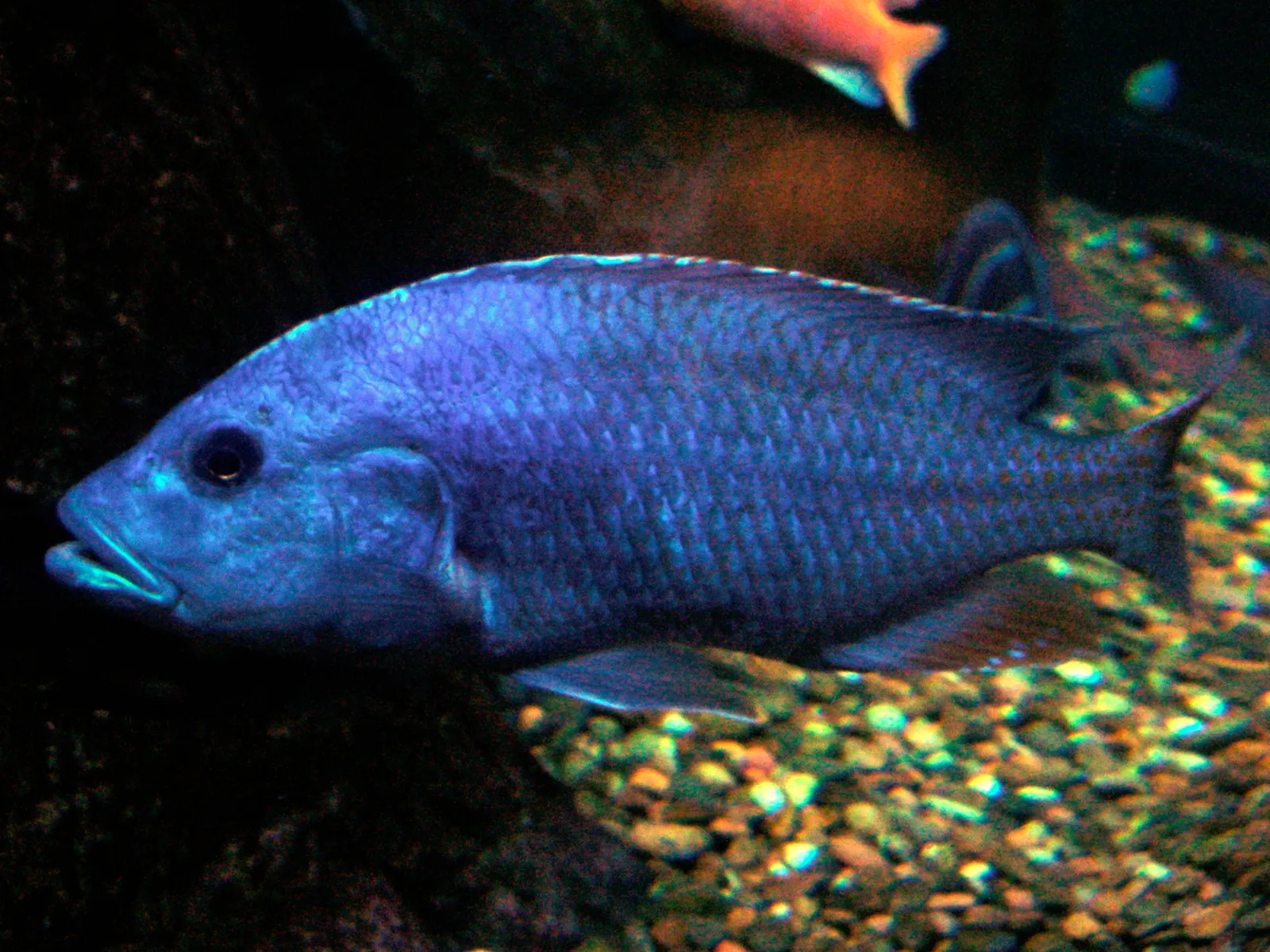
The defining feature is the pattern. Rather than the discrete round spots of livingstonii or polystigma, fuscotaeniatus wears an irregular, broken horizontal banding of dark melanin — blotchy stripes that run lengthwise and break the fish's outline against a mottled sand-and-rock background. The pigment pattern is noticeably less regular than the textbook spotting of its congeners, and there are no spots on the pectoral fins, a useful field mark separating it from look-alike relatives.
Sexual dimorphism is marked, and it is what sells the fish. Females and juveniles are a fairly plain silvery-brown overlaid with the dark banding — good camouflage, modest color. Dominant males transform: they develop an intense electric blue over the head and flanks, the dark bands still showing through, with red or orange flushing in the fins. The change is gradual; young fish look unremarkable for months, and hobbyists routinely describe a fish that "finally started coloring up" only well into its growth. That slow reveal, and the quality of the adult male's blue, are a large part of the species' appeal.
Habitat
Nimbochromis fuscotaeniatus is endemic to Lake Malawi — found nowhere else on Earth — and within the lake it is restricted to the southern portion. The IUCN assessment maps its range from Kande Island down to Mangochi along the Malawian (western) shore, and from Metangula in Mozambique down to Mangochi on the eastern side; FishBase notes the northernmost record as Namalenje Island. It is, in other words, a fish of the southern third of a very large lake, occurring in both Malawian and Mozambican waters.
It is a fish of the in-between. Rather than the pure rock of the mbuna zone or open sand, it favors the "intermediate" habitat where sand meets scattered rock and submerged vegetation, and is frequently found in shallow weedy areas. Reported depths run from the surface down to about 115 ft in the intermediate habitat, though it is most often encountered in vegetated water no deeper than about 50 ft. Sources consistently describe it as widespread but uncommon and usually solitary — not a fish you see in shoals, but a lone hunter spaced out across suitable ground.
The water it lives in is the warm, alkaline, well-buffered water characteristic of Lake Malawi's surface layers: temperatures broadly in the mid-70s °F (around 75–82 °F across the year) and a stable high pH typically between about 7.7 and 8.8. Those are the in-situ conditions a keeper is, in effect, trying to reproduce.
Feeding
Fuscotaeniatus is a piscivore — a fish-eater — and an ambush specialist, the trophic strategy that unites the whole genus Nimbochromis. FishBase places it at a high trophic level (around 4.2), consistent with a near-top predator in the inshore community. Its prey is principally smaller fishes, especially the smaller cichlids that swarm the intermediate and weedy zones it patrols.
The hunting method is the interesting part. The broken, dusky banding is not decoration but working camouflage: drifting slowly or lying still over a patchwork of sand, rock and plants, the fish dissolves into the background, then accelerates into a sudden lunge when a smaller fish strays within range. Its closest relatives take this to theatrical extremes — Nimbochromis livingstonii famously plays dead on the sand to lure scavengers — and while fuscotaeniatus is the more conventional drift-and-strike hunter of the group, it relies on the same combination of concealment and a fast, large-jawed snatch. In aquaria it will also take invertebrates and prepared foods readily, but in the lake it earns its living as a predator of fish, a role that makes it one of the inshore community's resident hunters and, as it turns out, an easy target for fishermen using the same shallow water.
Mating
Like the great majority of Lake Malawi haplochromines, Nimbochromis fuscotaeniatus is a polygamous, dimorphic spawner in the typical Malawi pattern. Reproduction turns on the dramatic difference between the sexes: a dominant male colors up into his electric-blue breeding dress, claims and defends a territory, and displays to court passing females, while drab, banded females and subordinate males look on. The IUCN account notes that males defend territories only when spawning, a behavioral switch that fits what keepers see in the tank.
That switch flips hard. Outside of breeding, descriptions converge on "solitary" in the wild and merely assertive in the tank — but a spawning male becomes intensely aggressive. Keepers across multiple independent forums report the same thing: a courting male will claim and patrol nearly the entire tank as his territory, driving off anything that enters it. This is well-corroborated community knowledge rather than a single anecdote. The flip side, also widely reported, is that a non-dominant fusco can be comparatively low-key, sitting back until it is the largest fish in the room and conditions tip it into breeding mode.
Breeding
Nimbochromis fuscotaeniatus is a maternal mouthbrooder — the female incubates the fertilized eggs in her mouth and continues to shelter the fry there after they hatch. The exact sequence of fertilization is less settled than is sometimes claimed. In the well-documented Nimbochromis livingstonii, eggs are fertilized on the open substrate and only then taken up into the female's mouth, the standard haplochromine pattern. A single, doubtfully identified source has reported that fuscotaeniatus instead fertilizes its eggs after they are already in the female's mouth — a real mechanistic difference if true — but that claim has never been confirmed and should be treated as an open question rather than fact. What is documented: spawning takes place over the substrate within the male's defended territory, and the female broods the clutch alone for roughly three weeks before releasing free-swimming young. The IUCN account records that females guard the resulting fry, and generation length is short, on the order of two to three years.
The species spawns readily in captivity, which is why captive-bred fusco are routinely available and why their breeding behavior is so well documented by hobbyists. A spawning male's near-total takeover of his tank (see Mating) is itself a breeding behavior, and the most practical thing a keeper has to manage: the same aggression that signals a fish is ready to reproduce is what makes a breeding fusco hard on its tankmates. Clutch sizes for the species are not well documented in the literature, but they fall in the range typical of large Nimbochromis and allied Malawi haps — broods of a few dozen relatively large, well-developed fry rather than the hundreds produced by smaller, less parental cichlids.
In the aquarium
The fusco is a handsome fish and a genuinely rewarding one, but it is not a beginner's cichlid and it is not a candidate for a small tank. The recurring verdict from experienced Malawi keepers is that an 8-foot (about 94.5 in) tank — in the region of 240 US gallons (around 240 US gal) — is the practical floor for keeping it well long-term, with several advising that this is the bare minimum and that more length is better for a predator of this size and temperament. Attempts to grow one out in a 4- or 6-foot community tank repeatedly end with the fusco bullying or eating its tankmates; one keeper's experience of a sub-2-inch fish that "shot up" and became the worst bully in a 75-gallon mixed tank is a representative cautionary tale.
Water should match the lake: warm (roughly 75–82 °F / 75–82 °F), alkaline and well-buffered, with a pH comfortably above 7.5, on a sand-and-rock layout with open swimming room. The cardinal rule with any Nimbochromis is the mouth rule — anything that fits in it is food, so tankmates must be too large to swallow; reports put the danger line at roughly 3 in (3 in) and under. Suitable companions are other robust Malawi haps of similar size — keepers commonly pair it with the likes of Dimidiochromis, Buccochromis, Fossorochromis and other large predators — and a useful trick the community repeats is to keep a slightly larger "police" fish in the tank to keep a breeding male in check. Mbuna are a poor match: their constant pestering and the fusco's bulk pull in different directions. The honest summary is a striking, hardy, captive-bred-available predator that asks for a big tank, careful tankmate sizing, and a keeper who understands that a spawning male will try to own the whole aquarium.
Conservation
On the IUCN Red List, Nimbochromis fuscotaeniatus is assessed as Vulnerable under criterion A2a (assessment dated 22 May 2018, published as an amended version in 2019 by Ad Konings), with a decreasing population trend. That is a notable step down from its 2006 listing as Least Concern, and the reason is specific: as a predator that hunts in shallow inshore water, it is easily caught by the hook-and-line fishermen who work those same shallows. The assessment cites a suspected population reduction of about 30% over ten years, an ongoing decline as line-fishing continues to target predatory haplochromines, and the telling detail that the species was not recorded at all during a 2016 trawl survey of the southern lake. Collection for the ornamental trade — it ships as "Haplochromis Fusco" — is noted as an additional, irregular pressure.
That species-level decline sits inside a lake under broad strain. The 2023 basin review by Chavula and colleagues in the Journal of Great Lakes Research (49(6):102241) documents a Lake Malawi/Niassa/Nyasa system facing compounding stressors: over-fishing that has collapsed the prized chambo (Oreochromis) fishery, heavy sediment and nutrient loading off deforested catchments, roughly 33 °F of warming in the shallow waters that strengthens stratification and tends to suppress the nutrient upwelling the lake's productivity depends on, and a rising risk from invasive species. For a fish whose entire range is the southern, inshore, intermediate-zone water of this one lake, those basin pressures land squarely on home ground. The same shallow water that makes it accessible to line-fishermen is where sedimentation degrades the weedy, sand-and-rock habitat it hunts and breeds over, and the warming-driven loss of productivity erodes the base of small prey fish it depends on. Unlike several of its more widespread relatives that remain Least Concern despite the lake's troubles, fuscotaeniatus is already feeling the squeeze directly — a Vulnerable, narrowly distributed endemic in a lake whose wider condition is deteriorating, which is exactly the combination that warrants attention rather than alarm-free reassurance.