Taxonomy & naming
Charles Tate Regan described the species in 1922 in the Proceedings of the Zoological Society of London (1921, pt 4: 723, fig. 30), placing it in the now-disused genus Cyrtocara as Cyrtocara annectens. The type material was collected from Lake Malawi (then Lake Nyasa) and the lectotype — selected by Eccles and Trewavas in their 1989 monograph on Malawian haplochromine genera — is held at the Natural History Museum, London (BMNH 1921.9.6.211), with one paralectotype at the same institution (BMNH 1921.9.6.212). No more specific type locality within the lake was given in the original description.
The valid combination Protomelas annectens was established by Eccles and Trewavas (1989), who erected the genus Protomelas to contain a group of Lake Malawi haplochromines characterised by their plesiomorphic (ancestrally retained) melanin pattern. The species had previously also circulated under the junior synonym Haplochromis annectens, the name under which it entered the earlier aquarium literature and under which Drummond wrote a keeping account in the Buntbarsche Bulletin in 1976. Konings (2016) confirmed its placement in Protomelas in the fourth edition of Malawi Cichlids in their Natural Habitat. No undescribed geographic colour morphs equivalent to those found in some other Malawi haplochromines have been reported for this species.
Morphology
FishBase records a maximum total length of 8 in TL; keeper experience recorded by aquainfo.nl suggests males in aquaria can reach 9 in TL, with females remaining somewhat smaller at around 6.5 in TL. The body is fusiform and laterally compressed, giving the fish a streamlined profile suited to open-water cruising above sand. Fin formula: 16–17 dorsal spines, 11–12 dorsal soft rays, 3 anal spines, 9–10 anal soft rays; vertebral count 32–33.
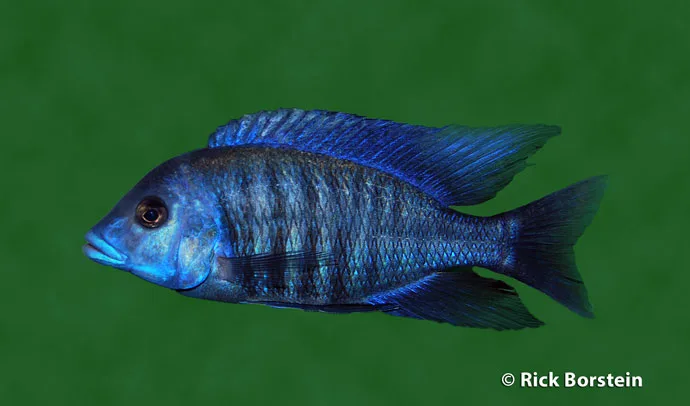
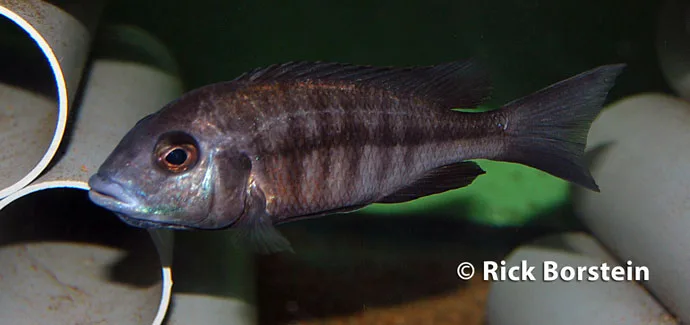
Sexual dimorphism is pronounced in colour. Dominant males develop a pale to medium blue body, a colour that intensifies during courtship; outside of breeding condition the blue is less saturated and a dark horizontal stripe from behind the gill cover to the caudal peduncle is often visible. Females, juveniles, and subdominant males are silver-grey with a distinct dark lateral stripe and faint vertical barring — a cryptic pattern that blends well against the sand. The anal fin of breeding males carries the egg-spots typical of Lake Malawi haplochromines. No greatly elongated fins or other extreme morphological specialisations are present; the species is a generalist in build, adapted for agile open-water swimming rather than the forceful digging or crushing specialisations seen in some relatives.
Habitat
Protomelas annectens is endemic to Lake Malawi and is distributed lake-wide, occurring in Malawian, Mozambican, and Tanzanian waters. The IUCN (Konings & Kazembe 2018) describes it as 'widespread with no known major widespread threats' and 'a rather common species'. Unlike the majority of Malawi's colourful haplochromines, which concentrate on rocky reefs, this is a creature of the sand and the open intermediate zone between rock and sand. FishBase notes it is 'common at depths of about 33 ft' and the Konings Yearbook account records that 'Protomelas annectens is found at any level', making it the most depth-flexible of the five conspicuously coloured sand-dwellers described in that study.
Field observations place it most reliably in the shallower sandy belt, typically above 33 ft, alongside species such as Taeniolethrinops praeorbitalis and Cyrtocara moorii that it follows to feed. Adults are usually encountered solitarily; juveniles form loose small groups. The lake's water chemistry — alkaline, well-buffered, with open-surface pH around 7.7–8.6 and temperatures 75–82 °F — is this species' entire known range; it tolerates the full thermal and chemical envelope of Lake Malawi and has never been recorded outside it.
Feeding
The feeding biology of Protomelas annectens is what sets it apart from almost every other Malawi cichlid. Rather than digging into the substrate itself, it functions as a commensal follower: it closely tracks individuals of Taeniolethrinops praeorbitalis, the large sand-ploughing lethrinopine that buries its snout and expels mouthfuls of sand through its gills. The moment Taeniolethrinops praeorbitalis strikes, Protomelas annectens moves in to pick through the disturbed cloud of sediment and the newly exposed surface for invertebrates that have been dislodged.
Stauffer, LoVullo and Han (1996) analysed stomach contents and gill-raker morphology across Protomelas annectens, Taeniolethrinops praeorbitalis, and Cyrtocara moorii and found that Protomelas annectens specialises on the smallest prey fractions: predominantly small Arthropoda and Cladocera in the 0.5 in range, considerably smaller than the chironomid larvae (mean 0.5 in) taken by the other two species. The interraker gap in Protomelas annectens is correspondingly narrower than in Taeniolethrinops praeorbitalis, an adaptation for retaining fine particles. Kocher and McKaye (1983) documented that Cyrtocara moorii will actively displace Protomelas annectens from the immediate vicinity of the host; Protomelas annectens is thus both a follower and a competitor, willing to forage independently on exposed substrate when no host is near. FishBase describes the trophic level as approximately 3.3. The IUCN habitat note characterising it as 'opportunistic feeder, attracted to anything that stirs up the sediments' is accurate: observers report it is attracted to any moving disturbance of the bottom, including divers and collecting nets, an opportunism consistent with its preference for small exposed invertebrates.
Mating
Like the great majority of Lake Malawi haplochromines, Protomelas annectens is a polygynous, non-pair-bonding species. Males become intensely blue during courtship and establish loose, loosely defined spawning territories in the sand, sometimes between scattered rocks. The Konings Yearbook account notes that male courtship behaviour and mouthbrooding females have been observed in open sand habitat without any shelter structure, which is unusual among haplochromines that often prefer to spawn near cover.
The male prepares a spawning pit in the sand between or near rocks, spreading his fins and displaying to attract ripe females. A single male will court multiple females successively; there is no lasting pair bond. Males are described by keepers as showing moderate rather than extreme aggression toward rivals and tankmates, more typical of larger, open-water haplochromines than of the highly territorial mbuna.
Breeding
Protomelas annectens is a maternal ovophilous mouthbrooder. The spawning sequence is notable in one respect: unlike most Lake Malawi haplochromines in which fertilisation occurs inside the female's mouth (she picks up dummy egg-spots on the male's anal fin to receive milt), in Protomelas annectens — as in Cyrtocara moorii — the eggs are fertilised outside the female's mouth on the sand surface before being taken up. Konings (Yearbook 1) and Drummond (1976) both record this behaviour; fertilisation inside the mouth was noted for Placidochromis electra and contrasted explicitly with the Protomelas annectens / Cyrtocara moorii pattern. Mouthbrooding females and their fry have been observed on open sand without retreating to rocky shelter.
Clutch size in experienced females is around 40 eggs, based on keeper records (aquainfo.nl). The female carries the brood for approximately 18–21 days, eating little or nothing during this period. The young are released as free-swimming fry, after which they disperse; there is no post-release parental care. In aquaria, females moved to a rearing tank on day 15–16 post-spawning can be stripped or allowed to release naturally; the fry are straightforward to raise on finely powdered food and small frozen items.
In the aquarium
Protomelas annectens is genuinely rare in the hobby. It circulated briefly under the name 'Haplochromis annectens' after Drummond's 1976 Buntbarsche Bulletin account and is occasionally exported from Lake Malawi, but it has never established itself as a staple trade item the way its relatives Protomelas taeniolatus or Protomelas fenestratus have. Keepers should expect to source it from specialist importers or dedicated breeders rather than a local fish shop, and should not assume that every fish sold as 'Protomelas annectens' has been reliably identified — the silver-grey striped juvenile is easily confused with several other large haplochromines.
For a fish that reaches 8 in TL in the wild (males reported up to 9 in in aquaria), a generous tank is non-negotiable. A single male with females should be housed in no less than 80 US gal, with 105 US gal or more allowing more natural behaviour and better management of male aggression during spawning. The layout should combine a deep sand bed of at least 2 in — fine silica or aragonite sand is ideal — with a background or side section of stacked rock for sightline breaks and territory definition. Unlike mbuna, Protomelas annectens does not require dense rock coverage across the entire footprint; it is a sand-zone fish, and open sand lanes of 19.5 in or more are both appreciated and consistent with how it lives in the lake.
Water chemistry must reflect Lake Malawi: pH 7.8–8.6, a general hardness of roughly 10–20 °dH as a practical keeping target, and temperature 75–82 °F. This is alkaline, well-buffered water; acidic or poorly buffered conditions will stress the fish and predispose it to bacterial infections. Reliable mechanical and biological filtration is important — large haplochromines produce a significant waste load — and a weekly water change of 20–30 % is standard practice. Avoid abrupt shifts in temperature or pH, which are more acutely damaging than stable parameters at the edge of the preferred range.
Diet in captivity is straightforward. Because this species specialises on small invertebrates picked from disturbed sand in the wild, it accepts most standard aquarium foods readily: high-quality cichlid pellets, frozen cyclops, daphnia, and Artemia, as well as colour-enhancing flake to support the male's blue. Critically, it must not be fed beef heart, feeder fish, or other high-fat mammalian protein — this is the primary trigger for Malawi bloat (a severe, often fatal gastrointestinal disorder widespread among Lake Malawi haplochromines fed inappropriate food). A spirulina-supplemented diet alongside invertebrate-based protein is ideal and broadly generalises to the dietary needs of the haplochromine community.
Tankmates should be other Lake Malawi haplochromines ('haps') of broadly similar size — species of Copadichromis, Nimbochromis, Sciaenochromis, or similar genera work well. Mixing with aggressive mbuna is generally inadvisable; the persistent harassment typical of territorial mbuna will outcompete a relatively peaceful open-water fish like Protomelas annectens. Aulonocara (peacock cichlids) of similar size are a commonly cited complement. Keeping one male with two or three females is the usual recommendation; multiple males in the same tank will spar unless the setup is very large and sightlines are blocked. Breeding proceeds readily in a well-managed tank. The female mouthbroods for 18–21 days and should ideally be moved to a dedicated 80–100-litre holding tank after the first week to allow her to carry to term undisturbed. Fry are released at a manageable size and take finely powdered dry food and baby brine shrimp nauplii from the outset.
Conservation
The IUCN Red List assesses Protomelas annectens as Least Concern (assessed 20 June 2018; e.T61075A148672165; assessors A. Konings and J. Kazembe; reviewer J. Snoeks). The justification cites a lake-wide distribution, apparent commonness, and no known major widespread threats. The species is collected for the aquarium trade under the old name 'Haplochromis annectens' but at a level not considered a population-level threat; the IUCN bibliography (Konings & Kazembe 2018) cites no evidence of population decline.
That favourable individual status sits within a wider context of mounting pressure on Lake Malawi as an ecosystem. Basin-level reviews document accelerating threats: warming surface waters and strengthening thermal stratification (documented by Chavula et al. 2023 and earlier limnological work) reduce the deep-mixing events that replenish nutrients to productive shallows; deforestation in the catchment drives sedimentation that degrades sandy habitats; commercial and artisanal fishing pressure is well documented across the lake's southern and central sectors; and shoreline development affects the near-shore zone. As a sand-dwelling species of the shallow, near-shore sand belt, Protomelas annectens is specifically exposed to sedimentation and habitat degradation of the sandy littoral — the very habitat it depends on. None of these basin-level pressures is currently documented as an acute danger to this species, but they set the trajectory against which its long-term status must be read.