Taxonomy & naming
The species was described by the British ichthyologist Ethelwynn Trewavas in 1935, originally placed in the catch-all genus Haplochromis. It was later moved to Protomelas, a genus Trewavas erected for a cluster of Malawi haplochromines; the name combines the Greek protos ("first") and melas ("black"). Eschmeyer's Catalog of Fishes lists the valid combination as Protomelas taeniolatus (Trewavas, 1935), and FishBase, GBIF and the IUCN follow that usage.
A distinctive form once treated as its own species, Protomelas dejunctus Stauffer, 1993, is now regarded as a subspecies, Protomelas taeniolatus dejunctus, restricted to a handful of offshore reefs and islands in the south of the lake. The hobby further fragments the species into named colour forms — "Red Empress," "Super Red Empress," "Fire Blue," "Boadzulu" and others — and Seriously Fish notes that some of these, which reach different maximum sizes, may eventually be split off as distinct species. In the older aquarium literature the same fish circulated under a string of "Haplochromis" and "Steveni" trade labels — including "Steveni Tiger," "Steveni Taiwan," "Steveni Mbenji" and "Steveni Maleri" — which is why identification of imported stock is often muddled. Konings treats the lake's "Steveni" populations as part of a wider Protomelas taeniolatus-complex whose members are hard to separate without locality data.
The trade-name confusion runs deeper still: for years fish sold under the names "Boadzulu," "Hinderi," "Red Empress" or (more accurately) "Namalenje" were in fact a geographical race of Protomelas taeniolatus, while the true Copadichromis boadzulu — a genuinely rare, plankton-feeding utaka known from only a couple of localities in the southeastern arm of the lake — is essentially unrelated and almost never seen in the hobby under its own name. And within the taeniolatus-complex itself, at least one locality population is not securely assigned even at species level: Konings examined the "Steveni Taiwan" form from the isolated Taiwan Reef north of Chizumulu Island and concluded it is not, as first suspected, a race of Protomelas fenestratus, but he stops short of calling it P. taeniolatus either — its anatomy sits closest to true taeniolatus, yet he regards it as probably a distinct, still-undescribed species in its own right. A further, blue-male population reported from the lake's eastern shore resembles the black-bellied "Steveni" of the northwest more closely than either named species, a reminder that the taeniolatus-complex outside a handful of well-studied reefs remains genuinely unresolved rather than merely a matter of colour-form bookkeeping.
Morphology
Reported maximum size depends on which authority you trust. The CLOFFA checklist figure carried by FishBase is a modest 4.4 in total length, but Ad Konings — who wrote the IUCN assessment and the standard field guide — gives males a maximum of about 7.5 in TL, and Seriously Fish cites roughly 8 in (8 in) in nature; Konings' Enjoying Cichlids tabulates a maximum of 7 in alongside the closely related Protomelas similis, in line with the higher figures. The discrepancy almost certainly reflects the various forms lumped under the name; a realistic expectation for an adult male is somewhere in the 6–7 in (6–7 in) range.
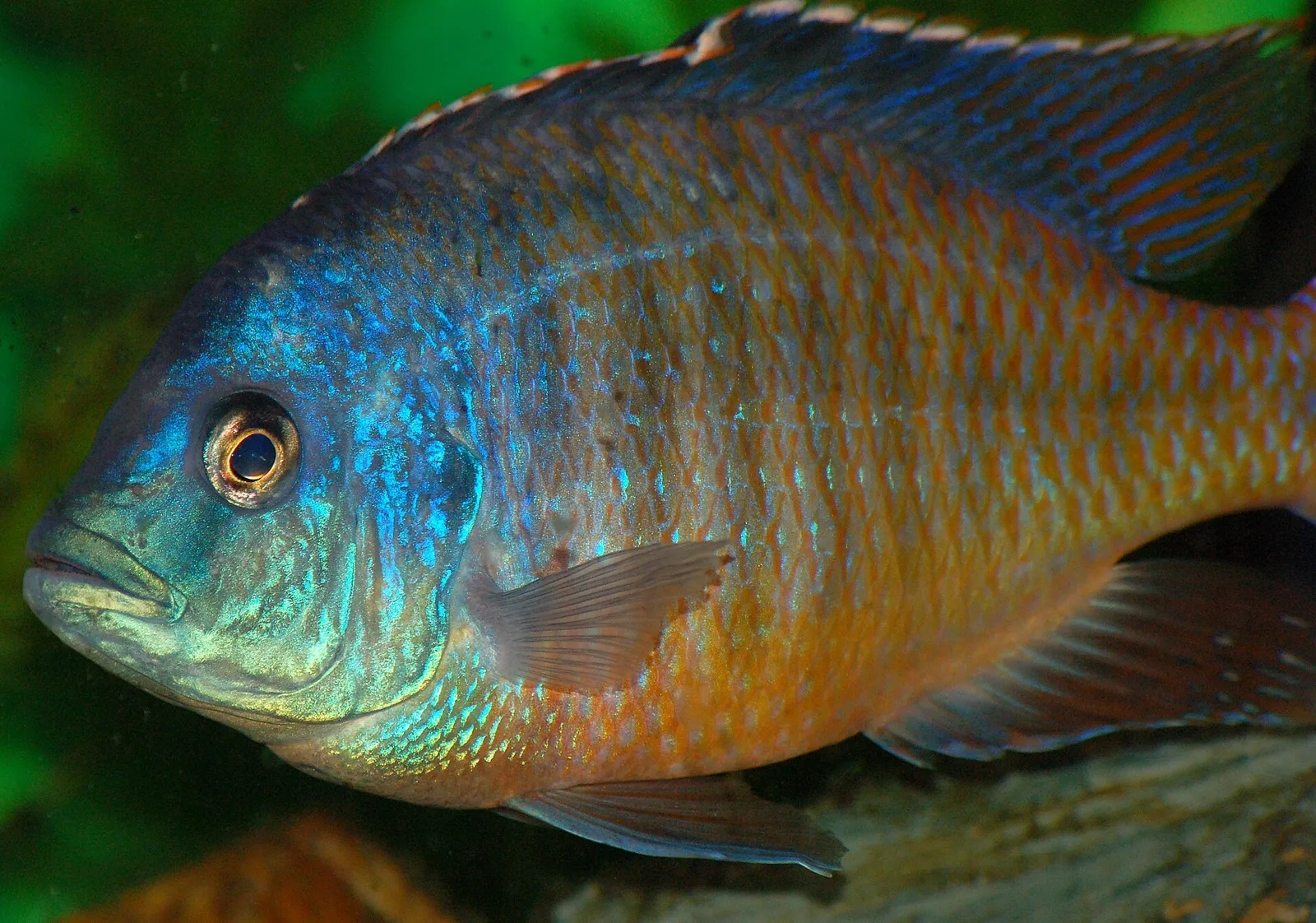
The body is fusiform and laterally compressed, with 16–17 dorsal spines, 10–11 dorsal soft rays, three anal spines and 31 vertebrae. Sexual dimorphism is pronounced. Females and juveniles are a plain silvery-grey marked with the dark lateral and mid-lateral bands that give the species its name (Latin taeniola, "a little stripe"). Dominant males are the show: depending on locality the flanks blaze red, orange or blue while the head and nape flush emerald to turquoise, and the dorsal, anal and pelvic fins are extended. Protomelas taeniolatus closely resembles its relative Protomelas fenestratus, differing in its larger eye and narrower preorbital, more teeth in the upper jaw and on the lower pharyngeal bone, and more gill rakers; it is separated from Protomelas virgatus by lacking enlarged pharyngeal teeth. Field workers rely on colour pattern as a second, independent check: Ribbink and colleagues found that P. fenestratus carries conspicuous vertical bars, while P. taeniolatus shows more horizontal elements — a second, dorso-lateral horizontal stripe running above the mid-lateral band is characteristic of P. taeniolatus and is a useful field mark, since it is absent in superficially similar species such as Copadichromis boadzulu, which has only the single mid-lateral line.
Habitat
Protomelas taeniolatus is endemic to Lake Malawi (also called Niassa or Nyasa), the rift-valley lake shared by Malawi, Mozambique and Tanzania, and it is widely distributed around the lake's shores. The IUCN puts its area of occupancy at roughly 471 mi² within an extent of occurrence of about 11,429 mi².
It is a fish of the shallow, sediment-free rocky habitat — the clear-water zone where bare rock meets sand and where the rocks are kept clean of silt by wave action. Konings, who has dived most of the lake's rocky coasts, describes it as common in the upper 33 ft at essentially every rocky shore he has visited, and FishBase records an in-situ temperature band of 75–79 °F. This is the same well-lit, alkaline environment that defines so much of Malawi's cichlid fauna; pH in the lake sits around 7.7–8.6 and the water is well-buffered. The one notable exception is the isolated Taiwan Reef north of Chizumulu Island, where an unusually strong current keeps the rock virtually free of sediment even at depth; the taeniolatus-complex population there ("Steveni Taiwan") appears to have been pushed by that current into much deeper water, with territorial males recorded below 66 ft — well outside the species' normal shallow range, and a plausible reason it has evolved a relatively large eye. Tying the fish to its biotope matters, because a shallow rocky-shore grazer lives exactly where shoreline disturbance and silt are felt first.
Feeding
Ecologically, Protomelas taeniolatus is a grazer of "aufwuchs" — the carpet of algae, diatoms and associated micro-invertebrates that coats sunlit rock. It feeds mainly by combing and sucking algae and loose material from the rock surface, and it opportunistically switches to zooplankton when a bloom makes that worthwhile. FishBase places it at a trophic level of about 3.2, consistent with a mostly herbivorous diet padded out with small animal prey.
That flexibility is typical of the rocky-shore haplochromines: nominally vegetarian, but quick to take a free meal of plankton or invertebrates. Within the community it occupies the same broad guild as relatives like Protomelas fenestratus, which is part of why the two are so easily confused and why keeping multiple Protomelas forms together in one tank is discouraged — they overlap in ecology as well as appearance, and they hybridise readily. In the field the two are in fact easiest to tell apart by feeding behaviour rather than looks: P. taeniolatus grazes the upper rocky zone directly, while P. fenestratus works deeper water and blows sediment off the rocks to expose the insect larvae and crustaceans hiding beneath — divers who watch which technique a fish uses can identify it even when colour pattern is ambiguous.
Mating
Like the rest of Lake Malawi's haplochromine flock, Protomelas taeniolatus pairs only briefly, and the burden of male display does all the work of attracting a mate. Konings reports that males are territorial throughout the year, holding a spawning station on top of the rocks while females shelter among the crevices. A ripe male clears or adopts a flat rock or a scraped patch of sand, intensifies his colour — the head flushing emerald-blue and the flanks to their locality red, orange or blue — and courts passing females with a lateral, quivering display.
That nuptial colour is strongly geographic, which is what makes the species such a hobby favourite and such a taxonomic headache. Around Senga Point and Namalenje Island males carry the famous red body of the "Red Empress" and "Super Red"; at Likoma and Chizumulu Islands the local "Steveni Tiger" race shows thin vertical bars on a silvery body with an intensely blue head and upper body and an orange-yellow flank (a markedly brighter, higher-contrast dress than its deeper-dwelling neighbour, P. fenestratus's broader-barred, paler-blue "Steveni Thick Bars"); the Chinyankwazi Island race is the blue "Fire Blue" with no red at all; the celebrated "Steveni Taiwan" form has a blue head and back, a yellow flank, a bright red anal fin and a white-blue blaze — though, as noted above, Konings now regards this population as probably a distinct, undescribed species rather than simply another colour race of true P. taeniolatus; and Likoma, Mbenji and Maleri each field their own variants. A courting male advertises this locality livery to females of his own population while driving rival males off his rock.
Breeding
Protomelas taeniolatus is a maternal mouthbrooder. When a female responds to a courting male she lays a small clutch — mature females carry on the order of 40–50 eggs — and fertilises them at the male's vent in the classic mouthbrooder "T" arrangement, gathering the eggs into her mouth as she goes. The male takes no further part once spawning is done.
The female then broods for roughly three weeks (about 21–28 days), not feeding, before releasing free-swimming fry. FishBase records an unusual wrinkle in early fry care: brooding females are said to group their protective "mantles" close together so that released young can pass from one parent's guard to the next, a loosely cooperative crèche. Generation length is short, on the order of one to two years, and the species is a productive breeder.
In the aquarium
The Red Empress is one of the more popular and widely available Protomelas in the hobby, and for an adult male it is genuinely spectacular. It is also a large, active "hap" rather than a dwarf: plan on a tank of at least four feet (around 48 in / 47 in, roughly 55–75 US gal) for a group, with more length better. Provide stacked rock with open swimming lanes, a sandy bottom, and alkaline, well-buffered water — pH in the high 7s to mid 8s suits it. Diet should lean vegetable-heavy (spirulina-based foods) to match its grazing biology; keepers and Seriously Fish both warn that it is greedy and prone to obesity, and that rich, meaty foods such as beefheart are best avoided.
Temperament is the point most often gotten wrong. By Malawi standards Protomelas taeniolatus is relatively peaceful and not a true mbuna-grade bully — but "peaceful" is relative. Experienced keepers on forums such as Cichlid-Forum and MonsterFishKeepers consistently report that a dominant male's aggression is mostly directed at other males of its own kind and at look-alikes, and that he will chase tankmates out of his courting territory; in mixed company that behaviour is usually tolerable rather than lethal. The standard advice is a harem of one male to several females to spread his attention, and to avoid housing multiple Protomelas forms or other red/blue look-alikes together both to limit fighting and to prevent hybridisation. Suitable companions are other even-tempered Malawi haps and peacocks (Aulonocara, Copadichromis, Placidochromis); pairing with the most boisterous mbuna is possible given space but adds friction. Adult wild-caught or top-colour fish are pricey, so most aquarists start with a group of six to eight youngsters and grow them out.
Conservation
The IUCN Red List assesses Protomelas taeniolatus as Least Concern (Konings, A. 2018), on the grounds that it is common, widespread across the lake, and faces no major lake-wide threat. That headline status is honest, but it comes with caveats the assessment itself spells out: the species is regularly harvested by the ornamental and aquarium trade and taken in subsistence fishing, and at Chinyankwazi and Chinyamwezi islands illegal fishers have "virtually extirpated" the local form (now the subspecies P. t. dejunctus). The assessment also flags sedimentation as an ongoing threat — and that is where the fish's biology and the lake's wider troubles intersect.
Lake Malawi as a whole is under real strain. The basin review by Chavula and colleagues (Journal of Great Lakes Research, 2023, 49(6):102241) catalogues the pressures: heavy over-fishing and the collapse of the commercially vital chambo (Oreochromis) stocks; sediment and nutrient loading washing off deforested, eroding catchments; shallow-water warming of roughly +33 °F that strengthens thermal stratification, slows the mixing that lifts nutrients into the sunlit zone, and so reduces overall productivity; and a growing risk from invasive species. A shallow rocky-shore grazer like Protomelas taeniolatus is most exposed to the sediment side of that ledger: it depends on clean, sunlit rock for its aufwuchs, and silt smothering those surfaces degrades exactly the habitat and food source it relies on. So the accurate summary is the careful one — the species itself is not currently threatened with extinction, but it lives in a lake whose nearshore habitats are being chipped away, and some of its narrow-range island populations are already gone. Part of its range falls within Lake Malawi National Park, which affords those populations some protection.