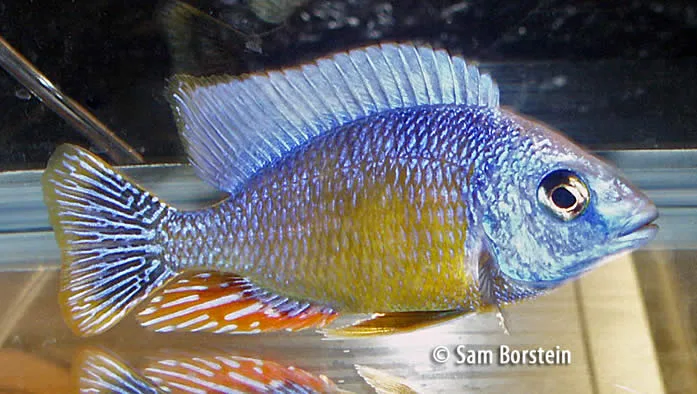
Taxonomy & naming
Protomelas sp. "Steveni Taiwan" is not a formally described species; it has no describing author, no publication date, and no entry in Eschmeyer's Catalog of Fishes. Its trade name places it among the "Steveni" complex, a set of Protomelas forms historically exported and sold under the defunct name Haplochromis steveni before the group was recognised as taxonomically unresolved; "Taiwan" refers to its type locality, Taiwan Reef in northern Lake Malawi (also recorded from nearby Higga Reef and Ngkuyo Island). Comparative examination of its anatomy has led observers to conclude that it is not simply a race of the described species Protomelas fenestratus, and that it sits closer to Protomelas taeniolatus, but differs enough — in body proportions and, notably, in a relatively large eye — that field workers treat it as a distinct population rather than folding it into either described species. Taiwan Reef itself is considered one of the few places in the lake that may have remained an isolated island of rocky habitat even through historical low-water stands, a scenario invoked to explain why old, narrowly endemic lineages persist there that are absent from nearby reefs.
Morphology
This Protomelas follows the genus's typical elongate, laterally compressed body plan and is closest in proportions to the described species Protomelas taeniolatus, differing chiefly in a relatively large eye — plausibly an adaptation to the greater depths at which this population is found. As an undescribed form its colouration has not been formally documented; field workers note it behaves like P. taeniolatus in the water, which in that species includes a sexually dichromatic pattern typical of the genus, with colourful territorial males and plainer, more cryptically patterned females, but a specific published colour account for the Taiwan Reef population itself is lacking. No formally published character distinguishes it from its relatives beyond locality, restricted depth range, and the eye-size difference noted above.
Habitat
This form is documented from Taiwan Reef in northern Lake Malawi, along with nearby Higga Reef (Tanzania) and Ngkuyo Island. Taiwan Reef sits in an area of persistently strong water movement — for much of the year the current around the reef is strong enough that swimming against it is difficult even with fins — and it is thought that this current has pushed the population into deeper water than its close relative P. taeniolatus typically occupies. Where P. taeniolatus lives mostly in the upper 33 ft along rocky coasts elsewhere in the lake, breeding males of "Steveni Taiwan" defend nest sites below 66 ft at Taiwan Reef. Taiwan Reef also has an unusually sparse mbuna community relative to other Lake Malawi reefs — a single species each from the Pseudotropheus zebra-complex, the tropheops-complex, and two from the elongatus-complex, one Melanochromis, and no Labidochromis at all — with Chindongo saulosi noted as the only species able to hold position against the reef's strong current.
Feeding
No diet study specific to this population has been published. By analogy with its close relative Protomelas taeniolatus, and with the broader Protomelas taeniolatus/fenestratus group it has been compared against, it is expected to take small invertebrates picked from the water column and rock surfaces rather than grazing algae directly, consistent with the genus's general feeding mode. Its confinement to a deep, current-swept reef habitat likely shapes what food is actually available to it, but this has not been documented in detail.
Mating
Protomelas sp. "Steveni Taiwan" is reported to behave much as P. taeniolatus does, with territorial breeding males defending discrete nest or display sites. The key documented difference is depth: where P. taeniolatus nests mostly in the upper 33 ft of rocky coast, breeding males of this Taiwan Reef population defend nests below 66 ft, a depth shift attributed to the reef's persistently strong current pushing the population deeper. As in other Protomelas, the system is understood to be polygynous, with no pair bond and males competing for position at spawning sites that females visit.
Breeding
As an undescribed but clearly Protomelas-type haplochromine, this form is presumed to be a maternal mouthbrooder like the rest of the genus, though a dedicated breeding account for the Taiwan Reef population has not been published. Breeding males are documented defending nest sites at depths below 66 ft, a considerably deeper nesting range than is typical for its closest relative, P. taeniolatus, which nests mostly above 33 ft elsewhere in the lake. Clutch size, brooding duration, and fry development have not been separately documented for this form.
In the aquarium
"Steveni Taiwan" is a niche form in the hobby, collected from one of the more distinctive and best-studied reef habitats in Lake Malawi, and it is generally kept by aquarists specifically interested in Taiwan Reef's unusual, isolated cichlid community rather than as a mainstream Protomelas.
A large tank with strong water movement across a rocky structure suits its habitat of origin, though captive-bred fish adapt readily to conventional Malawi cichlid set-ups without needing to replicate the reef's strong current. As with all Lake Malawi cichlids, stable warm, alkaline, well-buffered water is essential — soft or acidic conditions cause chronic health problems over time. Given its natural depth preference and comparatively large eye, subdued lighting and generous rockwork providing shaded retreats are a reasonable accommodation, though this is inference from its habitat rather than a documented aquarium requirement.
Diet should follow the general Protomelas template: a quality cichlid pellet as a staple, supplemented with small frozen or live invertebrate foods. Because it is scarce and locality-specific in the trade, keepers who obtain genuine Taiwan Reef stock should avoid mixing it with other Protomelas taeniolatus-group forms to preserve the line.
Conservation
Protomelas sp. "Steveni Taiwan" has no IUCN Red List assessment, since it has never been formally described and so has no valid scientific name that could be assessed. This reflects its taxonomic status, not a claim about its safety. Its documented range is limited to a single reef system — Taiwan Reef and its immediate surroundings — which by itself makes any narrowly endemic population inherently vulnerable to local disturbance, whether from collection pressure, changes in water level, or habitat degradation, though no population data exists to quantify current risk.