Taxonomy & naming
George Albert Boulenger described this fish in 1908 as Tilapia brevis, from syntypes collected in Lake Malawi (then Lake Nyasa) and held at the Natural History Museum in London. The species spent decades shuffled among the catch-all haplochromine genera before Eccles and Trewavas, in their 1989 reclassification of Malawi's haplochromines, erected the genus Tramitichromis for it and a handful of relatives. The genus name pairs the Latin trames (a path or route) with the Greek chromis (an old name for a perch-like fish) — a nod, perhaps, to the furrows these fish leave as they plow the sediment. Eschmeyer's Catalog of Fishes lists Tramitichromis brevis (Boulenger, 1908) as the valid combination, with Maréchal (1991), Snoeks & Hanssens (2004), and Konings (2016) all following suit.
Tramitichromis sits among the sand-dwelling 'utaka and aulonocarine' lineages of the Malawi flock rather than the rock-bound mbuna, and it is easily confused with the superficially similar Lethrinops — confusion the aquarium trade preserves to this day by exporting brevis under the names 'Lethrinops variabilis' and 'Lethrinops chizumulu' (or 'Lethrinops Chizumulu'). At Likoma Island it carries the local name kambuzi wa chigongo. None of the Lethrinops labels is correct: the fish has been a Tramitichromis for more than thirty years. Konings recognizes five, possibly six, species in the genus, of which four are formally described — brevis, variabilis, lituris, and trilineatus. A fifth name often seen alongside them, intermedius, does not belong: Eccles and Trewavas (1989) placed it in Tramitichromis, but Konings regards it as a member of the genus Trematocranus instead, on the strength of its different colour pattern (Cichlids Yearbook Vol. 2) — a live disagreement worth flagging rather than treating intermedius as a settled Tramitichromis congener.
Morphology
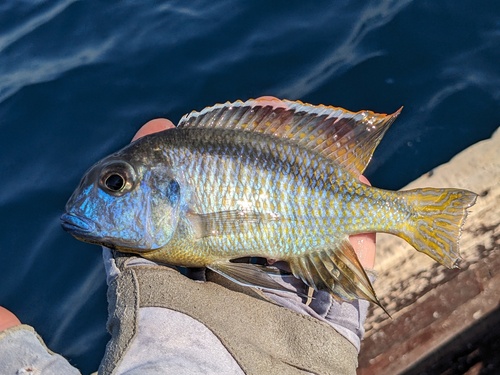
This is a moderately sized, fairly typical-looking Malawi haplochromine rather than a riot of color. FishBase gives a maximum of about 6.4 in total length; field and hobby sources, including Konings, more often cite a typical adult of around 5.5 in, with aquarium males reported to push past 6 in (6 in). As in most of the lake's haplochromines, the sexes diverge at maturity: dominant males develop the brighter, more contrasted coloration that signals breeding condition, while females and subordinate males stay a plainer silvery-tan — a colour scheme Konings describes as functional rather than merely drab: the silvery body of a sand-dwelling female forms near-perfect camouflage against the open sediment she forages and hides over (Enjoying Cichlids).
The most reliable field mark is a prominent diagonal stripe running across the flank, which helps separate brevis from its look-alike congeners and from the Lethrinops it is so often sold as. The genus-level distinctions are internal and telling: Tramitichromis carries a lower pharyngeal bone armed with long, slender teeth — the anteriormost markedly elongated with backward-bent tips, an unusual arrangement since in most other cichlids the anterior teeth are small and point forward — paired with a downward-projecting front blade and stout, squat lower gill rakers. The first two rakers are little more than knobs, while the central three to five broaden into wide plates whose tips form an almost horizontal platform. Those features are not cosmetic; they are the sorting machinery behind how the fish feeds.
Habitat
Tramitichromis brevis is endemic to Lake Malawi (Lake Nyasa/Niassa) and is found essentially lake-wide — FishBase notes a range from Nkhata Bay south, while the IUCN assessment records it throughout the lake, across the Malawian, Mozambican, and Tanzanian waters, with an estimated extent of occurrence near 11,429 mi². It is a fish of the soft-bottom littoral: open sand, mud and silt flats, and the 'intermediate' zones where sand meets scattered rock. This is the antithesis of the mbuna's rocky reefs — brevis belongs to the lake's vast, sparsely populated sediment plains.
Non-breeding individuals range over open sand and mud; breeding groups gather over sand or intermediate substrate at a depth of about 50 ft, the figure most sources converge on. As with the rest of the Malawi flock, the surrounding water is alkaline and well-buffered — the lake runs warm, well-oxygenated in its upper layers, with a pH typically around 7.7–8.6 and modest general hardness. Being a soft-bottom specialist rather than a reef obligate, it is one of the more habitat-flexible members of its guild.
Feeding
This fish is a sediment sifter, and the mechanics are worth describing because they explain the whole animal. It scoops a mouthful of sand or mud, then uses the squat lower gill rakers and slender pharyngeal teeth as a sieve: lighter material — worms, insect larvae, small crustaceans, and other soft invertebrates, along with incidental algae — is retained, while heavier sand is flushed back out through the gill openings. FishBase records it 'sifting sand through the gills and retaining the soft invertebrates such as insect larvae,' and field accounts add the worms and other infauna of the silt.
Functionally it is an invertebrate-feeding benthivore, sitting at a trophic level estimated around 3.2 — a mid-chain consumer rather than a top predator. Its role in the community is that of a bioturbator and benthic forager, turning over the soft floor and cropping the invertebrate fauna that lives within it. That guild — the sand-sifting haplochromines — is one of the major ways the Malawi flock has partitioned the lake's resources, and brevis is a representative example of it.
Mating
Away from spawning, female and subordinate brevis move alone or in small groups over the open feeding flats, while reproductive males stake out the sand. The social system is a loose, lek-like polygyny: a male clears and shapes a bower — a cave-crater nest — centered on a small stone, ringing it with a low, semicircular rim of pushed-up sand (an 'oxbow'). Konings notes that brevis builds these structures around notably smaller stones than its congeners use. The bright, high-contrast breeding dress of the dominant male advertises this territory; he courts passing females in, and rivals who approach the nest are met with the pugnacious display that is the behavior keepers most often run into.
This bower-building, colony-forming courtship is characteristic of the genus and its sand-dwelling neighbours. 'Tramitichromis' intermedius — a species long carried in this genus but which Konings assigns instead to Trematocranus — has been studied in detail running sand-bower 'leks,' and brevis fits the same template regardless of which genus intermedius ultimately belongs in: the conspicuous nest and the male's brief, showy bid for attention are the whole of his reproductive investment.
Breeding
Like the overwhelming majority of Lake Malawi haplochromines, Tramitichromis brevis is a maternal mouthbrooder. The female is courted onto the male's cave-crater nest and lays her eggs as far beneath the central stone as she can place them; she then takes them up into her mouth, and fertilization follows in the classic Malawi fashion. From that point the male's role ends — the female alone broods and guards the developing young, carrying them in her buccal cavity until they are free-swimming.
Breeding appears to run year-round rather than in a tight season. Konings reported the species' breeding behavior in 1990 and observed spawning in November, while Stuart Grant collected males in breeding color in April — the combination suggesting brevis can breed at essentially any time of year. This is not just an inference from scattered sightings: Konings states it as an explicit exception, noting that Lethrinops species, and to a lesser extent Tramitichromis generally, breed only during a specific season, whereas breeding males of T. brevis specifically are found throughout the year (Enjoying Cichlids). Clutch sizes are not well documented for this species but fall within the modest range typical of comparably sized sand-dwelling Malawi haplochromines (on the order of a few dozen eggs).
In the aquarium
Tramitichromis brevis turns up in the hobby — usually mislabeled as 'Lethrinops variabilis' or 'Lethrinops chizumulu' — and it is a rewarding fish for someone set up for sand-dwellers, not a community novelty. The single most important thing you can give it is a deep, soft sand bed: the sifting feeding behavior and the bower-building both depend on it, and on bare glass or coarse gravel the fish loses both its natural foraging and its reason to spawn. Plan on a long tank with a large footprint rather than a tall one; with adult males over 6 in (6 in) and a need for room to forage and for several females to spread out, a six-foot (roughly 71 in) tank is the honest minimum for a proper group.
Keep it in harem ratios — one male to several females — to spread male attention and reduce the pressure a courting male will otherwise concentrate on a single fish. Tankmates should be other open-water or sand haplochromines of similar temperament; the boisterous, rock-territorial mbuna are a poor match. Water should track the lake: alkaline, well-buffered (pH high 7s to mid 8s), warm, and clean. The honest caveat is diet — a sand-sifter does best with foods it can work for and a substrate it can actually sift; feed it like a generalist on a bare bottom and you waste what makes the fish interesting. A second, broader caveat: Konings groups the Lethrinops-like sand-dwellers — a category that includes Tramitichromis — among the more delicate Lake Malawi cichlids to keep long-term (Enjoying Cichlids), so this is not a fish for a beginner's tank even though its water chemistry needs are unremarkable for the lake.
Conservation
The IUCN Red List assesses Tramitichromis brevis as Least Concern (assessed 19 June 2018; Konings & Kazembe 2019, an amended version of the 2018 assessment), with a population trend judged stable. The rationale is straightforward: it is a common, widespread inhabitant of the lake's soft-bottom inshore zone with no known major lake-wide threat, and part of its range falls within Lake Malawi National Park. The pressures the assessors do flag are real but diffuse — it is taken by subsistence fishers and regularly collected for the ornamental trade (under those persistent 'Lethrinops' trade names). So the species itself is not, on current evidence, in trouble.
The lake around it is another matter, and honesty requires holding both facts at once. Chavula et al.'s 2023 basin review (Journal of Great Lakes Research 49(6):102241) catalogs the strains on Lake Malawi/Niassa/Nyasa: heavy and intensifying fishing pressure, exemplified by the long decline of the prized chambo (Oreochromis) fishery; sediment and nutrient loading washing off deforested, eroding catchments; warming of roughly +33 °F in the shallow layer that strengthens stratification and suppresses the mixing that drives productivity; and the looming risk of invasive species. For a soft-bottom, inshore sand-sifter, the catchment-driven sedimentation and nutrient inputs are the most directly relevant of these — they reshape exactly the silt-and-sand habitat and benthic invertebrate fauna this fish depends on, even where the warming and offshore-fishery pressures bear more heavily on pelagic species. The accurate summary is the unglamorous one: Tramitichromis brevis is Least Concern today, but it lives in a lake under mounting, basin-wide strain, and its security is ultimately tied to how that strain is managed.