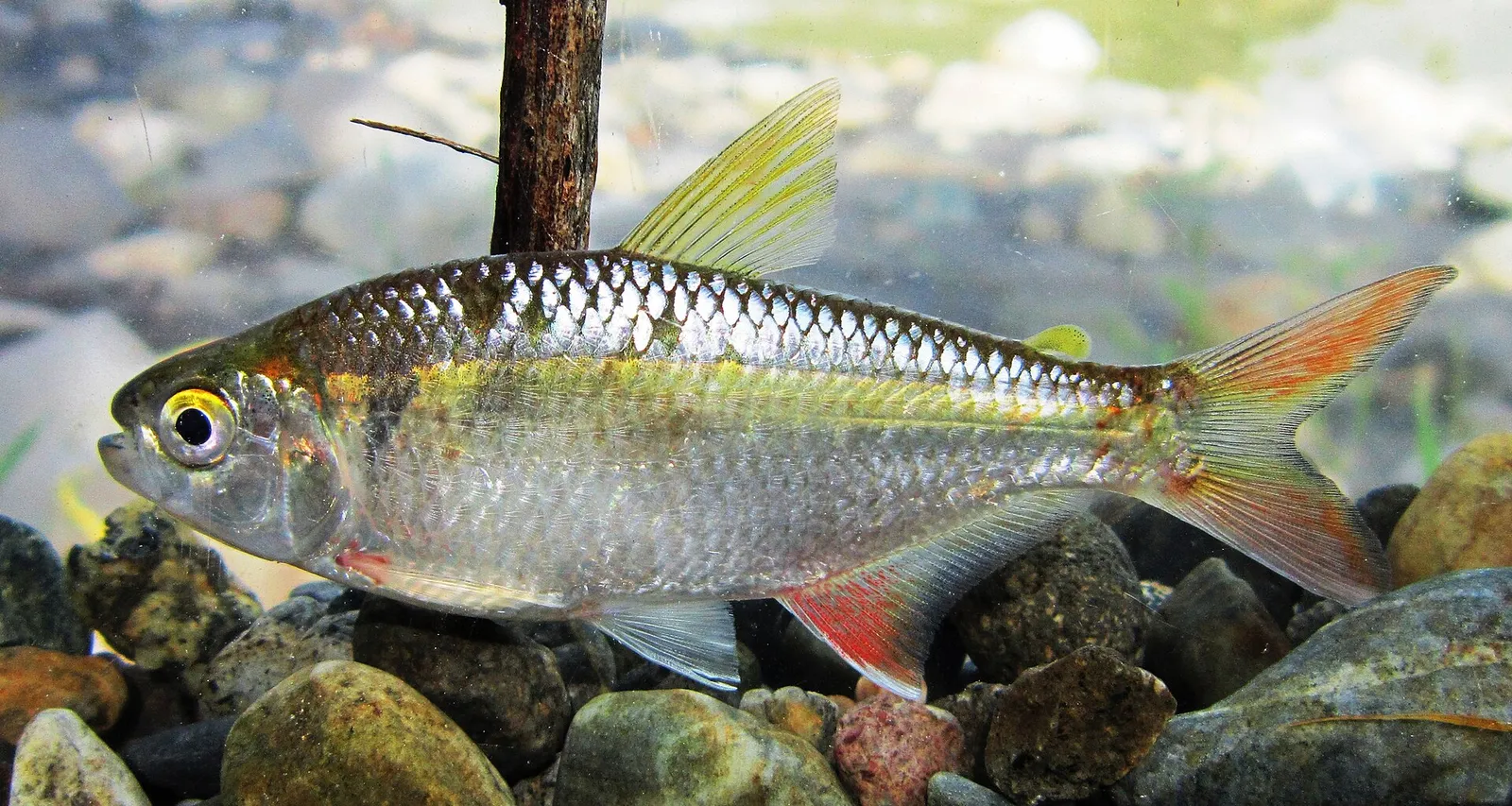
Taxonomy & naming
Psalidodon fasciatus was originally described by Georges Cuvier in 1819. Eschmeyer's Catalog of Fishes (Fricke, Eschmeyer & Van der Laan) records the valid name as Psalidodon fasciatus (Cuvier, 1819), placed in the family Characidae. Because Cuvier's original description used a binomial later moved to Astyanax, the authority is parenthetical.
The species is now widely understood to be a complex of cryptic, allopatric populations rather than a single biological species. Molecular and cytogenetic studies — particularly work on Upper Paraná River basin populations — have demonstrated polyphyly within the nominal taxon and support the recognition of multiple species within the complex. Some sources now assign portions of the complex to Psalidodon (the name used by FishBase for the type specimen's lineage), though Astyanax remains the name in broad use pending full taxonomic revision.
A well-studied northern subspecies, P. fasciatus mexicanus, has been examined in detail in the literature on cave versus surface populations of Mexican Astyanax — a model system for studying regressive evolution of eyes and pigmentation. These cave-adapted morphs (the so-called 'blind cave tetras' long kept in aquaria as Anoptichthys jordani) are now generally treated as the same species, illustrating how plastic the fasciatus complex can be.
This fish was long listed as Astyanax fasciatus; Eschmeyer's Catalog of Fishes places the species in Psalidodon, and the current combination Psalidodon fasciatus is followed here.
Morphology
Psalidodon fasciatus is a typical medium-sized characid: laterally compressed, with a fusiform body, a forked tail, and the adipose fin characteristic of the family. FishBase records a maximum standard length of 4.7 in, with total length reaching approximately 6.7 in in the largest individuals; females tend to grow somewhat larger than males. In the aquarium, most individuals remain below 4 in.
The body is silvery-white to pale brassy, often with a faint greenish or golden lateral sheen. A distinctive diamond-shaped or rhomboidal dark blotch sits at the base of the caudal fin and is one of the more consistent external characters across populations. Males take on pinkish tints in the pectoral fins and reddish hues in the anal and caudal fins during breeding condition, with a yellowish-gold caudal edged in black; females are generally larger but plainer in colour. The species schools actively in the wild.
Habitat
Few freshwater fishes occupy as broad a habitat range as Psalidodon fasciatus. The species is recorded from most major freshwater drainage systems of Central and South America, from Mexico through Central America south to the Río de la Plata basin in Argentina. It occurs across lowland rivers, montane streams, lagoons, floodplain lakes, and lentic zones — a generalism that partly explains its success across such a wide range.
Habitat preferences within this range are varied by population. The northern subspecies (A. f. mexicanus) has been documented in flowing jungle rivulets and clear, fast mountain-runoff streams with gravel bottoms, as well as in cave systems. Across its South American range, the species is most commonly found in streams and rivers without strong currents, including slow-moving and still waters. Water parameters recorded in the literature span a considerable range; FishBase reports temperatures around 68 °F and pH around 5.5 for part of the range, though conditions vary considerably by basin and season.
Feeding
Psalidodon fasciatus is a highly opportunistic, omnivorous feeder and is described in the literature as a vivacious predator for its size. The natural diet is broad: small fish, aquatic invertebrates, insects and their larvae, and plant matter, varying by habitat and season. FishBase characterises it as feeding on small fish and pieces of meat, and field studies confirm it can be aggressive toward prey items.
In the aquarium, it is an undemanding and adaptable feeder that accepts dried flake and pellets, live and frozen foods (brine shrimp, bloodworm, Daphnia), and vegetable matter. Its willingness to take almost anything makes it easy to maintain but also somewhat predatory — small tankmates and fry are at risk. A varied diet maintains condition and colour.
Mating
Psalidodon fasciatus is an egg-scattering open spawner with no parental care. Males in breeding condition develop brighter colouration — pinkish pectorals, reddish anal fins, and a yellowish-gold caudal with a dark margin — and actively court females. Spawning in the northern subspecies has been documented in flowing water habitats with clear, well-oxygenated conditions.
The species spawns in groups, scattering eggs over fine-leaved vegetation and substrate. Eggs are small (approximately 0.5 in in diameter in the mexicanus subspecies) and adhesive, settling into plants and gravel after release. There is no mate guarding, territory defence, or pair bond formation; both sexes leave the spawning site immediately.
Breeding
In captivity, Psalidodon fasciatus breeds readily once conditioned on live and frozen foods. A group of adults will spawn over fine-leaved plants or spawning mops placed in the aquarium. Eggs are adhesive and small; they hatch at approximately 24 hours at 75 °F in the mexicanus subspecies. Fry become free-swimming around the third day and initially require very fine first foods such as infusoria or rotifers before graduating to newly hatched brine shrimp nauplii and finely ground flake.
Because the adults will readily eat both eggs and fry, breeders typically transfer the spawning mop or move adults to a separate tank after spawning is observed. Sexual maturity is reached at approximately six months of age. The species is not demanding in terms of breeding water chemistry, reflecting its broad natural range, though clean, well-oxygenated water at moderate temperatures improves hatch rates and fry survival.
In the aquarium
Psalidodon fasciatus is an active, fast-moving schooling fish best kept in groups of six or more. It is hardy and adaptable, tolerating a wide range of water conditions — a useful trait in a beginner's tank, though its tendency to fin-nip and its predatory instincts toward very small tankmates limit suitable companions. Long-finned species and anything small enough to be eaten should be avoided. Robust, similarly sized tetras, barbs, and larger rasboras make better companions.
A tank of at least 31.5–39.5 in in length with open swimming space suits a school of adults well. Water chemistry need not be tightly controlled: the species tolerates soft to moderately hard water across a wide pH range, reflecting the diversity of conditions it encounters naturally. Regular water changes and good filtration matter more than precise water chemistry targets. A planted tank with some open water provides security and displays the fish's active schooling behaviour. The species is not particularly long-lived in captivity, typically three to five years under good conditions.
Conservation
No formal IUCN Red List assessment exists for Psalidodon fasciatus as currently circumscribed. The nominal taxon covers an enormous range across Central and South America and is locally abundant across much of it, but the recognised species complex status complicates any global evaluation — what is counted as P. fasciatus sensu lato may in practice encompass multiple narrower-range taxa, some of which could be more vulnerable than the aggregate suggests.
As a whole, the broad-ranging entity is not considered at risk. However, ongoing deforestation, agricultural runoff, dam construction, and habitat loss affect riverine habitats throughout its range, and localised populations — particularly those in isolated headwaters or cave systems — may face site-specific pressures. The taxonomic complexity of the fasciatus group means that any future split recognising additional species could reveal conservation concerns for newly delimited taxa with more restricted distributions.