Taxonomy & naming
Psalidodon eigenmanniorum was described by Edward Drinker Cope in 1894. Eschmeyer's Catalog of Fishes (Catalog of Fishes, CAS) records the valid name as Psalidodon eigenmanniorum (Cope, 1894); the parenthetical authority indicates that Cope placed the species in a different genus at the time of description, and it was subsequently transferred to Astyanax, where it currently stands.
The genus Astyanax is placed in the family Characidae and is one of the most taxonomically challenging groups in neotropical ichthyology, with well over 100 described species and ongoing revisions continually adjusting species boundaries and synonymies. The specific epithet eigenmanniorum honours Carl H. Eigenmann, the pioneering American ichthyologist of Indiana University whose monumental surveys of South American freshwater fishes during the early twentieth century remain foundational references for the group. The '-orum' genitive plural ending suggests the name was intended to honour Eigenmann and his colleagues or family collectively.
This fish was long listed as Astyanax eigenmanniorum; Eschmeyer's Catalog of Fishes places the species in Psalidodon, and the current combination Psalidodon eigenmanniorum is followed here.
Morphology
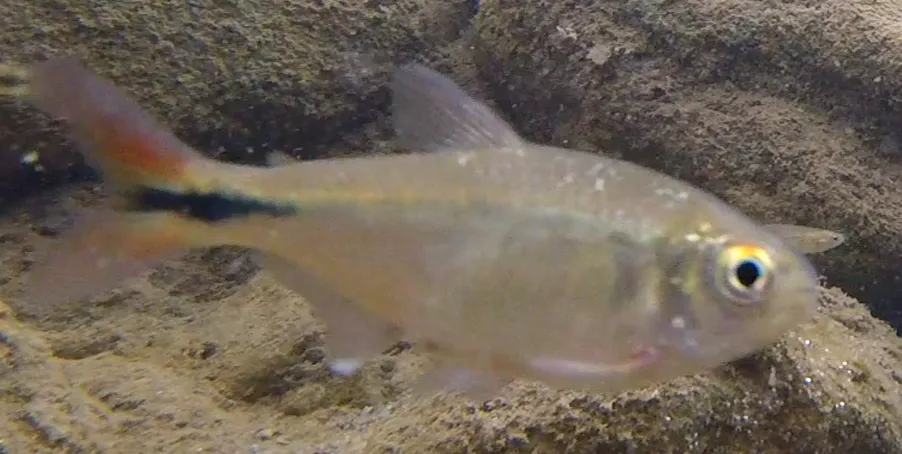
Psalidodon eigenmanniorum is a small characid with the typical body plan of the genus: moderately deep-bodied and laterally compressed, with a single dorsal fin, a small adipose fin, a forked caudal fin, and the toothed jaws characteristic of Characiformes. Like most Astyanax, it is silvery overall, typically with a dark lateral stripe or caudal spot — the humeral and caudal pigmentation patterns that ichthyologists use as diagnostic characters within the genus.
Published morphological data for this species are sparse in widely accessible literature. Detailed meristic counts, scale formulae, and colour descriptions would require consulting the original Cope description and subsequent revisionary works. It is a small fish in the size range typical of Astyanax in the La Plata basin, generally estimated at a few centimetres standard length, though precise maximum size data are not available in sources accessible to this account.
Habitat
Psalidodon eigenmanniorum is associated with the river systems of south-eastern South America, in the drainage basin of the Río de la Plata and nearby Atlantic coastal drainages spanning Argentina, Uruguay, and southern Brazil. This is a subtropical to warm-temperate region with distinct seasonality — cooler winters and warm summers — making this one of the few Astyanax found outside the humid tropics.
The rivers and streams of the Pampas and associated plateaus where this species occurs are generally turbid to slightly turbid lowland systems with moderate nutrient levels, contrasting with the blackwater or clear Guiana Shield habitats of many Astyanax relatives. Aquatic vegetation, shallow margins, and flooded riparian zones provide refuge and foraging habitat. The cooler winter temperatures of the region are a biologically significant feature of the habitat that distinguishes the ecology of P. eigenmanniorum from tropical Astyanax.
Feeding
No dedicated dietary study of Psalidodon eigenmanniorum is known from the accessible literature. As an Astyanax, it is almost certainly an opportunistic omnivore — the feeding strategy characteristic of the genus across its range. Astyanax species generally take small invertebrates (aquatic insect larvae, microcrustaceans, worms), terrestrial insects that fall onto the water surface, algae, plant fragments, and occasionally small fish, adjusting the diet opportunistically to what is available.
In the productive floodplain and stream habitats of the La Plata basin, food resources include abundant invertebrate life associated with aquatic vegetation and leaf litter, as well as terrestrial insects delivered by overhanging riparian vegetation. The omnivorous flexibility of Astyanax is one of the traits that has allowed the genus to colonise such a vast range of South American habitats, from high-altitude Andean streams to subtropical lowland rivers.
Mating
Specific mating behaviour of Psalidodon eigenmanniorum has not been documented in the literature accessible to this account. Across the genus Astyanax, reproduction follows the egg-scattering open-spawning strategy ancestral to Characiformes: males pursue ripe females and spawning occurs in open water or among aquatic vegetation, with eggs broadcast and abandoned immediately after fertilisation.
In the seasonal subtropical climate of the La Plata basin, spawning in Astyanax is typically cued by rising water temperatures and longer daylengths in the austral spring and summer — conditions that trigger the reproductive readiness of many temperate-zone freshwater fishes. Males may show temporary nuptial colouration or tubercles during the breeding season, though specific documentation for this species is lacking.
Breeding
No captive breeding accounts for Psalidodon eigenmanniorum appear in the hobbyist or scientific literature available for this account. The species is not established in the aquarium trade, and husbandry knowledge is essentially absent.
By analogy with other Astyanax and with the broad Characiformes clade, spawning in captivity would likely involve moderately soft to moderately hard water reflecting La Plata basin conditions, temperatures in the subtropical range (perhaps 64–79 °F, cooler than tropical Astyanax), fine-leaved plants or spawning mops as egg substrate, and immediate removal of adults after spawning to prevent egg predation. Eggs in Astyanax are typically small and non-adhesive or weakly adhesive, sinking to the substrate or resting among vegetation; hatching occurs within a day or two at warm temperatures. These are inferences from the genus and clade rather than from direct documentation of this species.
In the aquarium
Psalidodon eigenmanniorum is not established in the aquarium hobby and essentially no published husbandry information exists for the species. Its subtropical origin in the La Plata basin is the primary guide for care if it were to be kept: water temperatures can be lower than those maintained for tropical tetras, with winter cooling to around 61–68 °F likely tolerated and perhaps beneficial for long-term health and conditioning for breeding.
As an Astyanax it would be expected to be a robust, active, peaceful schooling fish suitable for a community aquarium with similarly sized tankmates, accepting a broad range of prepared and live foods without difficulty. The genus as a whole is hardy and adaptable — qualities that have enabled Astyanax to thrive in modified and human-impacted habitats across South America — and P. eigenmanniorum, as a member of a river system under considerable agricultural pressure, likely shares that adaptability. Any aquarist acquiring this species would be working without an established husbandry literature.
Conservation
Psalidodon eigenmanniorum has not been formally assessed on the IUCN Red List; it is currently Not Evaluated (NE). No conservation-status assessment has been published for this species in sources accessible to this account, and it does not appear on the IUCN search results for this name.
The La Plata basin, where the species is found, is one of the most heavily modified river systems in South America, with extensive agriculture, urbanisation, damming, and water extraction across Argentina, Uruguay, and southern Brazil affecting freshwater habitats throughout the watershed. For a species with limited published distributional data, the degree to which these pressures affect P. eigenmanniorum specifically is not possible to assess without a formal survey and evaluation. Its close relatives in the La Plata system occupy modified habitats and demonstrate the resilience typical of Astyanax, but the conservation status of this particular species remains uncharacterised.