Taxonomy & naming
The Buenos Aires tetra was described by the American ichthyologist Carl H. Eigenmann in 1907 from specimens collected in the Río de la Plata drainage of South America. For most of its taxonomic history the species was placed in the large, broadly defined genus Astyanax, under which it became widely known in the aquarium hobby. Terán, Benitez, and Mirande (2020), in a molecular phylogenetic revision of Astyanax and allied genera published in the Zoological Journal of the Linnean Society, resurrected the genus Psalidodon Pimentel, 1835 and transferred numerous South American species previously housed in Astyanax to it, including the Buenos Aires tetra. The Catalog of Fishes (Fricke, Eschmeyer & Fong, CAS) records the valid name as Psalidodon anisitsi Eigenmann, 1907. Because the species remains in the genus into which it was originally described under the revised classification, the authority is not placed in parentheses.
The specific epithet anisitsi honours José D. Anisits, a Paraguayan naturalist and collector who gathered much of the material on which Eigenmann's early South American characid work was based. The genus Psalidodon belongs to the family Characidae, the dominant family of small-to-medium freshwater fishes across the Neotropics. The 2020 revision substantially reorganised the taxonomy of Astyanax sensu lato, and the Buenos Aires tetra is now correctly cited as Psalidodon anisitsi in modern literature, though the old combination Astyanax anisitsi remains in widespread use in older aquarium references.
Morphology
Psalidodon anisitsi is a moderately robust, laterally compressed characid reaching up to 5 in total length (TL) according to FishBase — notably larger than many popular tetras, which rarely exceed 2 in. The body shape is typical of the Astyanax/Psalidodon group: a rounded, deep-bellied oval profile with a blunt snout, a short dorsal fin set near mid-body, an adipose fin, and a well-forked caudal fin. The scales are large and reflective, giving the flanks a bright, silvery appearance.
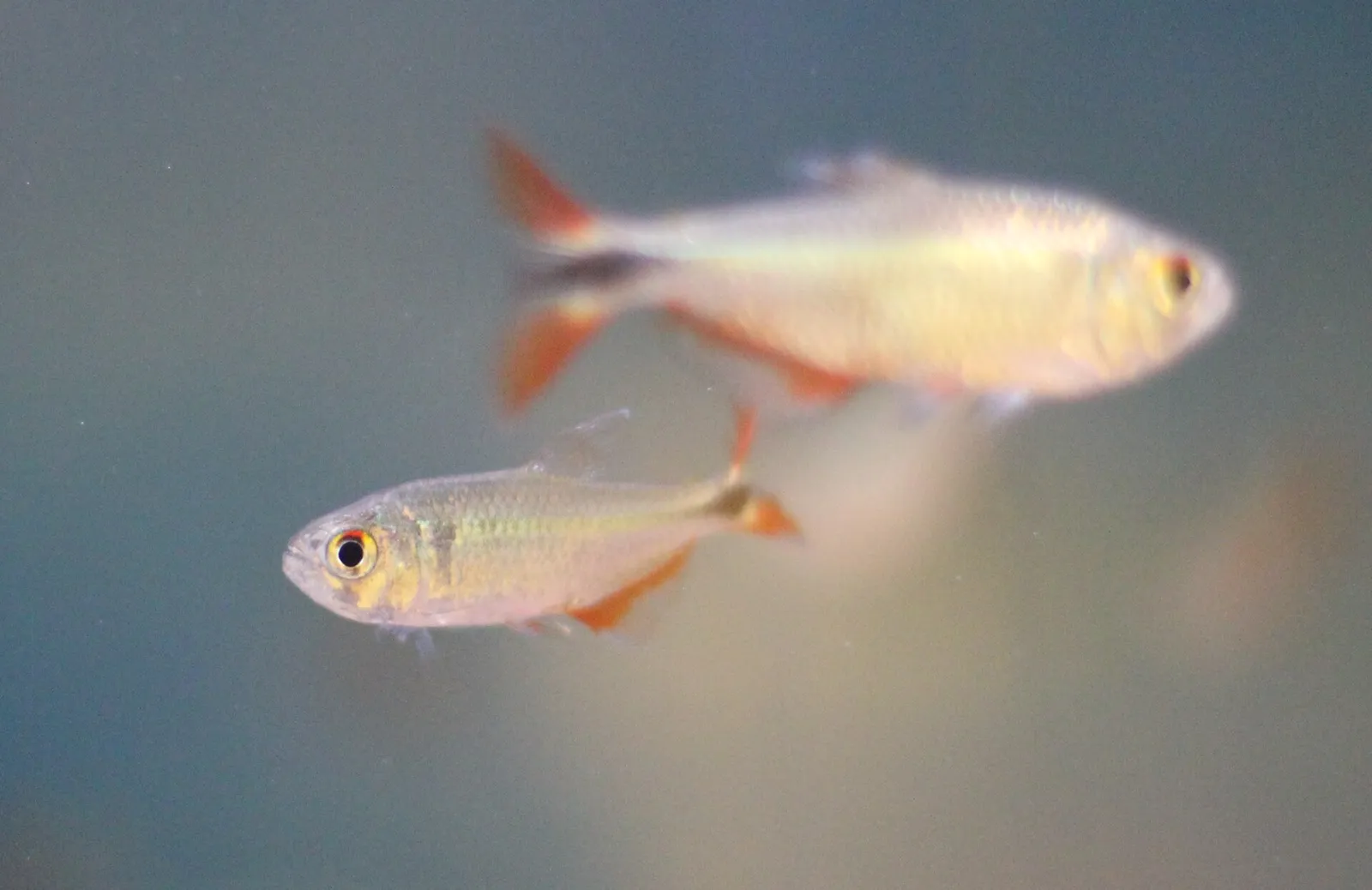
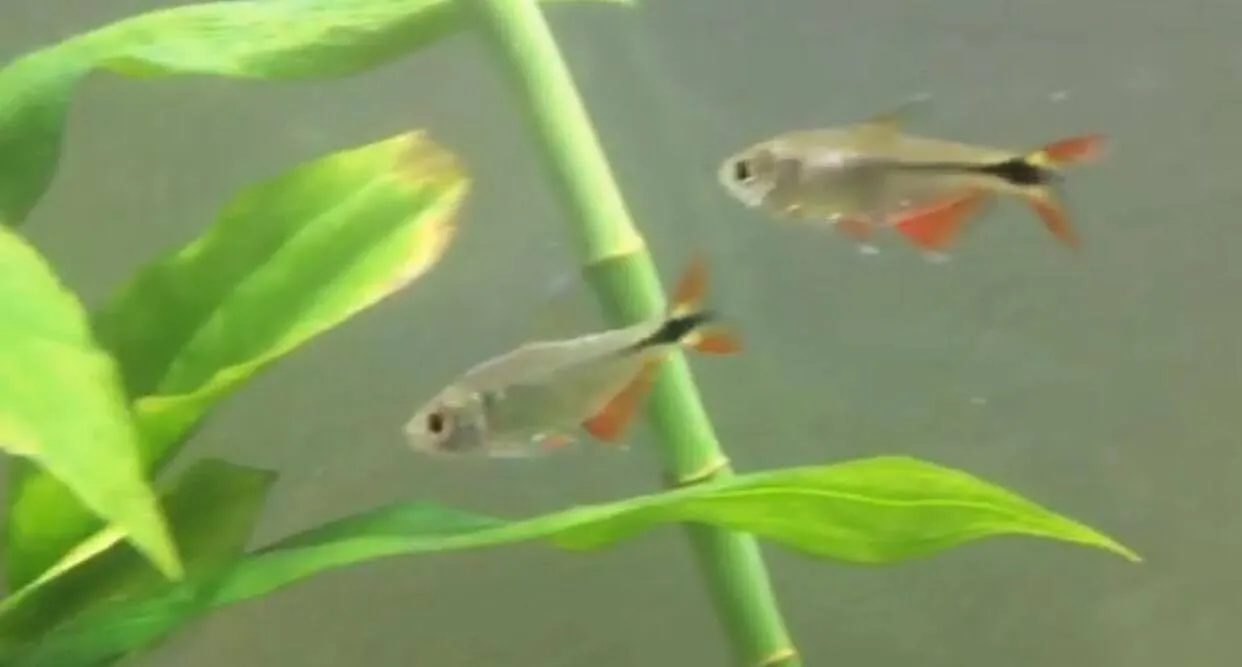
The overall colouration is silver with a faint bluish or greenish iridescence along the upper flanks in good light. A dark, roughly diamond-shaped blotch is present at the base of the caudal peduncle, and a fainter mid-lateral stripe may be visible running forward from this spot. The dorsal and caudal fins often carry a reddish or yellowish tinge that becomes more vivid in conditioned adults, particularly males. Sexual dimorphism is modest: ripe females are noticeably deeper-bodied than males, and males may show slightly more intense red in the fins. The large size relative to most common tetras makes P. anisitsi conspicuous in a community aquarium.
Habitat
The Buenos Aires tetra is native to the Paraná and Uruguay river basins of southern South America — a subtropical drainage system encompassing parts of Paraguay, Argentina, and southern Brazil. FishBase records the distribution as subtropical freshwater, benthopelagic, in the Paraguay sub-basin and broader Río de la Plata system. These rivers flow through open savanna, gallery forest, and seasonal floodplain habitats, and the water tends toward neutral to slightly alkaline chemistry, moderately hard, and clear to lightly turbid.
A key biological feature of the species' native range is its subtropical, seasonally variable climate: water temperatures can range widely across the year, from the low teens in austral winter to the high twenties and beyond in summer. This wide thermal tolerance is one of the species' most ecologically notable traits and directly informs its reputation in the aquarium hobby as a species that does not require a heater in temperate-climate rooms. FishBase records a preferred temperature range of 61–82 °F, substantially broader than the 75–82 °F typical of strictly tropical characids.
Feeding
Psalidodon anisitsi is an omnivore, and FishBase records its natural diet as worms, crustaceans, insects, and plant material. In the wild, the species forages opportunistically across the water column, taking benthic invertebrates, surface-fallen terrestrial insects, and a significant proportion of plant matter including algae, aquatic vegetation, and seeds.
In the aquarium the Buenos Aires tetra accepts virtually all standard foods: quality dried flakes and pellets, frozen and live foods such as bloodworm, Daphnia, brine shrimp, and tubifex, and vegetable matter. One practical consideration for planted-tank aquarists is that the species has a well-documented appetite for live aquatic vegetation and will systematically strip soft-leaved plants from an aquarium. Robust, tough-leaved plants (Anubias, Java fern, Vallisneria) are generally left alone, but delicate species such as Cabomba and Echinodorus may be eaten. Feeding a diet with a vegetable component — spirulina flake, blanched spinach or cucumber — can partially reduce plant damage but does not eliminate it entirely.
Mating
Psalidodon anisitsi follows the typical open-water egg-scattering mating strategy common to most Characidae. There is no pair bond and no parental care; males and females spawn together opportunistically in the water column or among vegetation, releasing eggs and sperm simultaneously before departing. In captivity, males in breeding condition may display chasing and fin-flaring behaviour toward ripe females, driving them through the tank before spawning.
The species is a relatively prolific spawner. Breeders typically condition separate groups of males and females on a varied high-protein diet prior to introducing them, then move conditioned adults to a separate, dimly lit spawning tank furnished with fine-leaved plants or spawning mops. Because the adults show no interest in protecting their eggs — and will readily eat them — separation of spawning adults from the egg clutch as quickly as possible is standard practice.
Breeding
Breeding Psalidodon anisitsi in the aquarium is considered straightforward relative to many tetras, and aqua-fish.net notes that it is an egg-scattering species with no parental care. The spawning setup recommended by hobbyists involves a dimly lit separate tank with fine-leaved plants, spawning mops, or glass marbles on the bottom to catch and shelter eggs from the adults. Water should be soft to moderately hard and slightly acidic to neutral, and a modest temperature rise may help condition the fish for spawning.
Eggs are adhesive and deposited among fine plant material or the spawning substrate. FishBase records a very short incubation period: eggs hatch in 20–24 hours at typical spawning temperatures. The fry are small but not unusually delicate for a characid of this size. First foods should be very fine — infusoria or commercial liquid fry food initially — progressing rapidly to newly hatched brine shrimp nauplii as the fry grow. Growth is relatively rapid compared to smaller tetras, and juveniles develop the characteristic silver colouration and caudal-spot markings within a few weeks.
In the aquarium
The Buenos Aires tetra is a robust, undemanding species well suited to aquarists looking for an active schooling fish that tolerates a wide range of conditions. FishBase describes it as highly commercial in the aquarium trade. It is best kept in groups of six or more, which allows the natural schooling behaviour to express itself and reduces any chasing or fin-nipping directed at tankmates — a tendency that solitary or small-group Buenos Aires tetras can display toward smaller, slow-moving fish.
A key selling point is temperature flexibility: the species thrives anywhere from about 61–82 °F, making it one of few tropical-origin tetras suitable for an unheated aquarium in a temperate home. Water chemistry tolerance is similarly broad; neutral to slightly alkaline, moderately hard water is ideal but the fish adapts well to a range of conditions. The principal practical caveat for aquarists is the species' appetite for live plants: planted tanks should use robust, tough species or artificial decor. For a species-appropriate setup, open swimming space, some cover, and good filtration matter more than any specific water chemistry target. Tankmates should be similar in size and temperament; the Buenos Aires tetra's own boisterous energy means it is not well paired with very small or slow-moving species.
Conservation
Psalidodon anisitsi is assessed as Least Concern (LC) on the IUCN Red List, with the assessment dated 04 March 2021. The assessment was carried out by Flávio Lima of the Universidade Estadual de Campinas (IUCN taxon ID 186783, assessment ID 1818314). The Least Concern designation reflects the species' broad distribution across the Paraná and Uruguay river basins, its tolerance of disturbed and modified habitats, its abundant wild populations, and the absence of evidence for a significant decline.
The Buenos Aires tetra is one of the more resilient characids in the region. Unlike many tetras whose natural ranges encompass highly sensitive blackwater or clearwater headwater streams, P. anisitsi inhabits large, productive lowland river systems that are broadly intact across much of their extent, even if locally degraded. The species is abundant in the aquarium trade, and the majority of individuals available commercially are captive-bred. No specific conservation measures target the species, consistent with its secure status.