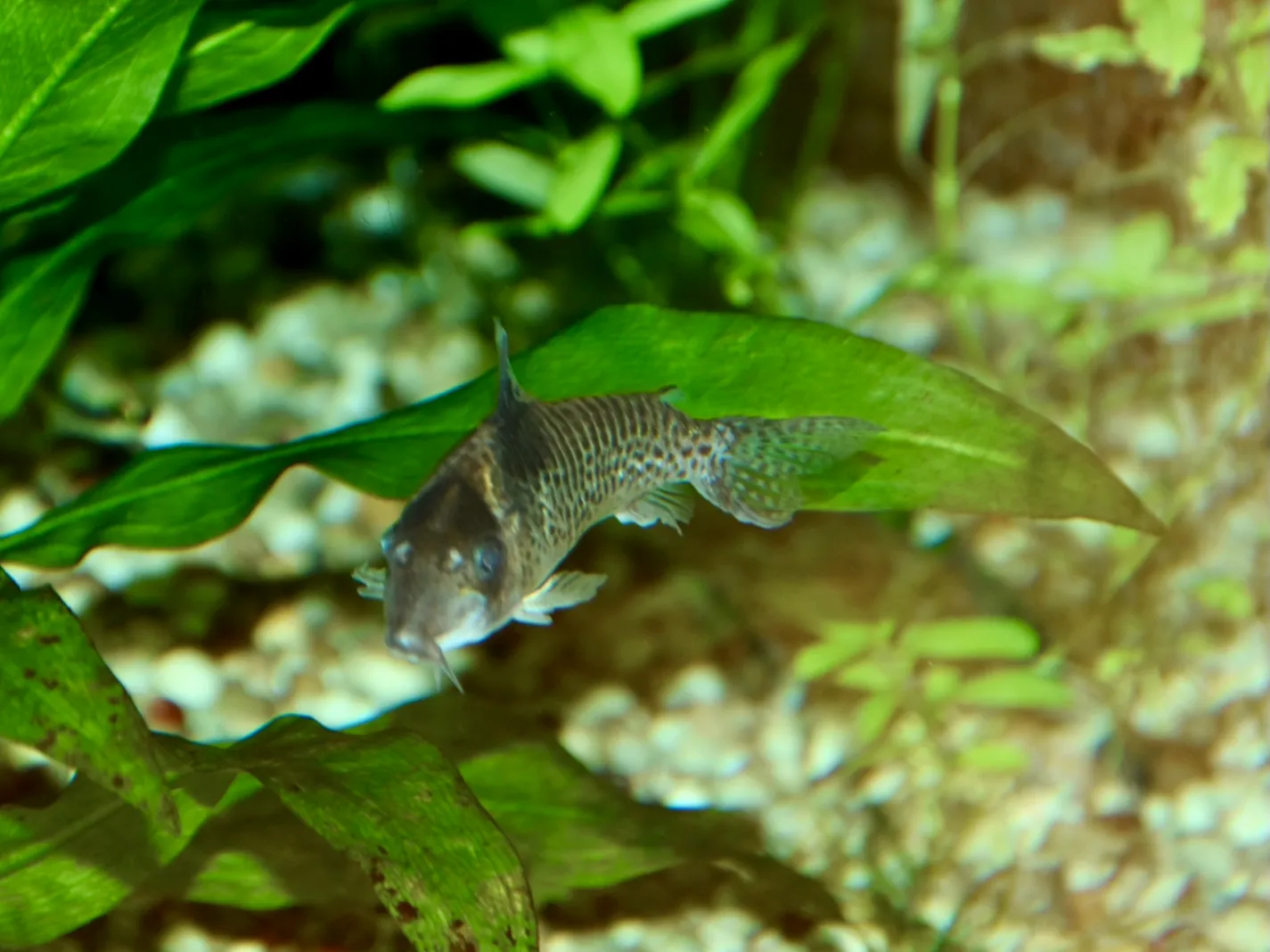
Taxonomy & naming
The species was described by the Austrian ichthyologist Franz Steindachner in 1876 as Corydoras agassizii, from material collected in the Amazon River near Tabatinga, on the Brazil–Peru–Colombia frontier, which remains the type locality (the lectotype is held in Vienna). The epithet honours Jean Louis Rodolphe Agassiz (1807–1873), the Swiss-American geologist and zoologist whose first love was the study of fishes.
For almost a century and a half it sat in Corydoras Lacépède, 1803, the vast genus of South American armoured catfishes in the family Callichthyidae. That genus had become a taxonomic catch-all of well over 170 species, and molecular phylogenies showed it was not a single natural lineage. In 2024 Dias, Tencatt and colleagues published a large revision (DOI 10.1093/zoolinnean/zlae053) that broke Corydoras into several genera — among them Brochis, Hoplisoma, Gastrodermus and Osteogaster — and under that scheme Agassiz's cory falls into the resurrected genus Brochis, as Brochis agassizii. Eschmeyer's Catalog of Fishes now lists the species under that combination. The change is recent and the aquarium world still says 'Corydoras agassizii,' so we keep that as the display heading while recording the current science honestly. The deeper, more practical taxonomic problem is one of identity in the trade: agassizii is one of a knot of densely spotted upper-Amazon corys, and fish sold under its name are frequently the very similar C. ambiacus or another spotted species. Reliable identification usually needs good provenance and a careful look at the fish, not just the label on the tank.
Morphology
Agassiz's cory is a small, deep-bodied catfish reaching roughly 2 in in standard length (about 2.5 in overall), with females growing larger and rounder than males. Like all corys it is armoured rather than scaled, with two rows of overlapping bony plates running down each flank and a hard, blunt-helmeted head. Three pairs of barbels fringe the downturned mouth, used to taste and sift the substrate, and the dorsal, pectoral and adipose fins each carry a stiff leading spine.
The colour pattern is what gives the species both its 'spotted cory' name and its trade confusion. The body is a pale tan-to-greyish ground densely peppered with small dark spots arranged in rough longitudinal rows, and the most useful diagnostic feature is a strong, well-defined black blotch occupying much of the dorsal fin. Spotting also extends onto the head and into the caudal and other fins. The difficulty is that several near-identical species — above all C. ambiacus — share this finely spotted scheme, and the extent of the dorsal marking varies, so a single feature is rarely enough to clinch an identification. Many specimens labelled agassizii in shops are something else in the same complex.
Habitat
Corydoras agassizii is an upper-Amazon fish. FishBase and the Catalog of Fishes place it in the Amazon River basin near the border of Brazil and Peru, with records also from adjacent Colombia — the broad tri-border region around Tabatinga where it was first collected. This is lowland rainforest river country, and like its relatives the species lives over soft substrates in the shallow, sheltered margins of streams, side-channels, floodplain pools and slow river reaches, among leaf litter and submerged wood.
These are warm, soft, gently flowing to still waters. The figures associated with the species are a temperature band of about 72–79 °F, a pH from acidic to neutral or slightly alkaline (roughly 6.0–8.0) and soft to moderately hard water. Like other corys it is a facultative air-breather, periodically darting to the surface to gulp air that it absorbs through a vascularised, modified hindgut — an adaptation that lets these fish persist in the warm, oxygen-poor backwaters they favour.
Feeding
This is a benthic omnivore and detritivore that works the bottom continuously, pushing its snout and barbels into sand and litter to taste out small invertebrates, insect larvae, worms, micro-crustaceans, fallen plant matter and the organic film of detritus, sieving clean substrate back out through the gills. It is an opportunistic generalist rather than a specialist, which is much of why corys are so adaptable. In the aquarium it readily takes sinking pellets and tablets, frozen and live foods such as bloodworm, Daphnia and brine shrimp, and whatever its tankmates let fall — but it should be fed a proper diet of its own at the bottom rather than left to scavenge leftovers.
Mating
Like other corydoradine catfishes, Agassiz's cory is an egg-laying shoaler with no pair bond and the genus's distinctive courtship. When a female is ready she cleans a spawning site and the group becomes active; a male takes up the classic 'T-position', lying at right angles across her head. In the observed sequence the female holds a small number of eggs — on the order of two to four — in a basket formed by her clasped pelvic fins while the male fertilises them, a process lasting only around half a minute. She then swims to the cleaned surface and presses the very sticky eggs into place. The pair repeats this again and again until on the order of a hundred eggs have been laid across the chosen surfaces.
Breeding
Spawning follows the familiar corydoras pattern and is typically triggered in the aquarium by a generous, cooler water change that imitates the onset of the rainy season. The adhesive eggs — a clutch building to roughly 100, laid a few at a time — are deposited on plants, wood, stones or the glass and receive no parental care; the adults will eat them, so breeders move either the eggs or the parents. Eggs hatch in a few days depending on temperature, and the fry, once they have absorbed the yolk sac, take microworm, baby brine shrimp and powdered foods, growing steadily on clean water and frequent feeding. Documented, deliberate captive breeding of this exact species is less commonly reported than for the staple bronze and peppered corys, partly because of the persistent uncertainty over which spotted species is actually in a given group.
In the aquarium
Agassiz's cory makes an excellent, peaceful community fish, with the same handful of real requirements that all corys share. It is a shoaling species and should be kept in a group of at least six; kept singly or in pairs it is visibly stressed and inactive. Provide a soft sand substrate, or at most very smooth rounded fine gravel — corys feed by sifting, and sharp or s-edged gravel wears down and infects their barbels, leaving the blunted faces that are a classic sign of poor husbandry. Keep the bottom clean, give them shade from wood and planting with open feeding space, and maintain warm (about 72–79 °F), well-oxygenated water with gentle flow and regular changes; they tolerate a broad pH and hardness range.
They are ideal companions for tetras, rasboras, dwarf cichlids and other calm fish, and should never be housed with anything large or aggressive. Two cautions worth knowing apply to all corys: the stiff fin spines readily catch in a net, so a rigid container is safer for moving them, and a badly stressed cory can release a skin toxin that, in the small volume of a bag or bucket, can kill an entire group — so transport them carefully and never crowd them. The honest aquarium footnote is identity: buy from a supplier who knows the fish's origin if it matters to you, because much of what is sold as 'agassizii' is another spotted species.
Conservation
Corydoras agassizii (as Brochis agassizii) was assessed by the IUCN as Least Concern in 2020. It is a widespread upper-Amazon fish with no evidence of major decline, and the broad pressures on Amazonian freshwaters — deforestation, agriculture, mining run-off, pollution and damming — are the relevant long-term concerns rather than any species-specific threat. It is collected for the aquarium trade, but as a small, fecund, fast-maturing fish it is rated of low fishing vulnerability. The most genuine conservation caveat is taxonomic: because the densely spotted upper-Amazon corys are so easily confused, trade and even some distribution records may conflate agassizii with its look-alikes, which muddies the picture of exactly how any one of these species is faring.