Taxonomy & naming
The powder blue cichlid was described by the Singapore-based zoologist D. S. Johnson in 1974, in the short-lived hobbyist journal Today's Aquarist, in a paper titled 'Three new cichlids from Lake Malawi.' He placed it in Pseudotropheus, the large catch-all genus that Regan had erected in 1922 for the rock-dwelling mbuna, and named it for the Florida fish farmer and exporter Ross Socolof, through whose trade the fish reached science. The holotype is lodged at the United States National Museum (USNM 213500). The type locality given in the original description is 'off Likoma Island' in the Malawian part of the lake — a label that almost certainly reflects where the exporting collectors said the fish came from rather than its true natural range, because every subsequent field survey has found wild powder blues only along the opposite, Mozambican coast.
In the early aquarium trade the fish moved under the same "Pindani" name it still carries: Ad Konings records shipments of wild-caught Chindongo socolofi — alongside Red Zebra and "Aulonocara nyassae" — going out through Stuart Grant's collecting station at Salima, on the Malawian shore, where they were received with enthusiasm by importers. Salima was a consolidation and export point rather than the species' native water, so this is trade history, not a range record; the fish's confirmed wild range remains the Mozambican coast described below.
For decades socolofi sat in the unwieldy Pseudotropheus alongside hundreds of only distantly related mbuna, and successive workers chipped that genus apart. In 2016 Li, Konings and Stauffer revised the Pseudotropheus elongatus species group and erected a new genus, Chindongo — a Tonga word for a small rock-dwelling fish — into which socolofi was moved as Chindongo socolofi. FishBase, the Catalog of Fishes and the IUCN now use that combination, and it is technically the current valid name. The hobby, however, has almost entirely ignored the change: the fish is still sold, bred and discussed as Pseudotropheus socolofi, and that is the name under which it remains best known. Chindongo species are diagnosed within the old Pseudotropheus by a particular tooth arrangement in the lower jaw and by their territorial-male coloration; socolofi is one of the more peripheral members, distinguished by its uniform pale-blue dress.
Morphology
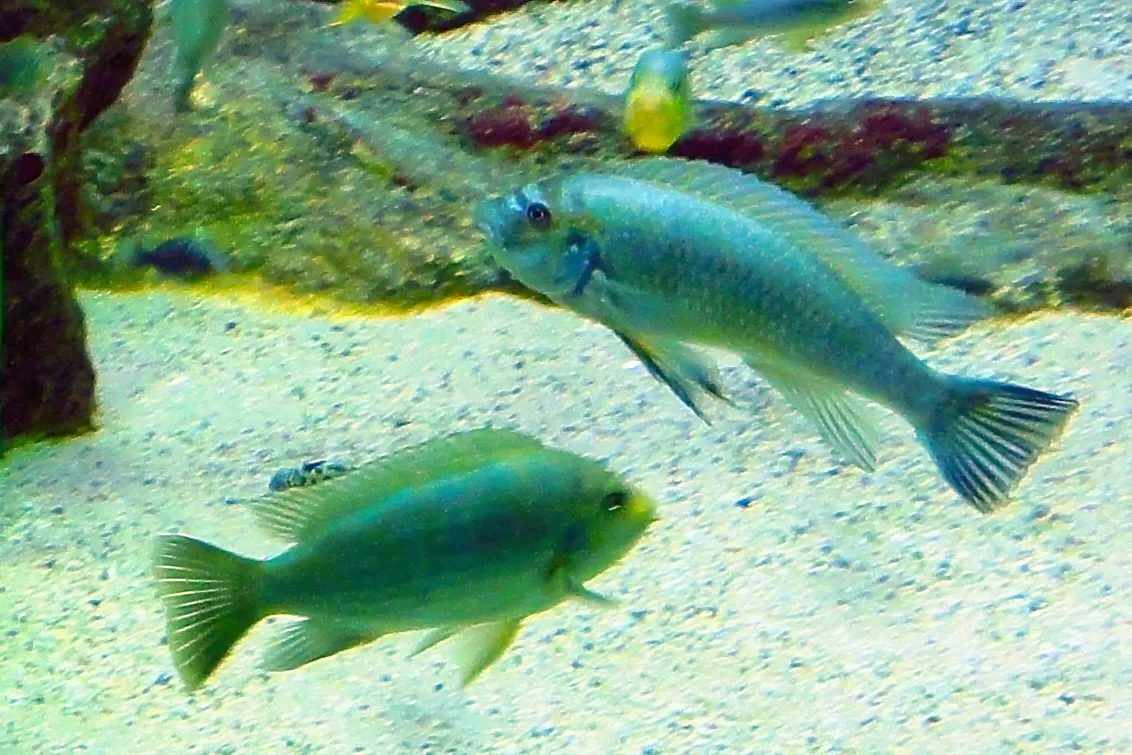
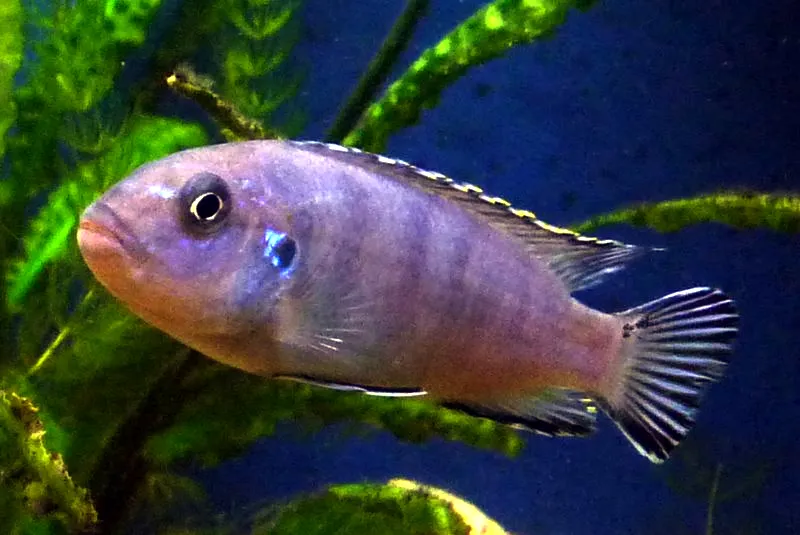
Chindongo socolofi is a small, sturdily built mbuna with the typical Malawi rock-cichlid profile: an elongate-oval body, a gently sloping forehead, and a terminal mouth set with the comb of fine bicuspid and tricuspid teeth that mark an algae-grazer. Mature males reach roughly 4.5 in and females about 4 in in standard length, though most aquarium fish settle a little smaller; FishBase's listed maximum of 2.5 in SL is anomalously low and appears to rest on a single small specimen rather than the species' true adult size. The defining feature is the colour, and it is the same in both sexes — an even, pale, almost pastel powder-blue over the whole body, lacking the bold vertical bars worn by most zebra-type mbuna. The dorsal and anal fins are edged in black, sometimes with a thin pale submarginal line, and the anal fin carries a few yellow-orange egg-spots. Because the sexes share this colour, the species is genuinely difficult to sex on appearance alone, which sets it apart from the many strongly dichromatic mbuna. The usual tells are subtle: males tend to run slightly larger, carry more numerous and more vivid egg-spots, and often have somewhat longer pelvic fins, while behaviour — territorial display and chasing — is the most reliable guide. A naturally occurring albino strain, bred in captivity, is also established in the trade.
Habitat
The species is endemic to Lake Malawi, the long, deep rift lake shared by Malawi, Mozambique and Tanzania, and within that lake its natural range is narrow: the eastern, Mozambican shore, running roughly from Cobwe (Cobue) south to Tumbi Point. It lives in the so-called intermediate zone — the transitional habitat where the rocky shoreline gives way to open sand — rather than in the heaviest rock piles favoured by many mbuna. There it stays in relatively shallow water, generally recorded between about 4 and 33 ft depth, foraging out over the sand while territorial males hold stations close to the nearest rocks. Lake Malawi's surface water is warm, clear and alkaline, a chemistry that defines the fish's requirements: temperatures around the species' habitat run roughly 24 to 28 degrees Celsius, with a high pH (about 7.6 to 8.8) and well-buffered water. Beyond its native stretch of coast, socolofi has been introduced and become established at a few Malawian sites, including Otter Point and Thumbi West Island near the lake's southern end, where it was not originally found; small feral populations from aquarium releases have also turned up far outside Africa, in Florida and Illinois in the United States, without evidence of wider spread.
Feeding
Like other mbuna, the powder blue cichlid is a grazer of aufwuchs — the dense felt of algae, diatoms, and the tiny invertebrates, larvae and detritus living within it that coats every sunlit rock and sand grain in the lake. Its fine, comb-like teeth are built to rasp and comb this biocover loose rather than to bite chunks from larger prey. Field observation places it as a fish that feeds from the biocover on both rock and sand, working the intermediate habitat where the two meet rather than specialising on either. Its trophic position is correspondingly low, near the base of the food web. In the wild this grazing diet is overwhelmingly vegetable, rich in algae and roughage and low in animal protein and fat — a fact with direct consequences for keepers, because mbuna fed too heavily on rich, meaty foods are prone to the digestive disorder known as 'Malawi bloat.' In the community of the rocky and intermediate zones it is one of many algae-grazers partitioning the same turf, holding small feeding territories that males in particular defend.
Mating
Chindongo socolofi follows the polygynous, male-territorial mating system that runs through the mbuna. There is no pair bond. A sexually active male takes up and defends a territory — typically centred on a rock, crevice or cleared patch of substrate — and from it displays to passing females, intensifying his blue colour and the contrast of his black fin margins and flashing the yellow egg-spots on his anal fin. He courts by leading a ripe female toward his spawning site with quivering, circling displays, and he will drive off rival males and other fish that intrude. Compared with many mbuna the species is only moderately aggressive, which is part of its appeal, but a dominant male can still be a relentless pursuer of females. This is why the species is best kept and bred as a harem — one male to several females — so that his attentions are spread and no single female is harried to exhaustion. Females not in breeding condition, and subordinate fish, shoal more loosely away from the held territories.
Breeding
The powder blue cichlid is a maternal (ovophilous) mouthbrooder, and breeding it is not difficult — one reason it has been a hobby staple for so long. Spawning follows the classic mbuna ritual. The male cleans and displays over a flat rock or cleared patch; a receptive female deposits a small batch of relatively large eggs and almost immediately turns to take them back into her mouth. As she does, she nips at the egg-spots on the male's trailing anal fin — dummy eggs that she treats as the real thing — and in snapping at them she draws in his milt, fertilising the clutch already in her mouth. Aquarists who have watched socolofi spawn describe the female's efforts to mouth these spots as persistent. Clutches are small, as is typical for the genus, on the order of a few dozen eggs rather than the hundreds laid by substrate-spawning cichlids — the trade-off for the intense protection mouthbrooding provides. The female then carries the developing eggs and larvae in her buccal cavity for roughly three to four weeks, not feeding throughout and recognisable by her distended, bulging throat, before releasing a small brood of fully formed, free-swimming fry. She offers no care after release. The fry are large enough at first swimming to take newly hatched brine shrimp, microworm and powdered dry foods, and grow readily. Breeders who want to maximise numbers sometimes strip a brooding female and raise the fry artificially.
In the aquarium
Chindongo socolofi is one of the classic 'first mbuna,' and deservedly so: it is hardy, colourful in both sexes, and milder-tempered than the zebra and Melanochromis species it is usually housed with. A single male with a small group of females can be kept in a tank from about 36 inches long (around 40 US gal), though more room is always better in a mixed mbuna community, where stocking heavily and deliberately is the standard tactic for spreading aggression. The décor should mirror the lake's rocky intermediate zone — stacked rock arranged into caves, crevices and broken sightlines, set over a sandy substrate, with some open water left for swimming. Stable rockwork built up from the tank base (not piled on the sand, which the fish will undermine) is safest.
Water chemistry is the non-negotiable part. These are fish of warm, alkaline rift-lake water: aim for roughly 24 to 28 degrees Celsius, a pH around 7.8 to 8.6, and moderately hard, well-buffered water (the literature cites about 10 to 25 degrees of hardness). Soft, acidic water will not suit them. Lake Malawi mbuna are also intolerant of accumulated dissolved waste, so generous filtration and regular water changes matter. Diet is the other classic pitfall: socolofi is a grazer that needs a vegetable-based menu — spirulina and other algae-based flake or pellet, blanched greens such as spinach, and similar — with only modest amounts of live or frozen animal food. Rich, fatty or mammalian foods (never beef heart) predispose mbuna to the often-fatal digestive condition called Malawi bloat.
On temperament, the species is best described as moderately territorial rather than mean. Suitable tankmates are other peaceable-to-moderate mbuna and open-water Malawi cichlids — Labidochromis caeruleus, Aulonocara peacocks, Copadichromis and the like — rather than the lake's most belligerent rock-dwellers, which will bully it. Keep one male per group with several females to diffuse his courtship, and expect some chasing during breeding. A common mistake is mixing socolofi with other plain pale-blue mbuna, which can hybridise with it in captivity; for true-breeding fry a species or carefully chosen community tank is needed. Kept in alkaline, well-buffered water, fed mostly greens, and given rock and space, it is an undemanding and long-lived aquarium fish.
Conservation
The IUCN Red List assesses the powder blue cichlid (as Chindongo socolofi) as Least Concern, in an assessment by Konings and Kazembe published in 2018, with the population judged stable. Although its natural range along the Mozambican coast is narrow, the species is locally common within it, occurs in habitat that is not under acute threat, and is bolstered by introduced populations elsewhere in the lake; it carries no CITES listing. Crucially, the overwhelming majority of powder blue cichlids in the aquarium trade are tank-bred rather than wild-caught, so commercial demand puts little direct pressure on the wild stock. The broader backdrop, however, is the mounting strain on Lake Malawi as a whole: one of the planet's richest concentrations of endemic fishes faces heavy artisanal and commercial fishing, sediment and nutrient runoff from a fast-growing catchment, and the looming pressures of climate change and water-level fluctuation. None of these is documented as a present danger to socolofi specifically, but they are the context in which the long-term security of all the lake's narrowly endemic rock-cichlids must be read.