Taxonomy & naming
Gymnogeophagus meridionalis was described in 1988 by the Brazilian ichthyologists Roberto E. Reis and Luiz R. Malabarba, in their revision of the genus Gymnogeophagus Miranda Ribeiro, 1918 (Revista Brasileira de Zoologia 4(4): 259–305), which also erected Gymnogeophagus lacustris and clarified the limits of the previously named species. The type locality is in southern Brazil: on the Rio Negro road at highway BR-153 near Bagé, Rio Grande do Sul (holotype MZUSP 28461); the paratype series spans the species' southern range and includes Argentine material in Buenos Aires (MACN 7466). The genus belongs to the eartheater subfamily Geophaginae (tribe Geophagini) and is diagnosed by two derived osteological features that set it apart from all other cichlids: the complete absence of supraneural bones and a distinctive forward-directed spine on the first dorsal-fin pterygiophore. In their revision Reis and Malabarba split Gymnogeophagus into two ecologically and morphologically contrasting groups — a short-bodied substrate-brooding clade, to which meridionalis belongs, and a long-bodied delayed-mouthbrooding clade built around Gymnogeophagus gymnogenys — with the deep-bodied Gymnogeophagus balzanii near the base of the tree. This placement matters, because in the aquarium trade Gymnogeophagus meridionalis has been chronically confused. The fish most often sold internationally as "meridionalis" is in fact an undescribed relative (treated by field workers as Gymnogeophagus sp. aff. meridionalis); following the original description and type material, the true meridionalis is the taller-finned "high dorsal" form. Both are substrate spawners, so the muddle is one of identity rather than of biology. Reis and Malabarba also grouped meridionalis with two other small, southerly Gymnogeophagus — Gymnogeophagus rhabdotus and Gymnogeophagus setequedas — on the basis of a reduced scale count along the flank (22–25 scales in a longitudinal row, against 26–28 in the rest of the genus); field workers treat the three as a closely related trio that is still being sorted out population by population, with several Uruguayan and Argentine populations recorded only as Gymnogeophagus cf. meridionalis or under provisional field names pending formal study.
Morphology
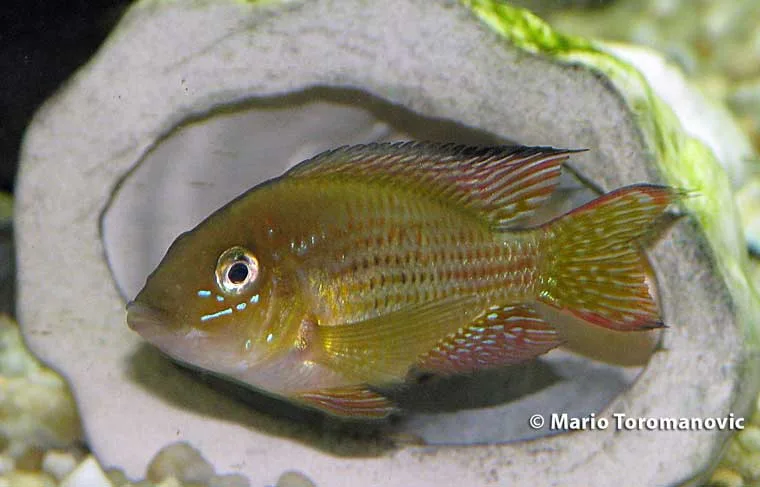
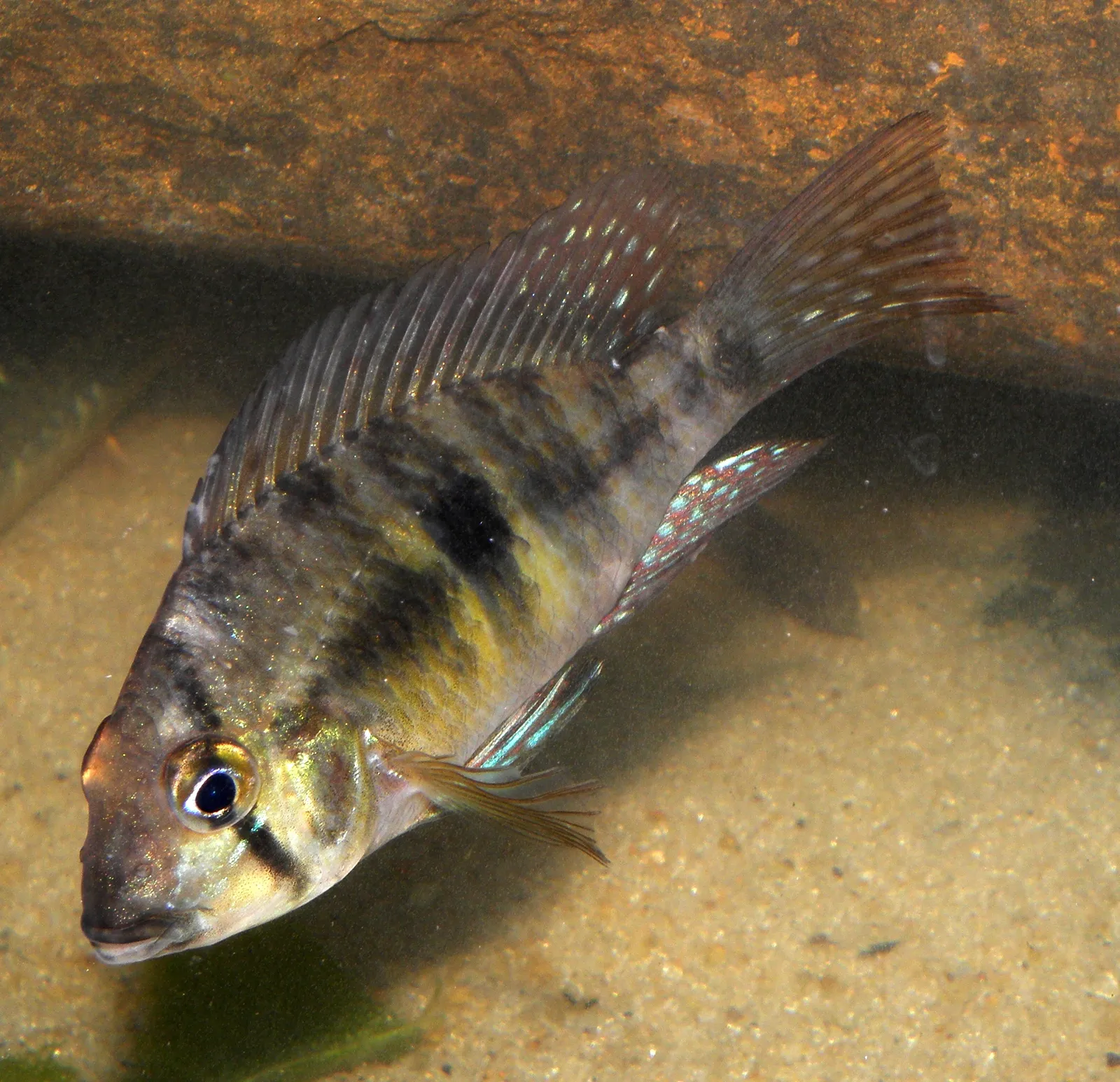
This is a small cichlid. FishBase lists a maximum of 3.5 in standard length, and field and hobby accounts put adults at roughly 4–4.5 in (about four to five inches) total length; occasional reports of males approaching 5.5 in should be read as outliers or as measurements of the larger look-alike rather than of the type form. The body is short and deep, the species' signature being a notably tall dorsal fin — the source of its long-standing trade name "high dorsal." Ground color is an olive to brassy green, broken by a single dark, roughly round blotch set on the mid-flank. The unpaired fins are the showpiece: the dorsal and caudal are densely spangled with iridescent blue-to-green dots, and breeding males flush the dorsal, caudal and anal fins with red. Like all Gymnogeophagus, it has the genus' bare (scaleless) cheek and predorsal midline that give the group its name. Sexual dimorphism is real but moderate: males grow larger, color up more intensely, and carry more produced (pointed) dorsal and anal fins than the plainer females. Unlike the mouthbrooding gymnos (Gymnogeophagus balzanii, Gymnogeophagus gymnogenys), males of this substrate-spawning species do not develop the exaggerated fatty nuchal hump.
Habitat
Gymnogeophagus meridionalis is a fish of the lower Río Uruguay drainage, occurring in Uruguay, southern Brazil (Rio Grande do Sul) and smaller drainages of nearby northeastern Argentina; it is the only member of its genus found south of Buenos Aires. Within Uruguay it is widespread through the Río Uruguay basin and is abundant in the Río Negro, the river's largest tributary. These are subtropical, strongly seasonal waters rather than tropical ones — the genus as a whole has one of the most southerly distributions of any Neotropical cichlid. Reis and Malabarba's original description characterizes the habitat broadly as small pools, streams and even large rivers over sandy or muddy bottoms, in water that ranges from clear to dark and murky, with no strong statement on current — though a preference for slow-flowing or still water can reasonably be inferred. Confirmed Argentine records include a lagoon along the Bella Vista–San Roque road in Corrientes, the Bosque de Palermo ponds in Buenos Aires, and the Río de la Reconquista roughly 62 mi upstream of the Represa La Reja; in Uruguay the species has been taken from a small lake just outside the town of Salinas, where it shares the water with the cichlid 'Cichlasoma' facetum and the livebearing toothcarps Jenynsia lineata and Cnesterodon decemmaculatus. Field observers describe water that is roughly neutral in pH and seasonally cool: temperatures swing from sweltering southern summers down to the low teens (Celsius) or colder in winter, and Uruguayan populations are reported to tolerate winter water near 50 °F without distress. Populations from warmer Brazilian rivers run at the upper end of that envelope. Precise in-situ chemistry specifically confirmed for meridionalis remains sparse, but closely related, look-alike Gymnogeophagus taken from the same general drainages — populations some workers write as Gymnogeophagus cf. meridionalis pending formal study — have been measured at roughly pH 6.5–7.5, 68–79 °F and up to about 8° dGH, a plausible proxy for the true species' range.
Feeding
Like its relatives, Gymnogeophagus meridionalis is a benthic omnivore — an "eartheater" in the literal sense, taking mouthfuls of sand and fine substrate and sifting them through the gill rakers to extract small invertebrates, larvae, micro-crustaceans, detritus and incidental plant and algal matter. FishBase places it around trophic level 3.3, consistent with an opportunistic feeder that leans on small animal prey but is far from a strict carnivore. In practice it is undemanding and not rigidly tied to the bottom: hobbyist observation notes that although it sifts substrate, it will readily rise into the water column and even to the surface to feed. In its native streams and lagoons it fills the generalist mid- and bottom-water forager role, working sandy and rocky margins alongside other gymnos, Australoheros, Cichlasoma and pike cichlids (Crenicichla).
Mating
Outside of breeding the species is reasonably sociable, but reproduction brings out a pronounced territoriality — and, in confinement, real aggression. Pairing is monogamous: a male and female form a bond and jointly hold a territory centered on a chosen spawning surface, which they clean before laying. Both sexes can be combative; field and aquarium observers note that males are strongly territorial even outside the breeding season, and that ripe females are far from meek. In nature this plays out across roomy stream and lagoon habitats where rivals can keep their distance, and spawning is seasonal — Uruguayan gymnos breed through the southern summer, roughly November to January, as water warms. The spawning surface can be a flat stone, a rock face or any firm vertical or horizontal substrate; in aquaria a flowerpot serves the same purpose.
Breeding
Gymnogeophagus meridionalis is a biparental substrate spawner — emphatically not a mouthbrooder, which sets it apart from the better-known gymnos of the gymnogenys and balzanii groups. The pair cleans a hard, sloping surface (a stone or, in captivity, the inside of a flowerpot) angled so the eggs sit above a shallow pit the female has dug, positioned so that hatching larvae drop straight into it; the female then deposits a clutch of light brown to grey-brown adhesive eggs on it, reported as high as around 400 in a single spawning. Both parents then guard the brood against intruders regardless of the intruder's size, though the female is the one who actually tends the eggs while the male mostly holds the wider territory and is merely tolerated near the clutch. At a water temperature of about 68 °F it takes roughly 120 hours (five days) for the female to work the larvae free of their eggshells and settle them in the pit. From there she digs a fresh pit and moves the whole brood into it at least once a day over the following days — a behaviour Körber (1998) reads as a hygiene strategy, since meridionalis is often found in still or even dirty water and repeatedly relocating the larvae keeps waste from accumulating around them. At 68 °F it takes about 13 days from spawning for the fry to become free-swimming and begin hunting food on their own; both parents lead the shoal and share brood-care duties in close to equal measure. One practical wrinkle keepers report: the newly mobile fry are too small for newly hatched brine shrimp at first, so an infusorian culture prepared in advance is the right first food before the fry can graduate to Artemia nauplii and crushed flake.
In the aquarium
Gymnogeophagus meridionalis is a rewarding but somewhat specialized aquarium fish, and the single most important — and most commonly abused — requirement is temperature. These are subtropical animals that do best in cool to room-temperature water and are poorly served by a permanently heated tropical tank; kept too warm for too long they become listless, drab and short-lived. A seasonal regime is ideal: cooler water (down toward the mid-to-high 50s °F / low-to-mid teens °C) in winter rising into the low-to-mid 70s °F (low-to-mid 20s °C) in summer, which also helps trigger spawning. In a mild climate they thrive in an unheated tank or even an outdoor pond over the warm months. Aim for clean, near-neutral water; keepers specifically warn that high temperature, low pH and accumulated nitrate together predispose Gymnogeophagus to "bloat," so keep nitrate low (well under ~30 mg/L) and do regular weekly water changes.
Because the fish is small, the limiting factor on tank size is temperament rather than bulk: a single pair can be housed in around 30 US gallons (about 30 US gal), but they are surprisingly pugnacious for their size and a dominant male can injure tankmates quickly, so more floor space and broken sightlines pay off. Use a fine sand substrate to allow natural sifting, and aquascape with rocks, driftwood and roots to create defined territories and refuges where subordinate fish and harried females can hide. The species is plant-tolerant provided the plants are firmly anchored. Feeding is easy — it accepts dry, frozen and live foods readily; a varied diet that emphasizes plant matter and small crustaceans (shrimp of any kind) suits it well.
For tankmates, choose robust companions that can hold their own without being bullies: medium tetras, Corydoras and Ancistrus are commonly cited as good company in a larger setup, and these gymnos generally coexist with cichlids that are "mostly bluff." Be cautious mixing them with genuinely aggressive cichlids (some Australoheros, Cryptoheros/Archocentrus, larger Geophagus) in the confines of a tank, where squabbles escalate. Be aware too of the trade confusion: much of what is sold as "Gymnogeophagus meridionalis" is the more widespread and even more aggressive sp. aff. meridionalis, which is easy to breed (often spawning readily near neutral pH and 73–77 °F) but is best kept alone or with larger, capable tankmates.
Conservation
The IUCN Red List assesses Gymnogeophagus meridionalis as Least Concern (assessed 19 November 2020 by R.G. Frederico; published 2023), with an unknown population trend. The species is reasonably widespread across the lower Uruguay system in three countries and is not flagged as facing any range-wide threat; it carries no CITES or CMS listing. It is taken in a minor way for the ornamental aquarium trade and appears in artisanal/commercial catches, neither at a level the assessment treats as a population concern. The broader pressures on its habitat are regional rather than species-specific: agricultural intensification in the basin — rice farming in particular has degraded gymno habitats in the neighboring Laguna Merín system — along with damming, water abstraction and pollution of subtropical rivers. None of these is documented as a present danger to this particular cichlid, but they are the backdrop against which the status of a temperate, relatively narrow-ranged South American eartheater should be read.