Taxonomy & naming
Melanochromis chipokae was described by D. S. Johnson in 1975 in the aquarium magazine Today's Aquarist, in an article titled 'More new Malawi cichlids' — an unusual venue for a formal description, but a valid one. The original combination is Melanochromis chipokae, and Eschmeyer's Catalog of Fishes still treats that as the valid name today, with the holotype (USNM 214173, an 3.5 in SL male) and a paratype (USNM 214174) lodged at the Smithsonian's National Museum of Natural History. The type locality is given as 'off Chipoka Island, Lake Malawi.' The fish is very often sold and discussed under the name Pseudotropheus chipokae, but that combination has no current standing — every modern authority, from the Catalog of Fishes to FishBase to Ad Konings' monographs, places the species firmly in Melanochromis, and 'Pseudotropheus chipokae' should be read as a lingering trade label rather than a real synonym. The genus name combines the Greek melas (black) with chromis (an old name for a perch-like fish); the epithet is a toponym for Chipoka, the lakeside town and island near the type locality. Within Melanochromis it belongs to the group of large, elongate, strongly dichromatic species, and Konings & Stauffer's 2012 review of the genus (Zootaxa 3258) redescribed it from fresh topotypic material, distinguishing it from close relatives such as Melanochromis robustus (broader interorbital) and Melanochromis heterochromis (shorter lower jaw). That review also restricted the species, in practice, to the reef now mapped as Chidunga Rocks near Chipoka, and noted historical confusion in which European aquarium literature (e.g. Mayland 1982, Schraml 1998) had figured this fish under the name Melanochromis loriae.
Morphology
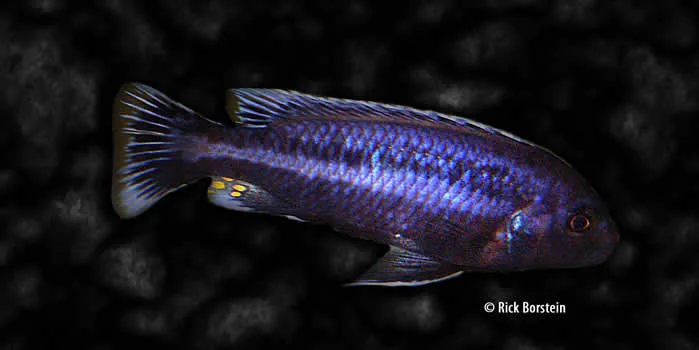
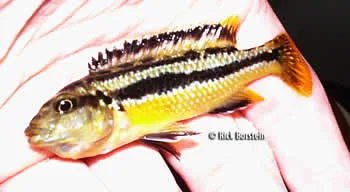
This is a medium-sized, spindle-shaped mbuna: FishBase gives a maximum of 4.7 in standard length, and the male holotype measured 3.5 in SL, though aquarium males commonly add a centimetre or two of tail to that and the occasional fish is reported near 6 in total length. The body is fusiform and noticeably more elongate than the deep-bodied algae-grazing mbuna, with a long snout and isognathous (evenly meeting) jaws bearing several rows of bicuspid and unicuspid teeth — the dentition of a fish that bites and grabs rather than rasps rock. The dorsal fin carries 17–18 spines and 8–9 soft rays, the anal fin 3 spines and 7–8 rays. Its defining feature is a pronounced sexual dichromatism. Breeding males are dark blue to blue-black over the whole body, marked by two solid light-blue horizontal stripes (a mid-lateral and a dorso-lateral band), a distinctively blue occipital region on the nape, and a blue dorsal fin edged in a broad white-to-pale-blue margin; the anal fin is black with one to three orange-yellow egg-spots. Females and subadults are entirely different — lemon-yellow to grey-yellow flanks crossed by two broad black stripes, with black interorbital bars on the snout and a black submarginal band running through the yellow dorsal and anal fins. That yellow ground colour plus the black submarginal fin band is the single feature Konings & Stauffer use to separate female chipokae from every other Melanochromis. The blue-male/yellow-female split makes the sexes look almost like different species, and hobbyists routinely confuse the species with the superficially similar (and likewise dichromatic) Melanochromis auratus; chipokae is told apart by its fully patterned tail and longer, more predatory snout.
Habitat
Melanochromis chipokae is a Lake Malawi endemic with one of the smallest ranges of any cichlid in the lake. The 2012 redescription and the IUCN assessment agree that it is essentially restricted to Chidunga Rocks, a small shallow rocky reef near Chipoka in the southwestern arm of the lake, with at most one additional small reef reported nearby; the IUCN puts its total area of occupancy at just 3.1 mi². It is a fish of the intermediate zone — the transitional habitat where rocky reef meets open sand — and is also found in the shallow purely rocky habitat, hunting as a wandering, mostly solitary individual rather than holding a fixed territory. The reef is shallow: the deepest water at Chidunga is no more than about 30 ft (around 20–23 ft over much of the reef, varying with season), so this is a near-surface, well-lit, sediment-free environment. Konings & Stauffer note the substrate as sediment-free rock and rock-sand interface. The water chemistry is the alkaline, well-buffered, stable regime typical of Lake Malawi: FishBase records a pH range of roughly 7.3–8.5, hardness of about 7–18 dH, and temperatures of 75–79 °F, alongside the broader lake's warm (often 75–82 °F in the upper layer), high-pH (pH ~7.7–8.6) surface waters, whose own general hardness is modest.
Feeding
Unusually for an mbuna, Melanochromis chipokae is a predator rather than an algae-grazer. FishBase estimates its trophic level at about 4.2 — high, and squarely in carnivore territory — and field observations describe it cruising the intermediate habitat in search of larger invertebrates and small fishes, including, plausibly, the fry and juveniles of other cichlids. Ribbink and colleagues' classic 1983 survey of the mbuna recorded it hunting small fishes and being attracted to stirred-up sediment, with invertebrates also turning up in stomach contents; hobbyist reports of wild-caught fish add filamentous algae and zooplankton to the list, so it is best described as an opportunistic carnivore with an omnivorous edge rather than a pure piscivore. The long snout, grabbing dentition and elongate, fast-cruising body all fit a fish that ambushes and chases mobile prey rather than scraping the aufwuchs (the algal-invertebrate film coating the rocks) that sustains most of its mbuna neighbours. In the community at Chidunga it functions as one of the rock-zone's small predators, a role that also shapes its temperament: a fish built to chase down other fishes does not make a relaxed tankmate.
Mating
Like all mbuna, Melanochromis chipokae is polygynous and provides no paternal care, so its social system centres on male display and female choice rather than pair bonds. Historically, males were described as territorial, digging spawning pits between rocks resting on sand and defending them (Ribbink et al. 1983). More recent underwater observation tells a subtler story: Konings & Stauffer report that at Chidunga most males are no longer obviously territorial, and that even fully coloured breeding males tend to roam through the habitat at the same unhurried pace as females and non-breeding males rather than guarding a fixed patch. Courtship follows the mbuna template — a coloured male displays his blue flanks and quivers alongside a ripe female to lead her to a spawning site. In the confines of an aquarium the species' aggression dominates the mating picture: males court and harass females relentlessly, and an unreceptive or unprepared female can be badly beaten or killed if she has nowhere to hide. The intensity of intraspecific aggression — directed at rival males and at females alike — is the defining behavioural trait of this fish and the single most important thing to understand before attempting to breed it.
Breeding
Melanochromis chipokae is a maternal mouthbrooder, the reproductive mode shared by all mbuna. After a male leads a female to a spawning site and they spawn, the female takes the fertilised eggs into her mouth and broods them there, fanning and turning them, for roughly two to three weeks (hobbyists commonly cite about 14 days of holding) before releasing free-swimming fry; she receives no help from the male. Spawning has never been witnessed in the lake itself, so most of what is known about reproduction comes from aquaria, where the species breeds readily provided the female has cover. Clutches are small for a cichlid — experienced breeders report only about 12–18 eggs per spawn, occasionally more — reflecting the species' modest size. Young females, harried by aggressive males, are unreliable holders and may spit or swallow a brood early; after a spawn or two they typically learn to retreat and hold reliably. Fry can be stripped from the female after roughly 10 days and reared on newly hatched brine shrimp, and they grow quickly, taking on the yellow-and-black female pattern within three to four weeks. There is no special spawning trigger beyond good condition, stable warm well-buffered water, and — critically — enough rockwork and refuges that a holding female can stay out of the dominant male's sight.
In the aquarium
Melanochromis chipokae is not a fish for the average mbuna tank, and keepers who treat it like a standard Pseudotropheus will regret it. The first requirement is space. A single male with several females needs a tank of at least 71 in (6 ft, roughly 80–90 US gal) with a long footprint that allows each fish to establish its own corner of the rockwork; 82.5–94.5 in tanks are better. This is a noticeably large cichlid — aquarium males regularly reach 5–6 in total length — and a cramped tank concentrates the male's aggression so heavily that females die. The tank must be stacked with rocks: irregular limestone, slate, or lava rock assembled into a dense, broken landscape of caves, crevices and blind passages that a holding female can disappear into, while still allowing the dominant male unobstructed swimming lanes in open water. A sand or fine-gravel substrate replicates the intermediate-zone habitat at Chidunga Rocks; plants are optional but almost pointless, as males uproot or destroy any soft planting. Keep the rockwork stable — wedge it against the glass — because chipokae is large and strong enough to topple unsecured piles.
Water chemistry should match Lake Malawi: pH 7.8–8.6, total hardness 10–18 dH, temperature 75–81 °F, with vigorous filtration and regular water changes (20–30% weekly). Soft or acidic water slowly undermines condition and disease resistance in this species, as with all mbuna. A strong canister or sump filter keeps nitrates low; chipokae produces considerable waste given its size and protein-rich diet.
Choosing tankmates is the most consequential decision a keeper makes. Melanochromis chipokae is semi-piscivorous — it will hunt and eat small fish, including juveniles of other cichlids — so no tankmate smaller than about 3 in belongs in the same enclosure. It is also one of the most confrontational cichlids in the mbuna assemblage; forum discussions routinely name it the most aggressive Melanochromis, and keeper reports from the GCCA and cichlid-forum communities describe it attacking, injuring, or killing fish it cannot physically eat. Suitable tankmates are large, robust mbuna with similar water requirements: deep-bodied Labeotropheus, large Pseudotropheus and Metriaclima, and big-jawed Petrotilapia can hold their own in a well-structured tank. Avoid small or gentle species: Melanochromis auratus (very aggressive itself but smaller-bodied), Labidochromis caeruleus, Iodotropheus, and similarly mild mbuna typically fare poorly. Keep only one male chipokae per tank — two males will fight to exhaustion or death regardless of tank size.
Diet should lean heavily toward meaty, whole-protein foods: high-quality cichlid pellets, krill, Mysis shrimp, and spirulina-supplemented flake for intestinal health. Unlike the algae-grazing mbuna that make up the bulk of its natural neighbours, chipokae in the wild runs a trophic level near 4.2 and does not need — or benefit from — plant-heavy diets. That said, a recurring mistake among mbuna keepers is feeding any African cichlid a diet based on live feeder fish or high-fat mammal proteins; this can contribute to Malawi bloat (a systemic bacterial or flagellate infection, sometimes dysbiosis-driven) in any Malawi cichlid. Use clean, frozen or prepared meaty items rather than live fish, keep feeding moderate, and watch for early signs of bloat (sudden loss of appetite, pinecone-scaled flanks, abdominal swelling) — if caught early it responds to metronidazole treatment.
Overall care difficulty is intermediate to advanced: the species is not delicate or demanding about water quality, and it breeds readily in a well-set-up tank. The difficulty is social management. The male's aggression toward females and any perceived rivals is relentless, and a keeper who does not provide enough space, enough rockwork, and enough well-matched tankmates will lose fish. Given the species' Critically Endangered status in the wild, chipokae is an important subject for responsible captive breeding: the CARES Preservation Program lists it as a priority species, and keepers holding healthy, lineage-documented specimens contribute something genuinely useful to its survival. Females should be allowed to hold to full term (or stripped at around day 10 if the male is harassing them back into the open); fry are reared easily on baby brine shrimp and grow rapidly to the yellow-and-black juvenile pattern.
Conservation
Melanochromis chipokae is assessed by the IUCN Red List as Critically Endangered (criteria A2a; B2ab(v)), assessed on 21 May 2018 by Ad Konings and published in 2018 (errata version 2019). It had been listed as Vulnerable in 2006, so this is a sharp downgrade. The reasoning is stark: the species is endemic to Lake Malawi, restricted to Chidunga Rocks near Chipoka and possibly one other small nearby reef, with an area of occupancy of just 3.1 mi² and effectively a single 'location' as the IUCN defines it. The population is estimated to have fallen by about 90% over ten years, and the assessment names the cause plainly — over-collection for the ornamental aquarium trade, with subsistence fishing a minor secondary pressure. It is, in the IUCN's words, 'one of the few species that has been overfished to near extinction by the ornamental fish trade due to its popularity.' This makes chipokae an important cautionary tale and a species of interest to conservation-breeding programmes such as the CARES Preservation Program, which lists it as a priority fish: because it breeds easily in captivity, the aquarium hobby that nearly emptied its reef is also its best insurance against extinction. (Older hobby write-ups describing it as 'common' and 'not bound to any particular habitat' predate the modern field surveys and should be read with caution — they reflect the abundant trade fish of the 1980s–90s, not the depleted wild population recorded since.) The species' plight sits within Lake Malawi's broader pressures — heavy fishing of inshore cichlid stocks, sedimentation and nutrient loading from a fast-growing lakeshore population, and the warming and reduced deep-water mixing documented across the lake — but for chipokae specifically, the threat is unusually direct and unusually fixable: regulate collection at one tiny reef, and keep captive lineages healthy.