Taxonomy & naming
The species was described by Nancy J. Bowers and Jay R. Stauffer Jr. in 1997 in the journal Ichthyological Explorations of Freshwaters, as one of eight new rock-dwelling cichlids of the genus Melanochromis from Lake Malawi (Bowers & Stauffer 1997: 51, fig. 2). The holotype — PSU 2649.1, an adult male of 3 in SL — was collected in February 1992 from Masinje on the Malawian eastern shore (13°35'S, 34°51'E) at a depth of 33 ft. Paratypes are distributed across Penn State (PSU 2649.2, 10 specimens), the Academy of Natural Sciences of Philadelphia (ANSP 175082, 3 specimens), the Smithsonian (USNM 343714, 5 specimens), and the Malawi Fisheries Unit (MFU 31, 5 specimens). The original description misspells the name once as 'Melanochromis dialectos' in the running text, a slip corrected without further comment; the intended name dialeptos (from the Greek noun meaning very small, in reference to the species' diminutive stature) is unambiguous and has been accepted without replacement since. The Catalog of Fishes (Eschmeyer, updated May 2026) lists the species as valid within Melanochromis, with validity upheld through subsequent revisions of the genus by Konings-Dudin, Konings & Stauffer (2009: Zootaxa 2076) and Konings & Stauffer (2012). The IUCN assessment (Konings 2018) and FishBase likewise retain Melanochromis as the correct genus. FLAG: The 2009 Zootaxa revision moved Melanochromis benetos to Pseudotropheus but explicitly retained Melanochromis dialeptos in Melanochromis; the 2012 revision confirmed this. Although Melanochromis dialeptos shares reversed sexual dichromatism with the johannii–cyaneorhabdos group (which Konings & Stauffer 2012 treated under Pseudotropheus), dialeptos was not moved and currently remains in Melanochromis on the basis of its melanin pattern and the revised genus diagnosis. Hobbyists knew the fish before its description as Melanochromis sp. 'dwarf auratus' (Konings 1990, Cichlids of Lake Malawi), and its pre-description citation under Melanochromis auratus in Ribbink et al. (1983) accounts for it being overlooked for over a decade. No synonyms are recognized beyond the informal trade labels.
Morphology
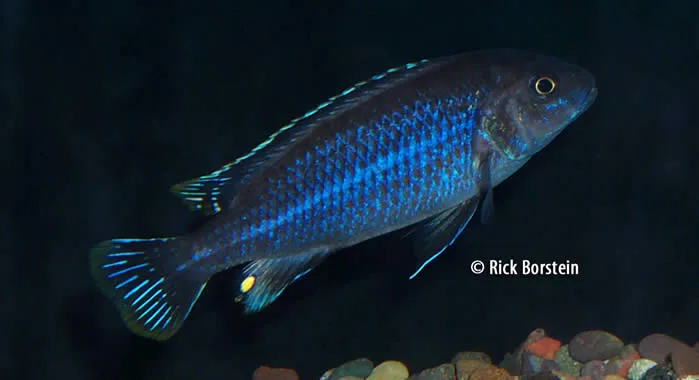
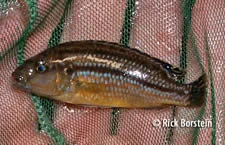
Melanochromis dialeptos is among the smallest species in its genus: FishBase records the maximum at 3 in SL, malawi.si gives males approximately 3 in and females approximately 3 in in total length, and the holotype itself measured only 3 in SL — the paratypes ranged from 1.5–3 in SL, indicating a fish that rarely surpasses 3 in under any conditions. Experienced keepers quote 3 in as typical captive adult size, consistent with 'about three inches' noted by GCCA fish-of-the-month (Borstein 2011). The body is elongate and moderately compressed, with a blunt, rounded snout and symmetrical (isognathous) jaws — standard mbuna architecture. Outer row teeth are distinctly bicuspid with symmetrical cusps; the lower pharyngeal bone is triangular. Fin formula: dorsal 18 spines (mode, range 18–19), 8 soft rays (mode, range 7–8); anal 7 soft rays invariably; pectoral 13 rays (mode); 30–32 lateral-line scales; 4 cheek scales. Coloration follows the reversed sex-based dichromatism that defines Melanochromis. Adult males carry a dark, near-black ground colour traversed by two thin, pale stripes — a mid-lateral and a dorso-lateral — whose edges are distinctly narrow and jagged (an important diagnostic feature relative to Melanochromis auratus, which has broader, smoother stripes). The dorsal fin is white with a black submarginal band and yellow-tipped lappets; the caudal fin is yellow with black vermiculations dispersed throughout both upper and lower lobes. This full-caudal black marking is the key colour character separating dialeptos from the closely related Melanochromis auratus, in which black markings in the caudal are restricted to the dorsal portion. Females are warm yellow to orange-gold with three or four thin, jagged-edged white horizontal stripes on the lower flank and a pale belly; the caudal fin bears the same dispersed black vermiculations as the male — again distinguishing it from female auratus. Juveniles share the female livery from birth. Sexual dimorphism is moderate in size (males marginally larger) and strong in colour; intermediate colour states occur as males darken with maturity and dominance.
Habitat
The species is endemic to Lake Malawi and confined to a roughly 37 mi strip of the lake's eastern shore, running from Makanjila Point (Malawi) in the north down to the Lumessi River (Mozambique) in the south — a range spanning Malawian and Mozambican territorial waters (IUCN 2018). Within this corridor, Melanochromis dialeptos inhabits both purely rocky substrates and the sediment-free intermediate zone where rock meets sand, generally from 7–66 ft depth; the IUCN assessment notes that most individuals occur in the upper 16 ft of habitat. Named location-variants documented on malawi.si reflect this geographic range: 'Masinje' (the type locality, northern part of the range), 'Narungu', 'Gome Rock', and 'Border' (near the Malawian-Mozambican border at the southern end). The lake water surrounding all these localities is characteristically alkaline and well-buffered — pH typically 7.7–8.6, conductivity moderate to high, surface-layer temperatures 75–82 °F year-round, and well-oxygenated near-shore water driven by wave action on exposed rocky points. The intermediate zone habitat — sheltered ledges, crack systems, and sandy pockets among boulders — provides the foraging surfaces and refuges that structure daily life for this mbuna. The species is not known from the northern or western shores of the lake. For context on the wider lake environment this fish inhabits, see the Lake Malawi water body pages.
Feeding
Melanochromis dialeptos is primarily an aufwuchs grazer: it feeds on the algal–diatom biofilm that coats sunlit rocks throughout the intermediate zone. FishBase describes the biology curtly as 'Inhabits rocky habitats and feeds primarily on loose attached algae,' and malawi.si confirms it as 'primarily herbivorous, feeding mainly on algae grazed from rock surfaces.' The IUCN assessment (Konings 2018) adds an interesting observation: some individuals have been observed preying on larvae of the catfish Bagrus meridionalis — a case of opportunistic carnivory documented in the wild, rare in mbuna. FishBase assigns a trophic level of 2.0 (the baseline herbivore value), consistent with an algal specialist. In the aquarium, the species accepts a wide range of prepared foods but does best on a diet dominated by spirulina-based flakes or pellets, with animal protein kept modest; over-feeding protein-rich foods to an mbuna of this guild risks the metabolic disorder keepers call 'Malawi bloat' (GCCA, Borstein 2011). The bicuspid teeth and moderately long lower jaw are suited to cropping the biofilm rather than digging substrate, and the species has not been described as a sand-sifter.
Mating
Melanochromis dialeptos is organized as a polygamous, female-initiated harem — the default social structure of mbuna — but with a distinctive quirk documented in the IUCN account: males in breeding colour do not hold or defend classical feeding territories. Instead, coloured males range the habitat and court females they encounter, rather than waiting for females to visit a defined spot. Females occur singly or in loose groups of up to five individuals. Males compete intensely with other males and with any similarly patterned fish; in captivity, intraspecific aggression is extreme in both directions — not just male-on-male or male-on-female, but female-on-female as well. GCCA keeper Rick Borstein describes two fresh-from-the-bag females immediately spinning mouth-to-tail at high speed for over five minutes — the rotary escalation behaviour that signals peak mbuna aggression — before one conceded. Coloration intensifies dramatically at the approach of spawning: both male and female flush with more saturated hues as they clean the spawning site together on the sand alongside a rock.
Breeding
Melanochromis dialeptos is a maternal mouthbrooder in the standard haplochromine mode. Spawning takes place on a clean sand patch alongside a boulder: the female deposits eggs one or a few at a time and immediately collects them in her buccal cavity; she then assumes the 'T' position and mouths the male's egg-spot ocelli on his anal fin, drawing in milt and fertilizing the clutch inside her mouth. Documented clutch sizes are small — around 15 eggs or fewer (GCCA; consistent with the species' diminutive size and the typical relationship between body size and clutch size in mbuna). The female broods without feeding for approximately 20–22 days, after which fry are released free-swimming at 0.5 in, already sporting the female coloration with stripes visible. The IUCN account notes that 'spawning takes place on the sand, alongside a rock and mouth-brooding females hide between rocks' — providing context for why females are rarely observed with swollen buccal pouches in the wild. Released fry are precociously aggressive: GCCA keepers report the same intraspecific spinning displays appearing at only three weeks of age. Males take no part in parental care beyond fertilization.
In the aquarium
Melanochromis dialeptos is rarely encountered in the hobby outside of specialist mbuna collections; it appears occasionally in dedicated African cichlid shops and at society auctions, usually under the name 'Dwarf Auratus' or its full scientific name. Its small adult size — males reach roughly 3 in SL, females a centimetre less — makes it superficially manageable, but its aggression is disproportionate to its stature, and it is not recommended for community aquarists who are new to mbuna.
A 150-litre (roughly 47 in) tank is a workable minimum for a single breeding group, and a 200-litre or larger tank significantly eases management of aggression. The substrate should be fine sand, as in the natural habitat — cichlid-grade sand or aragonite serves double duty by buffering pH upward and providing a spawning surface. Rockwork is not optional: Melanochromis dialeptos is a rock-dwelling mbuna and requires dense stacking of flat stones or slate into interconnecting caves and crevices that break lines of sight. A tank half-filled with rock piles, leaving open sand in the foreground, closely mirrors the intermediate zone the fish inhabits along the Malawian eastern shore. Alkaline, well-buffered water is non-negotiable: pH should be held between 7.8 and 8.5 (the species' wild range is 7.7–8.6), temperature 75–82 °F, and nitrates kept low via regular partial changes. Lake Malawi is a well-buffered lake, and conductivity should reflect that; crushed coral or aragonite substrate and a small amount of Rift Lake salt mix will maintain parameters in a standard aquarium without hard tap water.
Melanochromis dialeptos is not a safe community fish with other mbuna. The same intense intraspecific aggression documented by GCCA keepers — including rotary spinning displays between females within minutes of introduction — extends to conspecifics and heterospecifics alike. The recommended social structure is one male with at least three to four females; a single pair is a recipe for the female being harassed to exhaustion. If mixed with other mbuna at all, tankmates should be of similar size and aggression and should avoid Melanochromis species, which risk hybridization and will be targeted preferentially. Keeping multiple males of this species in anything but a very large, heavily broken-up tank results in persistent fighting. Docile mid-water fish or catfish that occupy the bottom are broadly incompatible — a Synodontis catfish occupying the same cave system will be chased relentlessly.
Diet in captivity should emphasize plant matter: spirulina flakes or pellets, blanched spinach or courgette, and algae-based prepared foods form the bulk of what this aufwuchs grazer needs. Animal protein — bloodworm, brine shrimp, krill-based foods — should be given sparingly if at all. This is not mere preference: Melanochromis dialeptos, like all aufwuchs-grazing mbuna, is susceptible to the condition hobbyists call Malawi bloat, a metabolic and possibly bacterial disorder triggered by excess dietary protein or fat. Fish that bloat show abdominal swelling, loss of appetite, and rapid deterioration; it is difficult to reverse once established. A predominantly plant-based diet, good water quality, and avoidance of overcrowding are the best preventive measures. The species is generally hardy once settled, accepts most prepared staple foods, and does not require live food to breed.
Breeding in captivity follows the standard maternal mouthbrooding pattern described in the Breeding section. A female holding a clutch of roughly 15 eggs should ideally be left undisturbed in the main tank among the rocks, or moved carefully to a quiet, well-established holding tank if aggression from other fish is a concern. She will brood without feeding for approximately three weeks before releasing free-swimming fry. The fry are immediately aggressive and should be reared in a separate vessel with fine food (crushed flake, newly hatched brine shrimp) and dense cover. Difficulty is rated moderate for experienced mbuna keepers and challenging for beginners — the aggression management and dietary discipline required place it a step above the easiest Malawi cichlids.
Conservation
The IUCN Red List assesses Melanochromis dialeptos as Least Concern in the 2018 evaluation by Ad Konings (reviewed by Jos Snoeks), citing 'ample habitat' along a ~37 mi shoreline with no major known threats and a stable population trend (estimated area of occupancy 40 mi²). This is a notable upgrade from the Vulnerable listing it carried in 2006, which reflected limited data rather than documented decline — the 2018 reassessment confirmed persistence across the full range. Two potential threats are nonetheless flagged: collection for the ornamental aquarium trade (where the species is sometimes exported under its scientific name or labelled 'Dwarf Auratus'), and sedimentation from agricultural and forestry runoff in the catchment. Neither is judged to affect more than a minority of the population. The species is not listed under CITES. For a fish confined to a single narrow coastal strip of one lake, the health of that inshore rocky habitat is existential. Lake Malawi as a whole faces growing anthropogenic pressure — shoreline cultivation driving soil erosion and turbid runoff that smothers rock biofilm, nutrient loading from lakeshore settlements, accelerating thermal stratification from climate warming that shrinks the productive oxygenated layer, and the commercial and artisanal fishery (Chavula et al. 2023; Genner & Turner 2005). Melanochromis dialeptos's range in the intermediate zone at 7–66 ft makes it acutely sensitive to both sedimentation (which buries the algal crust it grazes) and to shoreline development that degrades near-shore habitat. The lake-level pressures are real and accelerating even while this species' own status remains secure for now.