Taxonomy & naming
Mylochromis melanonotus belongs to Mylochromis, a large genus of Lake Malawi haplochromines whose name derives from the Greek mylē (a mill or millstone) combined with chromis, a reference to the molar-like, crushing pharyngeal teeth that many of the genus's species use to process hard-shelled prey such as snails. Not every Mylochromis species is a dedicated mollusc-crusher, however, and the genus spans a range of feeding styles across roughly two dozen or more described species distributed around the lake's sandy and intermediate habitats. The specific epithet melanonotus combines the Greek melas (black) and notos (back), describing a dark dorsal stripe or saddle marking that distinguishes this species from its many close relatives. Eschmeyer's Catalog of Fishes is the standing authority for the precise describing author, year and original citation for this species; those details are not asserted with confidence here.
Morphology
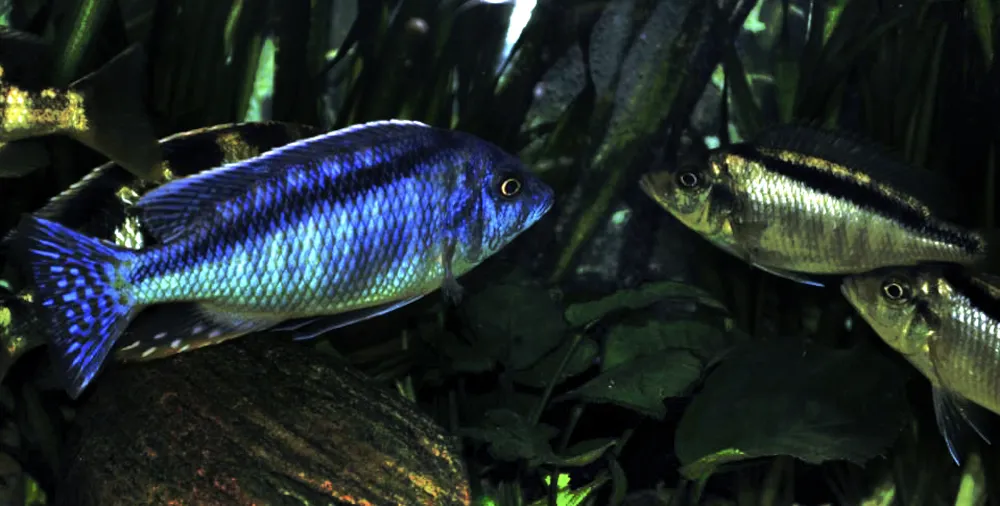
Mylochromis melanonotus has the moderately elongate, laterally compressed body typical of its genus, built for a life spent over sand and mixed rock-sand habitat rather than clinging to solid rock. As its epithet indicates, the fish is expected to carry a dark stripe or saddle running along the back — a marking pattern shared by several other Mylochromis species and one of the field characters used to separate them. Ground colour in the genus tends toward silvery to pale tones on the flanks, with breeding males typically intensifying in colour and finnage during courtship, a transformation expected here as in most Malawi haplochromines, though this species' full colour pattern is not confidently documented in the accessible literature. Size in Mylochromis varies considerably by species, from modest sand-dwellers to some of the larger haplochromines in the lake.
Habitat
Mylochromis melanonotus is endemic to Lake Malawi and has been documented from Chimwalani Reef, Londo Bay and Luwala Reef, a spread from the far northern lake down through the central shoreline consistent with a genuinely wide-ranging species rather than a narrow local endemic. Like most of its genus it is expected to favour open sand and the transitional zones where scattered rock meets sand, rather than solid rock faces or deep offshore water. The surrounding water is the typical alkaline, well-buffered Lake Malawi column: warm tropical temperatures through the mid-20s Celsius and a pH comfortably on the alkaline side of neutral, the chemical envelope every Malawi cichlid depends on.
Feeding
Mylochromis as a genus spans a range of feeding strategies, from durophagous mollusc-crushers using molariform pharyngeal teeth to more generalist invertivores and, in some species, small-fish predators, and the specific dietary specialisation of M. melanonotus is not confidently documented in the accessible literature. What can be said with reasonable confidence is that, like the great majority of its relatives, it forages over sand and mixed substrate rather than grazing algae from open rock, working the bottom for buried and surface-dwelling invertebrates. This substrate-associated foraging style places it among the diverse guild of sand and intermediate-zone haplochromines that partition Lake Malawi's soft-bottom habitats by subtle differences in feeding technique and prey preference.
Mating
Mylochromis melanonotus is presumed to follow the polygynous, non-pair-bonding courtship pattern common to nearly all Lake Malawi haplochromines. A breeding male is expected to establish and defend a spawning territory on or near the sand, potentially near cover from scattered rock given the mixed habitat the species is documented from, and display his nuptial colours to females that move through the area in search of a spawning partner. Females are not territorial and assess and select among displaying males rather than forming a lasting pair. No species-specific observations of courtship in the wild are documented for this fish in the accessible literature, so this account is drawn from the general Lake Malawi haplochromine pattern.
Breeding
Mylochromis melanonotus is presumed to be a maternal mouthbrooder, as is essentially the entire Lake Malawi haplochromine radiation. Following courtship and spawning, the female is expected to take the fertilised eggs into her mouth and brood them there through hatching and early larval development, releasing free-swimming fry once they can feed and evade predators independently, with no further parental role for the male. Clutch size, brooding duration and fry survival have not been documented specifically for this species; given the size range typical of Mylochromis, a clutch on the order of several dozen eggs would be a reasonable expectation by analogy with similarly sized congeners rather than a measured figure.
In the aquarium
Mylochromis melanonotus is uncommon in the aquarium trade and known mainly through collection-locality records rather than as an established hobby fish. A keeper who obtained specimens should provide a tank with a substantial sand substrate and open swimming space complemented by scattered rock, echoing the mixed sand-and-rock habitat the species is documented from. Water should match Lake Malawi's chemistry — warm, alkaline and well-buffered, roughly 75–82 °F with pH on the alkaline side of neutral — and diet should include a mix of quality cichlid pellets and meaty or sinking foods such as frozen bloodworm or Mysis shrimp to suit a substrate-foraging haplochromine. Detailed, species-specific husbandry experience for this fish is not well documented, so this account leans on general practice for sand- and intermediate-zone Mylochromis.
Conservation
Mylochromis melanonotus has not been assessed by the IUCN Red List in any record confidently known here, and no status should be assumed for it. Its apparent scarcity in collections and the trade likely reflects the naturally lower visibility typical of a sand- and transition-zone haplochromine rather than a documented decline. As with other Lake Malawi endemics, it is exposed to the general pressures affecting the lake's sandy and near-shore habitats: sedimentation and nutrient loading from catchment deforestation, artisanal fishing pressure across the food web, and a warming surface layer that is measurably altering the lake's stratification and productivity. Its precise range, abundance and conservation status remain to be formally established.