Taxonomy & naming
The species was formally described by Warren E. Burgess in 1979 as Haplochromis electra, based on material collected near Likoma Island (a Malawian exclave in Mozambican waters). The original account appeared in Tropical Fish Hobbyist (volume 27, number 8, pages 91–94) under the title "Studies on the family Cichlidae: 9" — part of a running series in which Burgess described several new Malawian haplochromines from aquarium-trade specimens. The name Haplochromis was at the time applied broadly to the Lake Malawi species flock, and the fish also circulated in the trade as "Haplochromis Jahni" (an invalid name) and "Deep Water Hap," a common name that stuck even after the taxonomy was reorganised.
In 1989 D.H. Eccles and Ethelwynn Trewavas published their landmark revision Malawian Cichlid Fishes: The Classification of Some Haplochromine Genera (Lake Fish Movies, Herten), which dismantled the old catch-all Haplochromis sensu lato and erected a series of more circumscribed genera for the Malawian flock. The electra group was placed in the new genus Placidochromis — a name combining the Latin placidus (calm or tranquil in appearance) with the Greek chromis (a perch-like fish, the standard cichlid suffix). The species has also passed through the genus Cyrtocara in some intermediate arrangements, but Placidochromis electra (Burgess, 1979) is the current valid combination, recognised by FishBase, the Catalog of Fishes (Eschmeyer), GBIF, and the IUCN Red List.
The Eccles & Trewavas genus contains a cluster of sand-associated, deep-water-capable haplochromines. Its most closely related member in the wild appears to be Placidochromis phenochilus, a similarly-built blue cichlid of the lake's northwest shoreline that shares the same follower feeding strategy; Konings noted the resemblance as early as the Cichlids Yearbook series and suggested that phenochilus's inclusion in Placidochromis was based on its close structural and ecological similarity to electra. Several undescribed follower-type cichlids (traded as Pseudotropheus sp. 'electra blue', Pseudotropheus sp. 'electra blackfin', Pseudotropheus sp. 'electra mozambique') occupy equivalent ecological niches at different localities around the lake and are tracked on malawi.si, but they are distinct from the described species.
Morphology
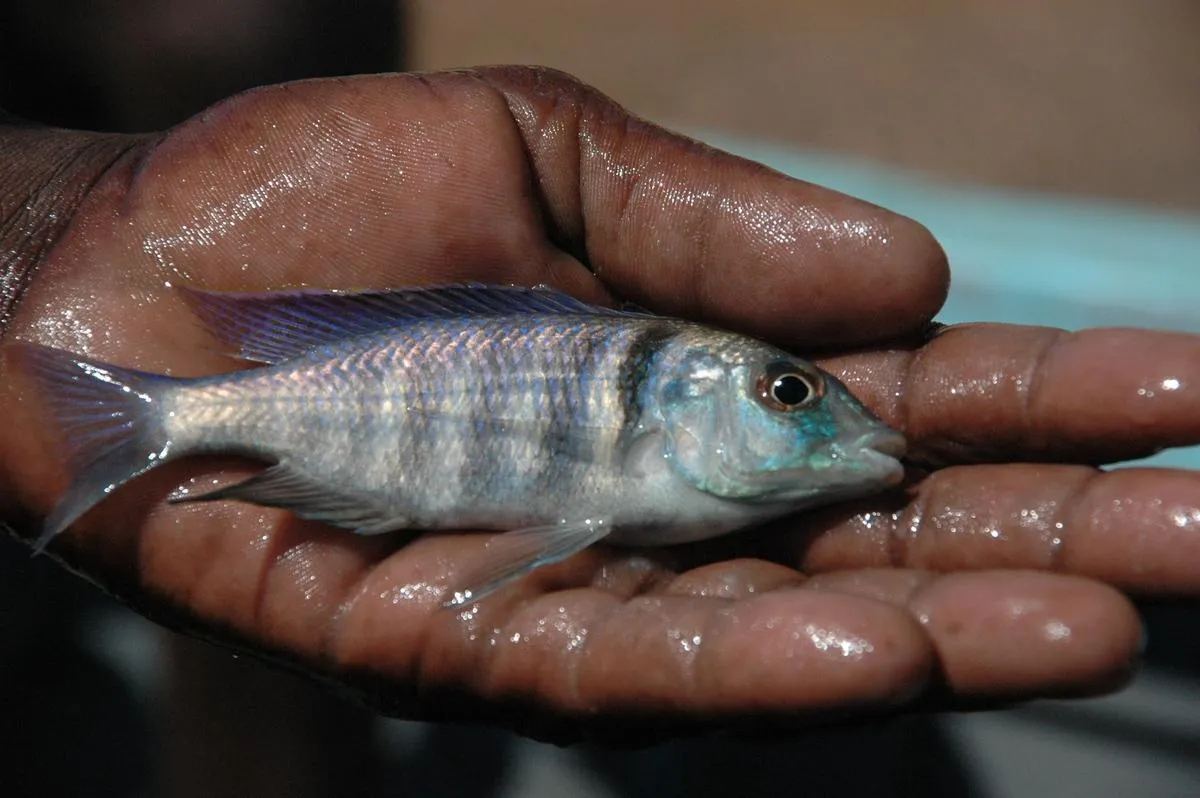
Placidochromis electra is a robust, moderately deep-bodied cichlid with a slightly pointed snout and the large eye common to haplochromines that forage over open sand. The original description by Burgess diagnosed the species partly on its colour pattern: five to seven vertical bars cross the body, with the first bar (or first two bars) notably darker and broader than the remainder; the posterior bars are faint in non-breeding fish and may be barely visible. A diagnostic black bar runs through the eye and expands into a prominent dark blotch covering the cheek, gill cover, throat, and chin — present in both sexes in and out of breeding condition and the most reliable field mark distinguishing electra from similar sand followers.
Adult males in breeding dress turn deep blue to very dark blue-black over the entire body, sometimes with iridescent highlights on individual scales; the dorsal fin carries a narrow white to yellowish margin that separates electra from the otherwise similar Pseudotropheus sp. 'phenochilus gisseli', whose dorsal fin lacks that border. Non-breeding males revert to a muted version of the same pattern. Females and juveniles are silver to sand-grey with faint barring, looking unremarkable against the lake floor until the male's colours make clear that the two belong together.
Size varies substantially with source and sex. FishBase cites 4.5 in SL for preserved museum specimens (Maréchal 1991), but wild males reach approximately 6 in total length and females around 4.5 in according to field data compiled on malawi.si; the IUCN assessment gives a maximum of 6.5 in; and Seriously Fish gives males up to 8 in TL in aquarium condition. The published divergence is real: museum specimens of haplochromines are typically smaller than fully-grown wild fish, and well-fed captive males genuinely grow beyond wild norms. The practical expectation for a keeper is a male of 6–7 in TL in good condition — a substantial fish. Sexual dimorphism is marked: males are noticeably larger, deepen in colour dramatically on maturation, and develop the full dark-cheek and egg-spot markings used in spawning; females remain silver-sand and are several centimetres shorter.
Habitat
Placidochromis electra is a Lake Malawi endemic, confined to the eastern arm of the lake. The IUCN range description runs from Chiwindi in Mozambique north to Makanjila Point in Malawi, including Likoma Island but not the nearby Chizumulu Island. Seriously Fish adds Mara Point and the stretch from Lumesse to the Malawi border and south to Ntekete; malawi.si records populations at Chiofu, Fort Maguire, Gome, Liwani, Londo, Maingano Island, Malopa, and Likoma Island itself. The IUCN notes it as common at most sites within this range and the population trend as stable, giving some confidence that the eastern-shore distribution is well established rather than a collection artifact. Konings singled out this restriction as unusual within the follower guild: the other blue sand-dwellers — Cyrtocara moorii, Protomelas annectens and Otopharynx selenurus — range lake-wide, while electra and its close relative Placidochromis phenochilus are each confined to a single shoreline (electra to the east, phenochilus to the northwest).
Within those sites the species is found over open sand — flat sandy plains, sometimes well away from any rock, and occasionally in the mixed habitat known locally as the "intermediate zone" where sand grades into rubble. FishBase records a depth to 49 ft; the IUCN assessment describes it as most common at 23 ft; and malawi.si, drawing on direct observation, gives a range from a few metres down to 131–164 ft, noting it can be encountered from the shallows to substantial depth. Konings in the Cichlids Yearbook placed Placidochromis electra and Placidochromis phenochilus as species usually observed below 49 ft — deeper than the followers Cyrtocara moorii and Otopharynx selenurus, which are rarely found below 33 ft. The depth range reflects a genuine distribution across the lake's sandy shelves rather than a preference for a narrow stratum: the fish follows its host wherever it digs.
Lake Malawi's open water is warm, alkaline, and well-buffered throughout this depth band. The chemistry is well constrained: FishBase records pH 8.0 and a hardness of 9–19 dH for this species, consistent with the whole-lake chemistry documented by academic surveys. Temperature in the upper 49 ft varies seasonally between roughly 75 °F and 82 °F, cooling slightly in the deep sand habitat during the cold, windy austral winter.
Feeding
The feeding ecology of Placidochromis electra is genuinely unusual, and it was this behaviour that likely gave Konings the clearest evidence for grouping it with a handful of other morphologically disparate cichlids into an informal "follower guild." The guild — which in the Yearbook article Konings listed as Cyrtocara moorii, Protomelas annectens, Otopharynx selenurus, Placidochromis electra, and Placidochromis phenochilus — share a single tactic: rather than digging or blowing sand themselves, they attach themselves to a large, industrious sand-sifter and exploit the disturbance it creates.
The primary host for Placidochromis electra in Konings's observations was Taeniolethrinops praeorbitalis (= Lethrinops praeorbitalis in the IUCN assessment), one of the largest sand-dwelling cichlids in the lake. Taeniolethrinops digs continuously, processing mouthfuls of sand through its gill rakers to extract buried invertebrates; the excavation throws up a cloud of debris and — more importantly for electra — exposes burrowing invertebrates that were previously hidden below the surface. Although it might appear that electra is simply filtering the same cloud of suspended material as Taeniolethrinops, Konings observed that the follower is more precisely interested in the ploughed sand: invertebrates dislodged from depth try immediately to reburrow, and electra is positioned to intercept them before they disappear again. FishBase's trophic level estimate of 2.8 is consistent with a diet centred on benthic invertebrates (insect larvae, small crustaceans, worms) rather than plankton or algae, and the IUCN habitat note confirms that the species "feeds on invertebrates and algae from the debris that is stirred up by larger digging cichlids."
This commensalism explains one of the more puzzling features of the follower guild: why are these cichlids so conspicuously coloured? Konings proposed that vivid male coloration in followers functions as a territorial signal — to other followers, not to predators. Because any given Taeniolethrinops may stir up only enough invertebrates for a single follower, there is competitive pressure for an electra to deter other electras (and other followers) from joining its host. Taking on intense breeding-dress blue in the vicinity of an active digger would then serve the same purpose as a bird defending a food patch.
Mating
Outside the spawning season Placidochromis electra is one of the more peaceable large haplochromines in the lake, moving across open sand in loose groups without establishing the hard rocky territories typical of mbuna. Konings's Yearbook account noted that fish of this guild are generally found solitarily or in very small groups rather than the schools that characterise most sand-dwelling cichlids — a social organisation consistent with the follower strategy, since a single territorial male attached to a digging host has more value than a school that would dilute the food benefit.
When males come into breeding condition they select a patch of open sand and excavate a shallow spawning pit, which they defend with increasing intensity against rival males. Konings noted in his Yearbook article that none of the blue sand-dwellers (apart from the better-observed Cyrtocara moorii and Protomelas annectens) had at that point been recorded spawning in the wild, but courtship observations were consistent with an open-sand spawning site: the male displays over the pit in full breeding colour and attempts to attract passing females. The male's anal fin bears egg-shaped spots — the classic haplochromine "egg dummies" — which are prominently displayed during the courtship shimmy. In the aquarium, males are noticeably less aggressive than the average Malawi haplochromine during the mating period; several keepers on cichlid-forum.com have described them as "one of the more passive haps," and they are generally considered poor companions for mbuna communities in confined tanks. Multiple keepers recommend keeping several females per male to distribute male attention.
Breeding
Placidochromis electra is a maternal mouthbrooder, as is the overwhelming majority of the Malawi haplochromine flock. Spawning in the aquarium has been recorded repeatedly since the species entered the hobby in the late 1970s — Seigars and Berardo published a breeding account in TFH in April 1979, the same year as the description, demonstrating how quickly the fish became established. Konings noted in the Cichlids Yearbook that aquarium spawnings confirmed the eggs are fertilised inside the female's mouth (the female picking up the eggs and then mouthing the male's egg-spot-bearing anal fin to receive sperm), which is the standard advanced-maternal-mouthbrooder sequence common across most Malawi haplochromines.
FishBase gives a clutch size of approximately 50 eggs; a spawn recorded from wild-caught fish on malawi.si yielded 70 eggs. The female carries the brood for roughly three weeks before releasing free-swimming fry. She does not feed during this period and can be recognised by her distinctly distended lower jaw. The fry are large enough on release to accept newly hatched brine shrimp nauplii immediately, and growth from fry to juvenile is relatively fast. Adult growth, however, is slow: multiple keepers on cichlid-forum.com have remarked on the species' leisurely pace toward full size, with one experienced keeper noting a large male reaching over 7 inches only after years in the tank. This slow maturation means juveniles purchased for breeding projects should be grown on in a species or compatible-hap-only tank rather than rushed.
For breeding in captivity, Seriously Fish recommends starting with a group of six to eight juveniles and growing them on together, selecting the best ratio of females to males as they colour up. The male excavates a pit in a sandy substrate area, and the temperature should be maintained at 77–80 °F (77–81 °F) with pH 8.0–8.5. If a female is stressed after mouthbrooding begins — by netting, disturbance, or persistent male harassment — she may spit the brood prematurely; experienced breeders sometimes strip the young at the two-week stage and raise them artificially to maximise survival.
In the aquarium
Placidochromis electra is one of the more rewarding Lake Malawi haplochromines for the experienced cichlid keeper. It is significantly more peaceable than most mbuna and calmer than many of the more assertive haps, and males in full blue-black breeding colour are genuinely striking. That reputation is conditional, however: the species grows large — expect a male of 6–7 in TL at full development — and requires correspondingly generous quarters. A minimum of 75 US gallons is needed for a single male with two or three females; 105 US gal or more is preferable if other species share the tank. Standard Lake Malawi chemistry applies throughout: pH 7.8–8.6, total hardness in the range of 10–19 dH, and temperature 75–82 °F. These parameters are straightforward to achieve with hard municipal tap water or by using a commercial rift-lake salt blend in soft-water areas; a stable, well-buffered pH matters more than hitting a precise value.
The tank layout should prioritise open sand over decorative rock. In the wild the species moves across open sandy plains and follows sand-digging cichlids rather than holding a rocky territory, and it is visibly more settled when it has a broad sandy area to patrol. A fine or medium-grade sand substrate of at least 2–3 in depth is ideal — males will excavate a spawning pit in it without prompting. Rock structures or slate formations along the sides and back provide visual barriers that reduce line-of-sight aggression between males in a mixed tank, but the centre of the floor should remain open. Strong mechanical filtration is important partly for the usual water-quality reasons and partly because a sand-digging male will periodically cloud the water; a canister filter or sump rated above the tank volume is standard for Malawi setups.
For tankmates, Placidochromis electra fits best in a mixed Malawi community of other peaceful haplochromines and Aulonocara peacocks of comparable size. The combination works well because these fish share water chemistry requirements and occupy similar niches without serious competition. What the species does not tolerate well is aggressive mbuna: rock-dwelling Pseudotropheus, Melanochromis, and related genera occupy the same tank volume differently and can harass or bully electra males to the point of chronic stress or hiding. Multiple males of the same species can also be problematic in smaller tanks; a single dominant male with a group of females is the standard recommendation, or two males only if the tank is large enough to hold genuine territories. Keeping one male per tank unless the footprint exceeds 71 in is a widely repeated practical rule among keepers on cichlid-forum.com.
Breeding is straightforward once the group is conditioned and the male has coloured up fully. He will excavate a pit in an open sandy area and court passing females with a shimmy display; spawning follows the typical haplochromine sequence, with the female collecting eggs and then mouthing the male's egg-spot-bearing anal fin to receive sperm. The female carries the brood for approximately three weeks, does not feed during this period, and releases free-swimming fry large enough to take brine shrimp nauplii immediately. The main management challenge is protecting the mouthbrooding female from persistent harassment: providing cover and, where possible, a separate grow-out tank to which she can be moved at the two-week mark both reduce premature spitting. Growth from fry to sale size is reasonable, but to full adult size it is slow — a male will take years to reach his largest and most vivid condition, which is worth knowing before purchasing juveniles for a breeding project.
The most common husbandry mistake with Placidochromis electra, as with Lake Malawi cichlids generally, is diet-related. In the wild the species eats benthic invertebrates — insect larvae, small crustaceans, and worms — and not plant matter in any quantity. Feeding a high-protein, protein-rich diet or live foods in excess can trigger the syndrome known informally as Malawi bloat: a combination of internal bacterial or protozoal infection and digestive disruption that presents as abdominal swelling, loss of appetite, and rapid decline. The established preventative approach is a varied but predominantly spirulina- and vegetable-protein-based staple diet supplemented with occasional frozen Mysis or small invertebrates, avoiding beef heart and other fatty mammalian proteins entirely. Maintaining good water quality and avoiding overcrowding are the other two levers most keepers point to; Malawi bloat incidence drops substantially in well-managed tanks.
Conservation
Placidochromis electra was assessed by the IUCN Red List as Least Concern (LC) in June 2018 by Ad Konings and J. Kazembe (reviewed by Jos Snoeks), with the justification that the species is widespread throughout much of Lake Malawi's eastern arm, faces no known major widespread threats, and maintains a stable population trend at most sites within its range. Identified pressures include collection for the ornamental trade — it has been exported since at least the late 1970s and remains a standard hap in the trade under the names "Deep Water Hap" and occasionally still "Haplochromis Jahni" — and incidental capture by beach seines used by subsistence fishermen. Neither is currently assessed as a population-level concern.
That reassurance has to be read against the broader state of the lake. Chavula and colleagues (2023, Journal of Great Lakes Research) provide the most recent basin-level synthesis and document mounting cumulative pressures: overexploitation of commercial stocks (the chambo Oreochromis collapse is the most dramatic example), sediment and nutrient loading from a heavily deforested watershed, and warming. Vollmer et al. (2005, Limnology and Oceanography) measured roughly a 33 °F rise in Lake Malawi's deep water driven by reduced cold-season convective mixing — a trend that reduces oxygen renewal and productivity at depth and is directly relevant to a sand-flat species that occupies 23–164 ft of water column. For Placidochromis electra specifically, the eastern-shore distribution through both Malawian and Mozambican national waters means it has no single protected area providing blanket cover.
The fish's population resilience — high, per FishBase modelling, with a doubling time under 15 months — reflects the advantages of early maturation and a 50–70 egg clutch that produces large, survivable fry. A Least Concern haplochromine in a lake under mounting pressure is not the same as a species with nothing to watch, but on current evidence Placidochromis electra is among the more durable members of the Malawi sand-dweller community.