Taxonomy & naming
Placidochromis sp. "Phenochilus Tanzania" carries no describing author, no publication date, and no entry under a validated name in Eschmeyer's Catalog of Fishes; it is an informal trade name. It follows the standard convention for undescribed cichlids allied to a known species: the genus, a reference to the closely related described species Placidochromis phenochilus (Trewavas, 1935), and a locality qualifier — here "Tanzania" — distinguishing this northern population from P. phenochilus forms recorded elsewhere in the lake. Malawi cichlid specialists recognise several such regional phenochilus-type trade forms across the lake, treating them as distinct entities pending genetic or morphological confirmation rather than lumping them automatically with the nominal species. This particular Tanzanian form is documented with a photograph in Ad Konings' book Enjoying Cichlids, which is evidence of its recognition in the specialist literature even without a formal description.
Morphology
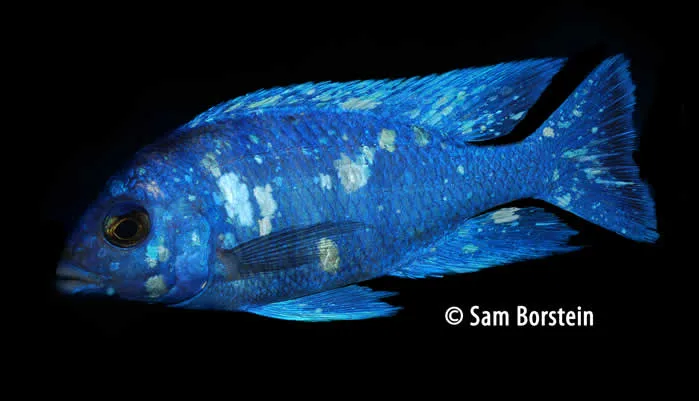
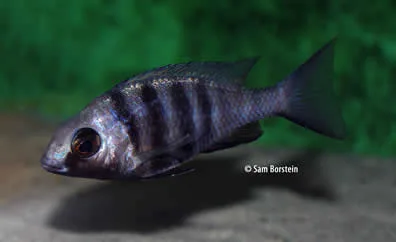
Placidochromis phenochilus and its regional relatives are known for notably thick, fleshy lips — the feature behind the species name — set on a moderately elongate, deep-bodied Placidochromis frame. Breeding males typically show a striking blue body colour. Detailed morphometric data specific to the Tanzanian population have not been published, so the extent to which its lip development and colour intensity match or differ from the nominal P. phenochilus is not established. Genus-typical size for phenochilus-type Placidochromis runs larger than most mbuna, to roughly 6.5–8 in total length, with males somewhat larger than females. Sexual dichromatism is expected to be pronounced, with females duller, silvery, and lacking the thick, showy lips developed by mature males.
Habitat
The form is recorded from three points along the northern Tanzanian shore of Lake Malawi — Lupingu, Makonde, and Ngwasi. Placidochromis phenochilus and its relatives are characteristically deep-water fish, associated with sand and rubble zones well below the depths typically explored by recreational diving, generally in the range of 66–164 ft. The surrounding water follows the general Lake Malawi profile — warm, alkaline, and well-buffered — though deep-water habitat of this kind tends to run cooler, darker, and more thermally stable than the sunlit shallows. Because these depths sit largely beyond the reach of recreational SCUBA, most records of phenochilus-type Placidochromis, in Tanzania as elsewhere in the lake, come from targeted deep-diving expeditions or occasional trawl catches rather than routine survey work, which likely means the true extent of this form's range along the northern Tanzanian shore is understated by the three localities recorded so far.
Feeding
Placidochromis phenochilus and its relatives are understood to be benthic invertivores, using their thick, sensitive lips to probe sand and rubble for buried prey — likely insect larvae, molluscs, and other small invertebrates — in a manner broadly comparable to the sand-probing feeding style seen in some other deep-water Malawi cichlids. The thickened lip tissue is thought to function much like a specialised sensory pad, letting the fish detect and extract prey items from within the substrate without needing to take large mouthfuls of sand the way sand-sifting Lethrinops do. Placidochromis sp. "Phenochilus Tanzania" is presumed to feed similarly, given its close resemblance to the described species, though no dedicated feeding study specific to this population has been published, and the depths involved make direct field observation of feeding behaviour difficult.
Mating
Breeding behaviour has not been documented specifically for this Tanzanian form. By analogy with other phenochilus-type Placidochromis, males are expected to establish territories over sand or rubble at depth and display their blue breeding colour and thickened lips to attract passing females, following the general haplochromine courtship pattern built around egg-spot markings on the anal fin. Because the depths involved — often well beyond recreational diving range — make direct field observation difficult, most behavioural inference for this ecological group comes from analogy with better-studied, shallower Placidochromis species such as P. electra rather than from direct observation of phenochilus-type fish themselves. Detailed behavioural accounts remain scarce even for the formally described relative, let alone this undescribed Tanzanian population.
Breeding
As in all Lake Malawi haplochromines, reproduction is understood to be by maternal mouthbrooding: the female carries the fertilised eggs and subsequent fry in her mouth, without normal feeding, for several weeks until they are ready for independent release, with no further parental role for the male. Clutch size and brooding duration have not been documented for this specific form; genus-typical figures for larger Placidochromis species suggest a moderate-to-large clutch given the group's bigger adult body size. The scarcity of direct field data on reproduction in this ecological group is a direct consequence of its deep-water habitat: unlike shallow-water Placidochromis such as P. electra, which are readily observed and even bred in captivity, deep phenochilus-type populations are rarely kept or bred by hobbyists, leaving a much larger gap between what is assumed from genus-level biology and what has actually been confirmed for this specific Tanzanian form.
In the aquarium
Placidochromis sp. "Phenochilus Tanzania" is an uncommon fish in the trade, reflecting the depth from which it and its relatives are collected. Where kept, a tank should provide a soft sand substrate suited to a fish that naturally probes sediment, open swimming space, and only modest rockwork, since this is a sand- and depth-associated species rather than a cave-dweller. Water chemistry should follow the Lake Malawi standard — alkaline and well-buffered, pH roughly 7.7 to 8.6, temperature 75–82 °F. Given its larger adult size, a generously sized tank of 59 in or more is advisable. Diet should include a quality cichlid pellet supplemented with small live or frozen invertebrates such as bloodworm and mysis shrimp, and fatty foods should be limited given the general susceptibility of Malawi cichlids to digestive bloat.
Conservation
Placidochromis sp. "Phenochilus Tanzania" has not been evaluated by the IUCN and, as an undescribed form, has no Red List status of any kind. Deep-water Lake Malawi cichlids in general are less intensively surveyed than shallow rocky-shore species, since collection and observation both require deeper diving or trawling than the shallow rocky mbuna zones that dominate most fieldwork, and the true range and population status of this Tanzanian form beyond its three recorded localities are not established. Deep-water haplochromines of this kind are more likely to face pressure, if any, from commercial or subsistence fisheries operating over sand and rubble bottoms than from aquarium collection, which tends to concentrate on shallower, more accessible reefs. In the absence of a formal assessment, caution rather than either alarm or reassurance is the appropriate stance.