Taxonomy & naming
The species was described from material collected at Thumbi West Island in the southern section of Lake Malawi, on the Nankumba Peninsula archipelago — the same island that served as the base of operations for Hennie and Peter Davies, the first commercial exporters of Malawi cichlids to the United States. The valid name dates to Oliver, 1989, published in the compendium Malawian Cichlid Fishes: The Classification of Some Haplochromine Genera by Eccles and Trewavas (Lake Fish Movies, Herten, Germany, 1–334). The species had appeared in the hobby literature under the provisional name Cyrtocara milomo since Oliver first circulated descriptions in 1984, and that pre-description handle is now a synonym. The genus Placidochromis was simultaneously erected in the same 1989 Eccles and Trewavas volume: it currently contains around 40 described species, all endemic to Lake Malawi, and sits within tribe Haplochromini of the subfamily Pseudocrenilabrinae. Placidochromis milomo is one of only a handful of Placidochromis species with a conspicuous ecological specialisation; most congeners are visually unremarkable sand- or rubble-zone fish. The species is sometimes sold under the older labels 'Haplochromis Super VC 10', 'Haplochromis Labrosus' or 'Brown White Labrosus' — all pre-revision trade names that have stuck in some corners of the aquarium trade.
Morphology
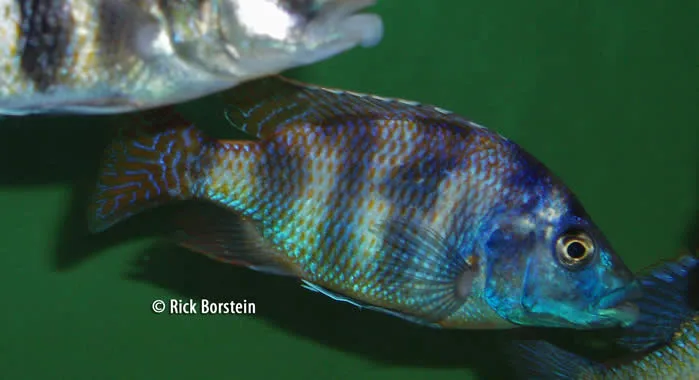
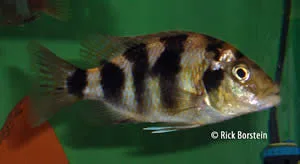
Placidochromis milomo is a deep-bodied, moderately elongate cichlid that reaches a maximum of 7.5 in standard length for males (FishBase, citing Maréchal 1991), corresponding to roughly 8 in total length per the IUCN assessment. The fish's most arresting feature is its lips: both upper and lower lips are hypertrophied into broad, fleshy lobes that give the head a blunt, almost cartoonish profile in wild-caught adults. The degree of hypertrophy is not fixed — it scales with the abrasiveness of the fish's feeding environment, so individuals from rougher, more turbulent shorelines carry larger lips than those from calmer bays. In aquarium-raised fish the lips typically fail to develop fully or recede to a slightly swollen state, since the fish is never called upon to seal its mouth against hard rock at depth. Beyond the lips, the coloration follows the broad pattern of the Malawi haplochromine flock: non-breeding individuals and females wear a silvery-tan base colour with a pattern of broad, irregular vertical bars on the flanks; dominant breeding males suppress that barring and develop a clean, bright blue-to-blue-silver body with darker fins, the intensity varying between location variants. Sexual dimorphism is present: breeding males are more intensely coloured and tend to grow slightly larger, and their dorsal, anal and pelvic fins develop elongated soft-ray extensions. Females and subdominant males look superficially alike.
Habitat
Within Lake Malawi, Placidochromis milomo is documented from Malawian waters at two main areas: Nkhata Bay in the northern section, and the southern part of the lake along the Nankumba Peninsula from Thumbi West Island through to Zambo. The IUCN assessment (Konings & Kazembe, 2018) describes the range as lake-wide, suggesting additional localities beyond the FishBase summary. Malawi.si records the variant known from Chinyamwezi Island, and the species has been photographed across a range of rocky localities by Ad Konings. The fish is strictly a rocky-shore specialist and is moderately common wherever suitable habitat occurs. It occupies depths from around 13 ft down to at least 115 ft, with many sightings in the 30–98 ft band, making it deeper on average than the mbuna assemblage that dominates the shallows. The substrate it prefers is unusual: not the clean, algae-rich boulders that mbuna scrape, but rocks that carry a thin, dusty layer of sediment — exactly the substrate where invertebrates are most likely to be buried in crevices. Water chemistry at these Malawi rocky sites is alkaline and well-buffered: pH typically 8.0–8.5 and temperature 73–79 °F in situ.
Feeding
Placidochromis milomo is classified as an insectivore in Konings (Enjoying Cichlids, 2nd ed.) and documented to feed on insect larvae and crustaceans (Fryer and Iles 1972; FishBase) as well as, occasionally, mbuna fry (IUCN assessment). The trophic level is estimated at 3.3 (FishBase), consistent with invertivore-predator status. The mechanism is what makes this species notable: its enlarged, fleshy lips function as a functional seal. The fish locates a crevice in the sediment-coated rock, presses its lips firmly around the opening, and creates suction — effectively vacuuming the enclosed space. A parallel technique is described for related thick-lipped species at Thumbi West Island (Konings, Exploring Lake Malawi: Thumbi West Island, CRC/Cichlid Press): the fleshy lips form a seal over the rock surface while the fish generates negative pressure, pulling prey items from within narrow gaps. This is trophically quite different from the mbuna strategy of rasping algal mats from rock faces or the sand-sifting geophagine strategy — Placidochromis milomo is specifically exploiting the invertebrate fauna sheltering beneath sediment in deep, low-turbulence rocky environments.
Mating
Like virtually all Lake Malawi haplochromines, Placidochromis milomo is polygynous and lek-like in its mating system. Breeding males establish and defend territories centred on a chosen spawning site — either a flat rock surface or a depression excavated in the substrate — and display with intensified coloration to attract passing females. Intraspecific aggression between males can be pronounced, and males will energetically exclude rival males from their territory when a potential spawning partner is nearby. Outside of breeding events the species is solitary and relatively peaceful with other species, rarely harassing tankmates of comparable or larger size. Females moving through the territory signal readiness by approaching the spawning site; the male's colour intensifies further during courtship. The species does not form permanent pair bonds.
Breeding
Placidochromis milomo is a maternal mouthbrooder, as is standard for the haplochromine flock of Lake Malawi. After a brief spawning sequence on the male's chosen site, the female collects the fertilised eggs in her mouth and enters a holding period of roughly three weeks, during which she does not feed. She can be identified by her distended buccal region. The fry are large for a cichlid when released — around 0.5 in — and can immediately accept brine shrimp nauplii and finely crushed flake. Clutch size has not been precisely documented in the wild for this species; published hobby accounts note that artificially stripping the female's brood at the two-week stage generally increases the number of fry successfully raised, a technique widely applied to Lake Malawi maternal mouthbrooders. Males do not participate in parental care once spawning is complete.
In the aquarium
Placidochromis milomo is a moderately popular Lake Malawi haplochromine in the specialist cichlid hobby, most often sold as 'Super VC-10' or 'VC-10 hap'. Adults reach 7–8 in total length, so a single male with a small group of females requires a tank of at least 80 US gal (roughly 59 in long); a 400-litre or larger tank is more appropriate if other haps are included. The footprint matters more than the depth: this is a mid-water and lower-water species that patrols open areas rather than inhabiting a single territory, and it benefits from unobstructed swimming lanes.
Water chemistry must reflect Lake Malawi conditions throughout the fish's life. Target pH 8.0–8.5, total hardness 10–20 dH, and temperature 73–79 °F. Many keepers run the temperature at 75–77 °F as a year-round baseline. Regular partial water changes of 25–30% weekly are the most reliable way to maintain water quality and buffer stability; Malawi cichlids are particularly sensitive to nitrate build-up and a drop in buffering capacity that can tip the pH downward — one of the commonest triggers for the bacterial enteritis condition colloquially called 'Malawi bloat'. A sand substrate 2–3 in deep satisfies the species' natural association with sediment-dusted rock bottoms and allows the fish to exhibit natural sifting behaviour. Large, stable rockwork arranged to form open caves and crevices is appropriate; the fish is not a ledge-hugger in the mbuna sense but uses rocks as reference points and spawning sites. Leave significant open sand between rock piles.
Placidochromis milomo is broadly compatible with other robust haplochromines of similar size — Copadichromis, Nyassachromis, Sciaenochromis, and other mid-sized Placidochromis are typical choices. Avoid pairing it with mbuna species (Melanochromis, Pseudotropheus, Labeotropheus): the perpetual aggression of mbunas toward blue-bodied haps will stress Placidochromis milomo, and the dietary mismatch (high plant matter in mbuna diets promotes bloat in haplochromines) complicates feeding management. The species is not suitable with small, timid fish that will be outcompeted at feeding time. Keeping a single dominant male with two or three females is a workable arrangement; a second male is possible only in a very large tank with visual breaks.
In the diet, the species does well on a carnivore-leaning staple — high-quality cichlid pellets or granules formulated for Malawi haplochromines, supplemented with frozen or live foods such as mysis shrimp, krill, Daphnia, and bloodworm. Avoid feeding beef heart or mammalian meat products; high-fat animal proteins are a well-documented contributing factor to Malawi bloat in haplochromines (a point widely noted in specialist keeper accounts, generalising from Malawi-hap husbandry practice broadly). Feed moderate amounts twice daily rather than one large meal.
Breeding in captivity follows the maternal mouthbrooding pattern described for wild fish. A conditioned female will spawn with the dominant male on a flat rock or in a depression, then hold the clutch for approximately three weeks. She should not be moved unless she is being harassed, as stress commonly causes premature releasing or swallowing of the brood. Once the fry are seen moving in and out of the female's mouth they can be stripped gently if required or allowed to be released naturally. First foods are brine shrimp nauplii and finely crushed cichlid flake; fry grow quickly under good water conditions. The main keeper mistake beyond bloat risk is understocking the tank — keeping a single male with no other fish, or in a tank too small to disperse his aggression, often results in chronic stress for females during the post-spawn period. Overall, Placidochromis milomo is considered a moderately easy Malawi hap: hardier than several of the more delicate species in the genus once established, but demanding enough in its water-quality and space requirements that it is not recommended for a first cichlid setup.
One husbandry detail is specific to thick-lipped species like this one: because a tank-raised fish is never called on to press its lips against rock and suck prey from a crevice, captive individuals often fail to develop the full, hypertrophied lips of wild fish (see Morphology). Aquarists chasing that wild look sometimes rig a simple feeding device — a piece of tube covered with fine insect-screen mesh, with food packed in the gap so the fish must work it through the gauze rather than simply engulfing it — to make feeding effortful in a way that approximates natural crevice-sucking (Konings, Cichlids Yearbook, Vol. 2). It is a slow, marginal effect rather than a guarantee of wild-grade lips, but it is a documented technique for this exact purpose.
Conservation
The IUCN Red List assesses Placidochromis milomo as Least Concern (assessed 12 June 2018, by Konings, A. and Kazembe, J.; reviewed by Snoeks, J.): the species has a lake-wide distribution across rocky habitats in Lake Malawi, population trend is stable, and the only recorded threats are ongoing collection pressure from the ornamental fish trade and incidental capture by subsistence hook-and-line fishermen. The species occurs within Lake Malawi National Park, which provides a degree of protection at its southern core range around Thumbi West Island. No CITES listing applies.
The broader picture for Lake Malawi is more concerning. A basin-level review by Chavula et al. (2023, Journal of Great Lakes Research) documents accelerating anthropogenic and climatic stressors across the Lake Malawi / Niassa / Nyasa system: increased sediment and nutrient loading from agricultural run-off and deforestation along the shoreline, warming surface waters, and ongoing fishing pressure. Sedimentation directly threatens the thin-sediment rocky habitats that Placidochromis milomo depends on: thicker, finer sediment loads can bury the crevice fauna the fish targets and reduce prey availability. The southern rocky shores around Cape Maclear and the Nankumba Peninsula — the heart of this species' documented range — have experienced significant shoreline development and tourist pressure in recent decades, though the Thumbi West Island reserve status limits some of that impact locally. For now, the species' relatively wide distribution and stable numbers support the Least Concern rating, but it is exactly the kind of shallow-rocky-shore specialist that would be the first to show population stress if sediment loads and habitat degradation continue to increase.