Taxonomy & naming
Pseudotropheus elegans belongs to the mbuna genus Pseudotropheus, the group Ernst Ahl and later Regan-era workers used as the original catch-all for Lake Malawi's small, barred rock-dwelling cichlids before the modern wave of genus splitting (Maylandia, Metriaclima, Chindongo, and others) pulled most of that diversity apart. This species has remained in Pseudotropheus proper rather than being reassigned. Its epithet, Latin "elegans" (elegant, tasteful), is a purely descriptive name referring to the fish's refined proportions or finish rather than to any single anatomical landmark — a common naming choice among the many similar-looking mbuna described from Lake Malawi's northern rocky shore. Eschmeyer's Catalog of Fishes is the authority for the species' currently accepted status and any synonymy.
Morphology
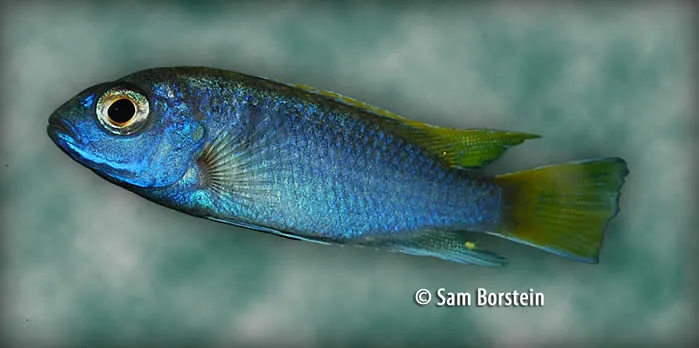
Pseudotropheus elegans has the compact, laterally compressed body typical of rock mbuna, with a small, slightly subterminal mouth equipped with fine bicuspid teeth suited to combing algae from rock. Adults are modestly sized, in the general 3.5–4 in range typical of the genus. As in most Pseudotropheus, sexual dichromatism is present: dominant males in breeding colour are typically more vividly marked, often blue-based with vertical barring and anal-fin egg-spots, while females and subordinate males run paler and less contrastingly patterned. Specific colour details for this species are not confidently documented here, so keepers should treat photographs of trade specimens, rather than assumption, as the reliable guide to its actual appearance.
Habitat
The species is recorded from several sites along the northern Malawian shoreline, including Kasinda, Mdowa, and Ngara — a stretch of rocky coast typical of the boulder-strewn habitat mbuna specialise in. Like all members of the group it is essentially confined to rock and rarely if ever crosses open sand, so its distribution is naturally patchy, tracking the scattered reefs and rock outcrops along this coast rather than forming a continuous population. Water in this zone is the lake's characteristic warm, alkaline, and well-buffered mix, well oxygenated by wave action in the shallow rocky littoral.
Feeding
As with essentially all Pseudotropheus, Pseudotropheus elegans is an aufwuchs grazer, cropping the algal turf, diatoms, and associated micro-invertebrates coating sunlit rock surfaces. Feeding is territorial: an individual defends a productive patch of algae against rival grazers, since repeated close-range foraging on a maintained patch is more efficient than ranging widely across contested ground. This algae-heavy diet is supported by a gut proportionally longer than that of predatory Malawi cichlids, standard for the mbuna grazing guild.
Mating
Pseudotropheus elegans follows the lek-like, polygynous mating system typical of Lake Malawi mbuna. Males hold small breeding territories among the rocks, intensify in colour, and display to passing females with quivering courtship movements; there is no lasting pair bond. A receptive female enters the male's territory to spawn directly on the cleared rock surface he defends, after which the classic haplochromine mouthbrooding sequence follows. Details specific to this species' courtship have not been separately documented here and are inferred from the shared behaviour of the genus.
Breeding
This is a maternal mouthbrooder, as are all Lake Malawi mbuna. The female takes her eggs into her mouth immediately after laying, is drawn to the egg-spot markings on the male's anal fin, and takes in milt in the process that fertilises the clutch she already holds. She broods the eggs and fry for roughly three to four weeks, largely without feeding, before releasing free-swimming young. Clutch size for this species is not documented here, but by comparison with similarly sized Pseudotropheus it is likely a few dozen eggs. There is no paternal care.
In the aquarium
Pseudotropheus elegans is a minor presence in the hobby rather than a mainstream trade fish, and where it is kept the standard rock-mbuna template applies. Provide a tank of at least 47 in with heavy rockwork over sand, giving broken sightlines and multiple bolt-holes to diffuse aggression. Water should match the lake's chemistry — warm, alkaline, and well-buffered, roughly pH 7.7 to 8.6 — since soft or acidic water causes chronic problems in Malawi cichlids. A single male kept with several females is the standard low-stress ratio. Diet should lean on a spirulina- or vegetable-based staple, since excess protein predisposes mbuna to bloat, with occasional small live or frozen invertebrates as a treat.
Conservation
No confirmed IUCN Red List status for Pseudotropheus elegans is available here, so none is stated. Numerous Lake Malawi mbuna have been assessed in broader efforts led by cichlid researchers such as Ad Konings, but the specific category for this species is not confirmed in the sources consulted. As a rock-restricted species tied to a limited stretch of northern shoreline, it would generally share the pressures common to that habitat type — aquarium collection at known reefs and the wider basin concerns of sedimentation, shoreline development, and fishing pressure documented across Lake Malawi.