Taxonomy & naming
Corydoras julii was described by Franz Steindachner in 1906 from a creek entering the Rio Parnaíba near Alto Parnaíba, in the dry interior of northeastern Brazil — still the type locality. It was placed in Corydoras Lacépède, 1803, the vast genus of South American armoured catfishes in the family Callichthyidae, and traded under that name ever since.
In 2024 Dias, Tencatt and colleagues published a large molecular-and-morphological revision of the Corydoradinae that split the unwieldy Corydoras into several genera — among them the resurrected Aspidoras, Scleromystax, Gastrodermus, Osteogaster, Brochis and Hoplisoma. Under that scheme the julii cory becomes Hoplisoma julii (Steindachner, 1906), and that is the combination now carried by Eschmeyer's Catalog of Fishes. The change is recent and far from universally adopted; the aquarium trade still says 'Corydoras julii,' so we keep that as the heading while noting the new genus.
The more practical taxonomic problem is identity, not genus. For decades the name 'C. julii' has been applied loosely to any small, spotted, single-striped cory, and the great majority of fish sold under it are actually Corydoras trilineatus (Cope, 1872) — a separate, wider-ranging western-Amazon species (itself now Hoplisoma trilineatum). The true C. julii is a comparatively local fish of the northeastern coastal basins, and genuine specimens are uncommon in shops.
Morphology
This is a small, compact cory, reaching roughly 2 in in standard length; like its relatives it is armoured rather than scaled, with two rows of overlapping bony plates (scutes) down each flank and a hard, blunt, helmet-like head. Three pairs of short barbels fringe the downturned mouth.
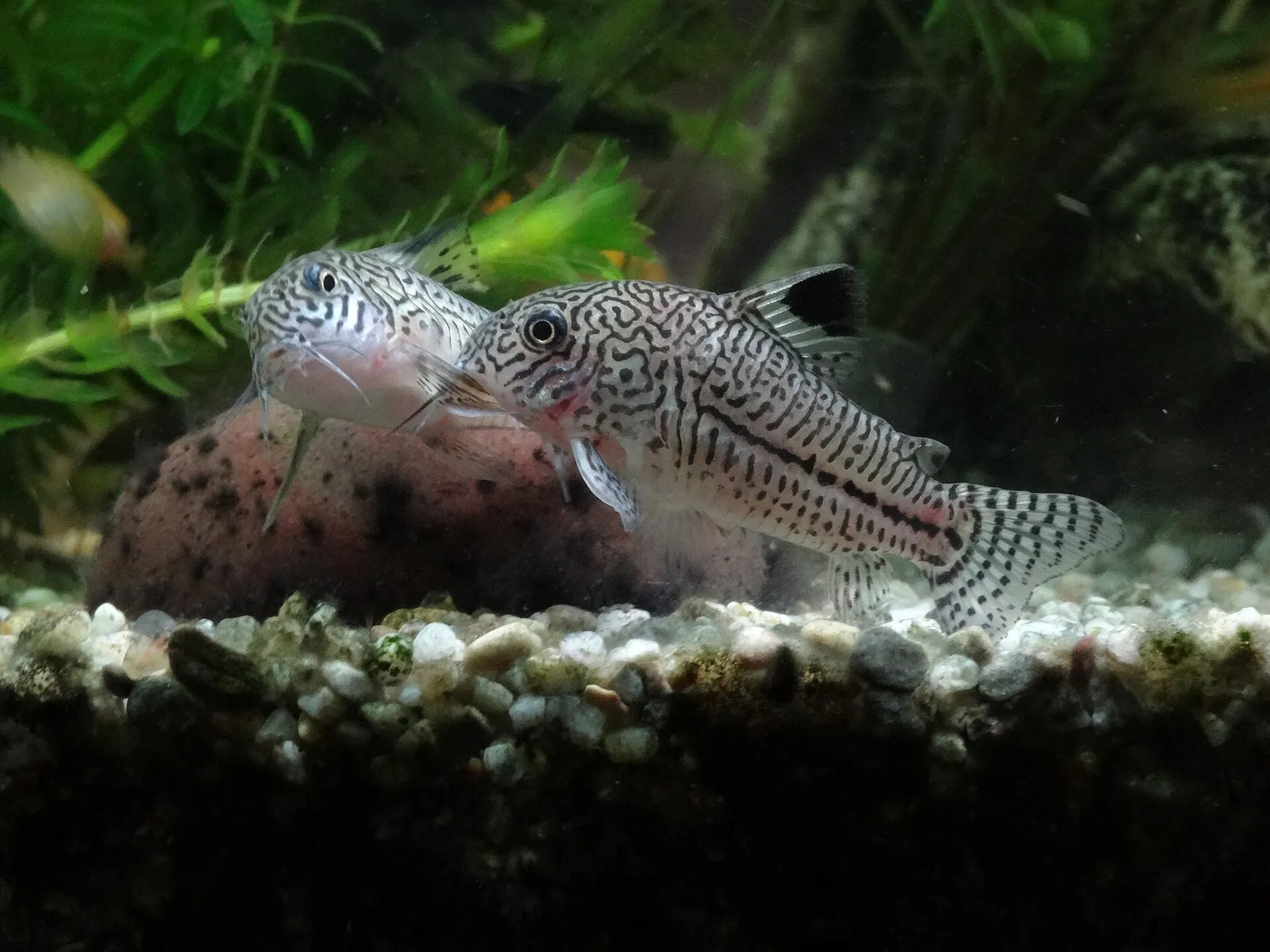
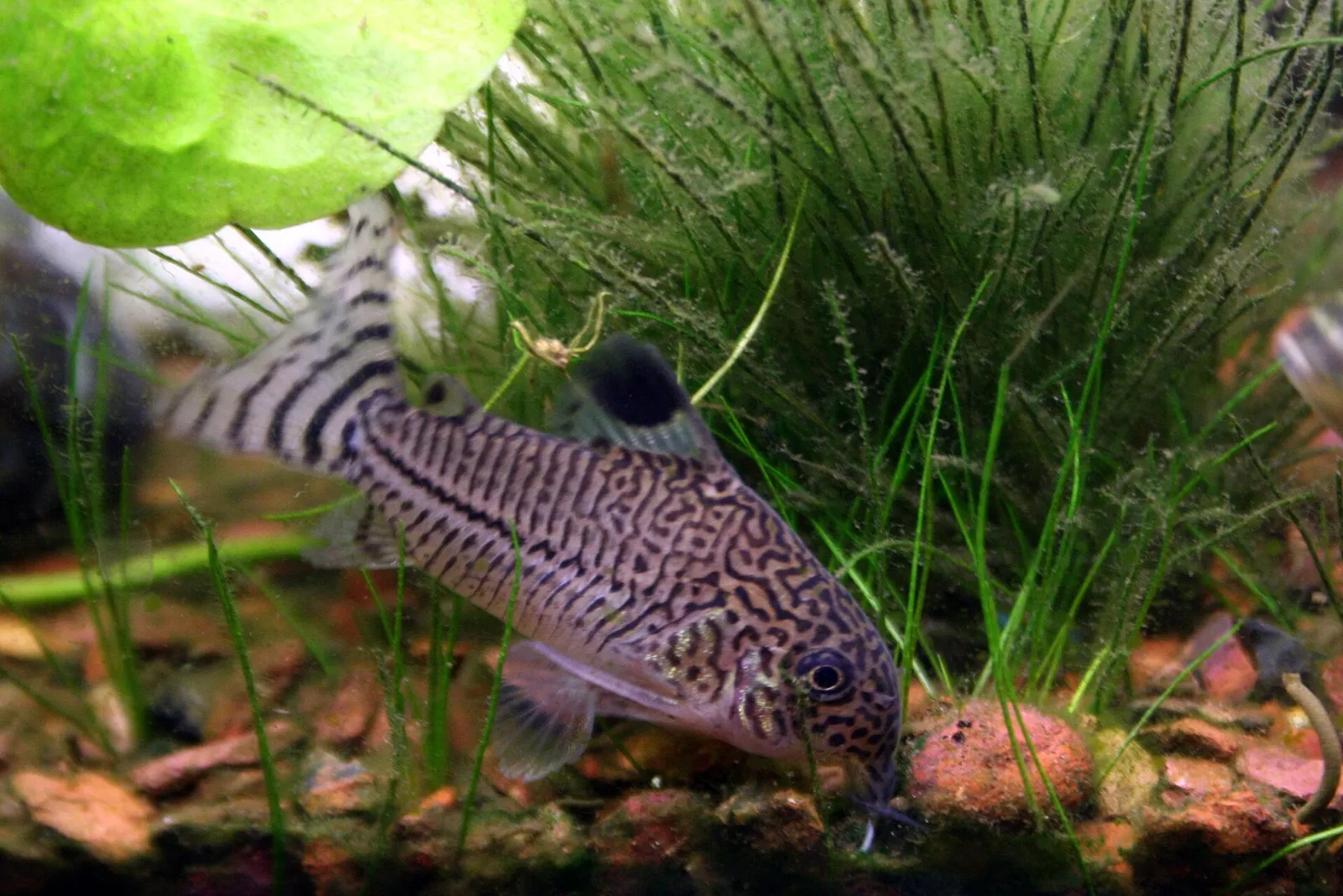
The ground colour is a pale silvery-grey. The diagnostic feature — when you can find a true specimen — is the head pattern: numerous small, distinct, separate dark spots scattered over the head and the front of the body, never coalescing into lines. A single bold black stripe runs along the midline of the flank from behind the gill cover into the tail, with a scatter of smaller spots above and below it, and a dark blotch marks the dorsal fin. This 'spots-not-scribbles' head is the classic way to separate it from C. trilineatus, whose head markings fuse into vermiform, worm-like squiggles and whose body reticulation is heavier — though the two grade into one another enough that even careful aquarists are routinely fooled, and some genuine trilineatus show spottier heads. As in all corys, the dorsal, pectoral and adipose fins carry a stiff, mildly venomous spine.
Habitat
Corydoras julii is native to northeastern Brazil, in the coastal river systems south and east of the Amazon delta and in the lower Amazon itself — recorded from the Parnaíba basin and the coastal drainages of Maranhão, Piauí, Pará and Amapá (rivers such as the Guamá, Mearim, Piriá and Parnaíba). It may be effectively endemic to the Maranhão–Piauí coastal region, which makes it a far narrower-ranged fish than the catch-all trade name suggests.
It is a fish of flowing, well-oxygenated water over fine sand, the clear-to-tannin-stained streams and river margins of the region rather than still backwaters. Reported parameters are warm and near-neutral: temperatures around 73–79 °F, a pH band of roughly 6.0–8.0 and soft to moderately hard water. Like other corys it is a facultative air-breather, gulping atmospheric air at the surface and absorbing oxygen through a vascularised hindgut — useful in the warm, seasonally shrinking pools of its dry-interior range.
Feeding
The julii cory is a foraging benthic omnivore. It works the substrate continuously, burying its snout and barbels in sand to taste out small invertebrates, insect larvae, worms, crustaceans and fallen organic detritus, sieving clean sand back out through the gills. It is an opportunist rather than a specialist. In the aquarium it readily takes sinking pellets and tablets, frozen and live bloodworm, Tubifex and brine shrimp, and anything its tankmates let fall — but, like all corys, it should be fed a varied diet of its own and never left to subsist on leftovers.
Mating
Like all Corydoras, the julii is an egg-laying shoaler with no pair bond and the family's distinctive 'T-position' courtship. When a female is ready she cleans a spawning site — a leaf, a stone, the aquarium glass — and the group becomes active; a male positions himself at right angles to her head, forming the T, and she appears to take his milt into her mouth. Sperm is thought to pass quickly through her gut to fertilise the few eggs she clasps in a basket formed by her pelvic fins, which she then carries to the cleaned surface and presses into place. The sequence repeats, a few eggs at a time, until the clutch is scattered across the chosen sites. Several males to each female improves fertilisation.
Breeding
Captive breeding follows the standard cory pattern, though the true C. julii is bred far less often than the trilineatus that usually wears its name. Spawning is triggered by a large (50–70%) water change with cooler water and stepped-up oxygenation and flow, mimicking the onset of the rains. The adhesive eggs are laid on glass, plants or wood and receive no parental care — the adults will eat them, so breeders remove either the eggs or the parents. Eggs hatch in roughly three to four days, and the fry, after absorbing the yolk sac, take microworm, baby brine shrimp and powdered foods. Honest note: because so little of what is sold as 'julii' is the real species, much published 'C. julii' breeding experience actually concerns C. trilineatus, and the two are similar enough in husbandry that the distinction rarely surfaces.
In the aquarium
Whether you have the true julii or its trilineatus stand-in, the care is the same and undemanding. It is a shoaling species and is stressed kept alone or in pairs — keep six or more and they reward you with constant, confident foraging. A group is comfortable in a tank of around 23.5 in / 20 US gal or more; bottom area matters more than height.
Substrate is the one non-negotiable: provide soft sand or very smooth, rounded fine gravel, because corys feed by sifting and sharp or coarse gravel wears down and infects their barbels, leaving the blunted faces that betray poor husbandry. Keep the bottom clean and the water warm (about 73–79 °F), well-filtered and well-oxygenated with a gentle current; they tolerate a broad pH and hardness range. They are utterly peaceful and make ideal companions for tetras, rasboras, dwarf cichlids and other calm community fish, never anything large enough to bully them. Two standing cautions for all corys apply: the fin spines can snag in a net (a cup is safer), and a badly stressed fish can release a skin toxin that, in the small volume of a bag or bucket, can kill the whole group — so transport them with care.
Conservation
Corydoras julii is assessed by the IUCN as Least Concern. It is judged a hardy, resilient fish of low vulnerability, and although it is collected for the aquarium trade, much of the collecting pressure nominally attributed to 'julii' actually falls on the far more widespread C. trilineatus that is sold under the name — so genuine wild C. julii populations see less trade demand than the figures suggest. As a comparatively narrow-ranged, regionally endemic species, however, it is more exposed than a continent-spanning cory to local pressures: deforestation, agriculture, damming and pollution all degrade the coastal-stream habitats of northeastern Brazil. Its status would benefit from being assessed on its own terms rather than under the blurred identity it shares with trilineatus in the hobby.