Taxonomy & naming
The bronze cory was described by Theodore Gill in 1858 as Hoplosoma aeneum, from material collected on Trinidad — still the type locality. It was soon folded into Corydoras Lacépède, 1803, the huge genus of South American armoured catfishes (family Callichthyidae) that now holds the great majority of the 'cory cats' of the hobby. For more than 150 years it sat there as Osteogaster aenea, and that is the name under which it is bred, traded and written about worldwide.
The genus, however, had grown unwieldy — well over 170 species, and molecular work showed it was not a single natural group. In 2024 Dias, Tencatt and colleagues published a large revision that split Corydoras into several genera (including Brochis, Hoplisoma, Gastrodermus and Osteogaster), and under that scheme the bronze cory becomes Osteogaster aenea. The change is recent and not yet universally adopted, and the aquarium world still overwhelmingly says 'Osteogaster aenea,' so we keep that heading while noting the new combination. A further wrinkle is that the fish in the trade is not one thing: the 'aeneus' sold as bronze, albino, green-laser and a string of 'C-' and 'CW-' collection codes spans populations from Colombia and Venezuela south to the Río de la Plata, several of which are likely undescribed species in their own right.
This fish was long listed as Corydoras aeneus; Eschmeyer's Catalog of Fishes now treats that name as a synonym of Osteogaster aenea, the valid name followed here.
Morphology
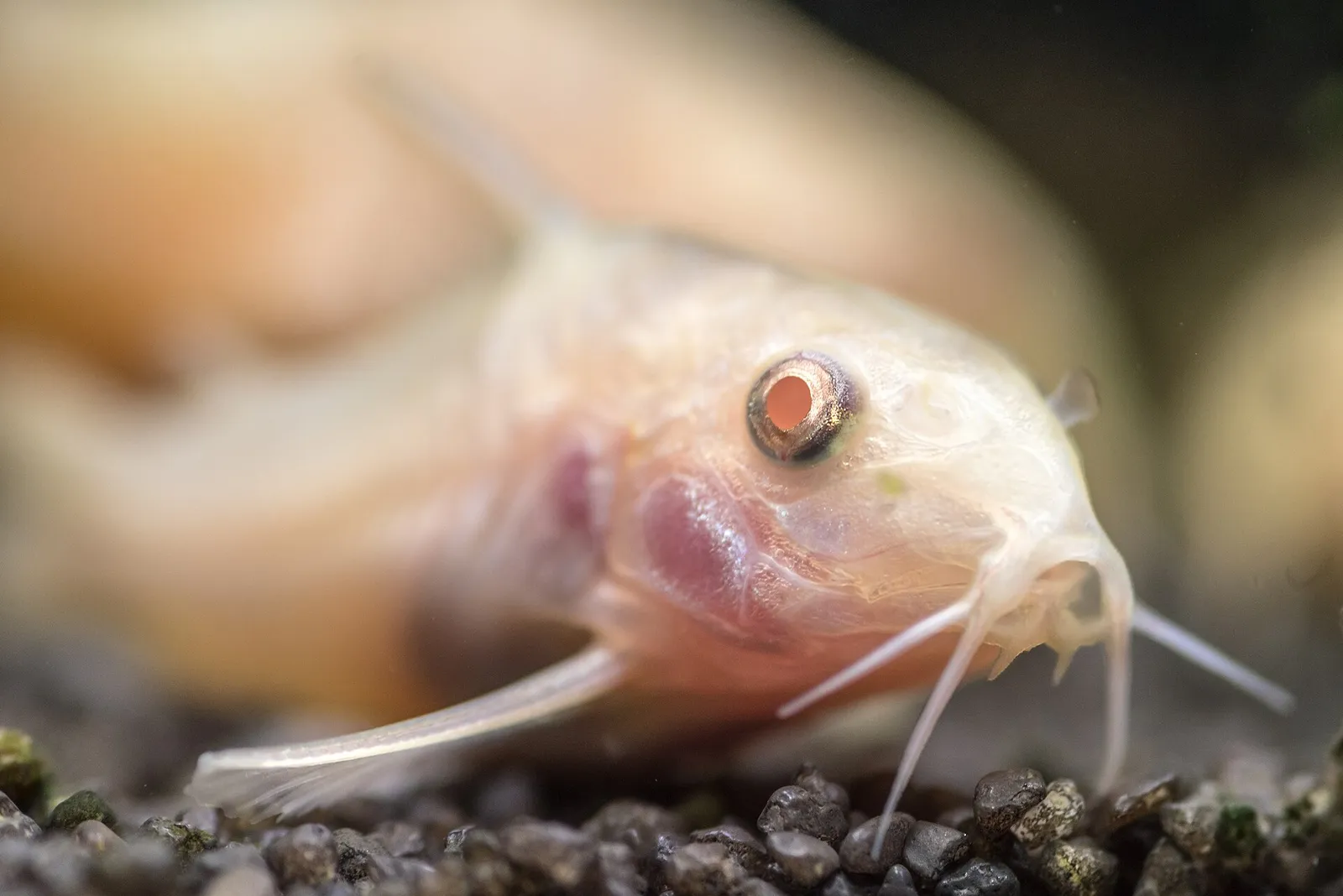
This is a small, stocky catfish, deep-bodied and flat-bellied, reaching about 2.5–3 in in total length; females grow visibly larger and rounder than males. Like all Corydoras it is armoured rather than scaled: two rows of overlapping bony plates (scutes) run down each flank, meeting in a ridge along the back, and the head is a hard, blunt helmet. Three pairs of sensory barbels fringe the downturned mouth — the tools it uses to taste and sift the substrate.
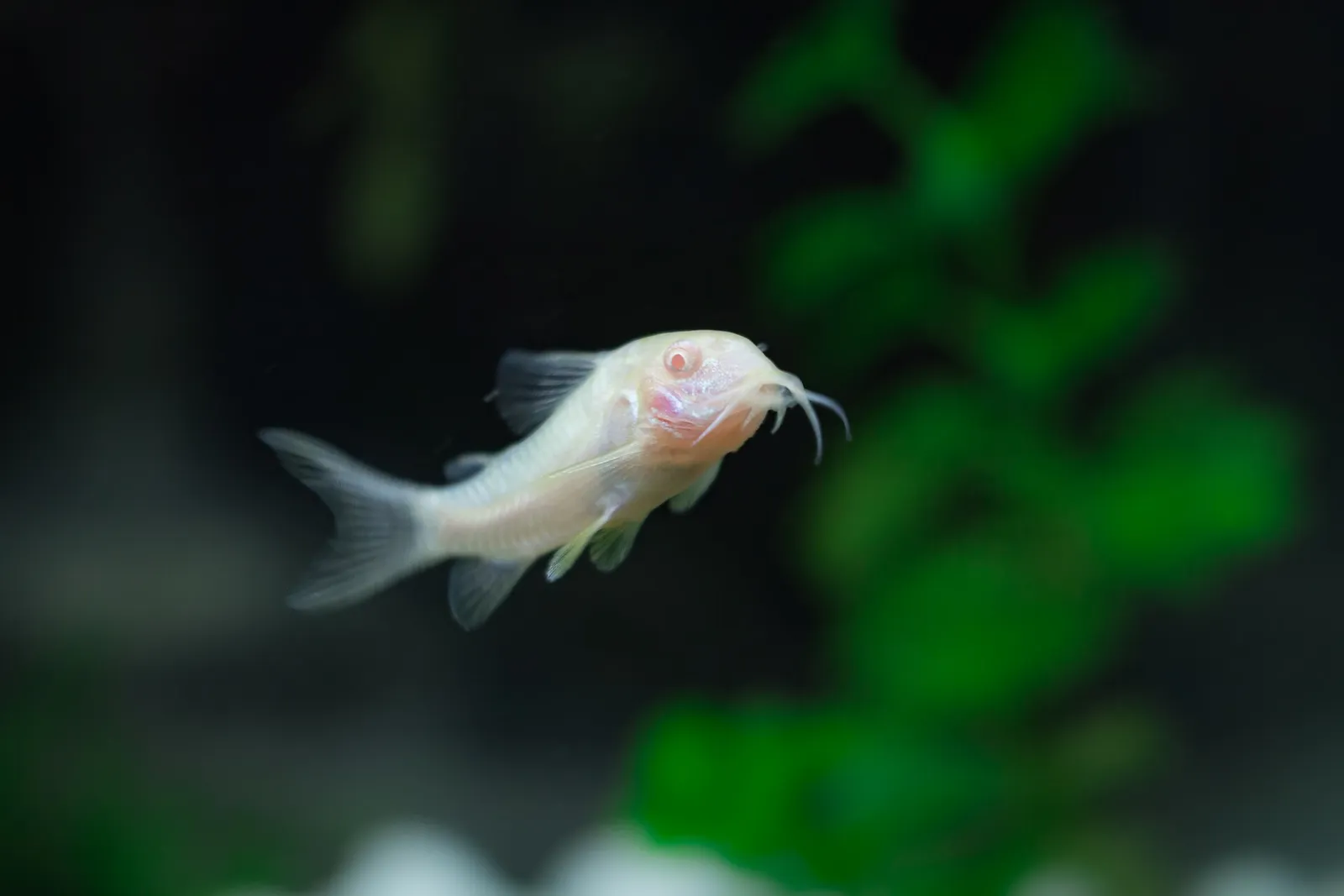
The ground colour is a metallic pinkish-grey overlaid with an iridescent bronze-to-green sheen along the side, brightest behind the gill cover, which is where both the common name and the Latin aeneus ('made of bronze') come from. The fins are mostly clear, and the dorsal, pectoral and adipose fins each carry a stiff, mildly venomous spine — a defence that can give a careless hand a sharp jab and that occasionally tangles in a net. Long-line aquarium breeding has fixed several colour forms, the ubiquitous albino (pink body, red eyes) and the 'green laser' among them, but wild fish are the plain bronze original.
Habitat
Osteogaster aenea (in the broad, trade sense) is one of the most widely distributed of all corys, recorded across much of tropical and subtropical South America — from the Caribbean drainages of Colombia, Venezuela and Trinidad south through the Amazon periphery to the Paraná–Paraguay and La Plata systems of Argentina. It is a fish of quieter water: the shallow margins of streams, ponds, ditches, oxbows and slow river reaches, typically over soft sand or mud with leaf litter and submerged wood.
These are warm, shallow, often slightly turbid waters. Across its range it tolerates a wide envelope — temperatures from roughly 72–82 °F, a pH band from acidic to slightly alkaline (about 6.0 to 8.0) and soft to moderately hard water — which is exactly why it has proven so adaptable in captivity. Crucially, it is a facultative air-breather: it darts to the surface to gulp air and absorb oxygen through a modified, vascularised hindgut, an adaptation that lets it survive in warm, low-oxygen pools and shrinking dry-season puddles where most fish could not.
Feeding
The bronze cory is a benthic omnivore and detritivore. It works the bottom continuously, burying its snout and barbels in sand to taste out small invertebrates, insect larvae, worms, crustaceans, fallen seeds and the organic film of detritus, expelling cleaned sand through the gills as it goes. It is an opportunist rather than a specialist, and that catholic diet is part of its hardiness. In the wild it forms an unglamorous but important part of the substrate-cleaning guild of the shallows; in the aquarium it takes sinking pellets, frozen bloodworm and brine shrimp, and anything its tankmates let fall, but it should never be left to subsist only on leftovers.
Mating
Corydoras are egg-laying shoalers with no pair bond and a distinctive, well-studied courtship. When a female is ready she cleans a site — a leaf, a stone, the aquarium glass — and the group becomes active; a male positions himself at right angles to her head, in the classic 'T-position', and she appears to take his milt into her mouth. Sperm is then thought to pass rapidly through her gut and out to fertilise the few eggs she clasps in a basket formed by her pelvic fins, which she carries to the cleaned site and presses into place. The sequence repeats, a few eggs at a time, until dozens to a couple of hundred sticky eggs are scattered across the chosen surfaces.
Breeding
This is one of the first egg-laying fishes most aquarists breed, because it so often does it unbidden. Spawning is typically triggered by a cool, large water change that mimics the arrival of the rainy season, dropping the temperature several degrees. A productive group skews to more males than females. The adhesive eggs — a clutch on the order of 50–300, laid in small batches — receive no parental care; in fact the adults will eat them, so breeders move the eggs or the parents. Eggs hatch in three to five days depending on temperature, and the fry, after absorbing the yolk sac, take microworm, baby brine shrimp and powdered foods. They are hardy and grow quickly. This easy, reliable reproduction is why O. aenea is bred commercially in vast numbers and why almost every fish sold is captive-raised rather than wild-caught.
In the aquarium
The bronze cory is deservedly a beginner's fish, but a few real requirements separate a thriving group from a struggling one. First, it is a shoaling species and is genuinely stressed when kept alone or in twos — keep six or more, and they reward you with constant, confident activity. A group is comfortable in a tank of around 23.5 in / 20 US gal or more; footprint and bottom area matter more than height.
Second, substrate is not optional decoration. Provide soft sand or very smooth, rounded fine gravel: corys feed by sifting, and sharp or coarse gravel erodes and infects their barbels, leaving stubby, blunted faces — one of the commonest signs of poor husbandry. Keep the bottom clean, because they are always nosing in it. Water should be warm (about 72–79 °F; they do not want tropical-hot water), well-filtered and well-oxygenated, with the gentle current and regular changes any catfish appreciates; they tolerate a broad pH and hardness range. They are utterly peaceful and make ideal companions for tetras, rasboras, dwarf cichlids and other calm community fish — never with anything large enough to bully them. Two cautions worth knowing: the fin spines can catch in nets (a cup is safer), and a distressed cory can release a toxin from its skin that, in the confined volume of a bag or bucket, can kill the whole group, so transport them with care.
Conservation
Osteogaster aenea is assessed by the IUCN as Least Concern. It is extraordinarily widespread, ecologically flexible and tolerant of disturbed and degraded habitats, and the overwhelming majority of fish in trade are commercially captive-bred, so collection pressure on wild populations is negligible. None of that makes it immune to the broad pressures on South American freshwaters — deforestation, agricultural run-off, damming and pollution all degrade the shallow marginal habitats it favours — but as a species it is in no danger. The more interesting conservation footnote is taxonomic: because 'O. aenea' is a complex of populations, some of the regional forms now being separated out may prove to be much narrower-ranged species whose status will need assessing on their own terms.