Taxonomy & naming
Copadichromis melas was described by Jay R. Stauffer Jr. and Ad Konings in 2006, in their review of the genus Copadichromis (Ichthyological Exploration of Freshwaters 17(1):9–42), a paper that erected one new genus and six new species at once. Before that formal description the fish circulated in the aquarium trade under the provisional name Copadichromis sp. "midnight mloto," a nod to its resemblance to the pale, silvery mloto-type utaka combined with the dramatic black breeding dress of its males. The Catalog of Fishes and FishBase both carry the name as valid, with no synonyms.
The genus Copadichromis was erected by Eccles and Trewavas in their 1989 revision of the Malawian haplochromine genera to hold the "utaka" — the shoaling, open-water and sand-associated plankton-feeders of Lake Malawi. Within that genus, Copadichromis melas is placed in the Copadichromis mbenjii species group (Cichlid Room Companion; malawi.si), a cluster of similar zooplanktivores that are told apart chiefly by male breeding colour and by the arrangement of dark spots and bars on the flank. The type locality is Mala (also spelled Mara) Point on the eastern, Mozambican shore of the lake.
Morphology
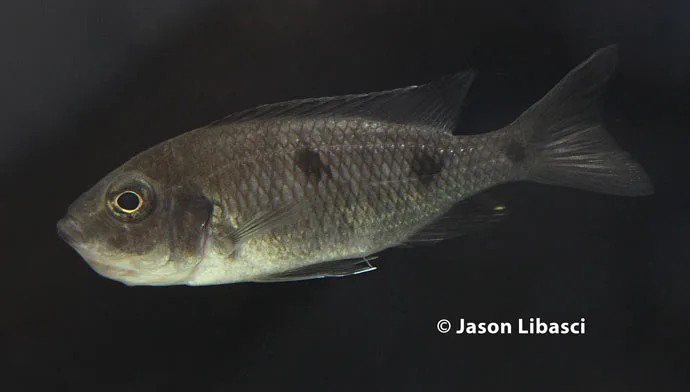
This is a small cichlid. The original description gives a maximum of 3.5 in standard length for the type series, while field and hobby accounts on malawi.si describe males growing to roughly 5.5 in in total length, with females a little smaller — the difference largely reflecting standard versus total length and aquarium versus wild fish. The body is fusiform and unremarkable in shape; the diagnosis instead rests on colour and markings. Stauffer and Konings diagnose the species by three lateral spots on the body, a supra-pectoral spot about the same size as the supra-anal spot, three vertical bars between the supra-pectoral spot and the gill cover, and the absence of any black submarginal band in the dorsal fin. Fin-ray counts are typical for the genus (roughly 15–17 dorsal spines, 10–12 dorsal soft rays, 3 anal spines and 8–9 anal soft rays).
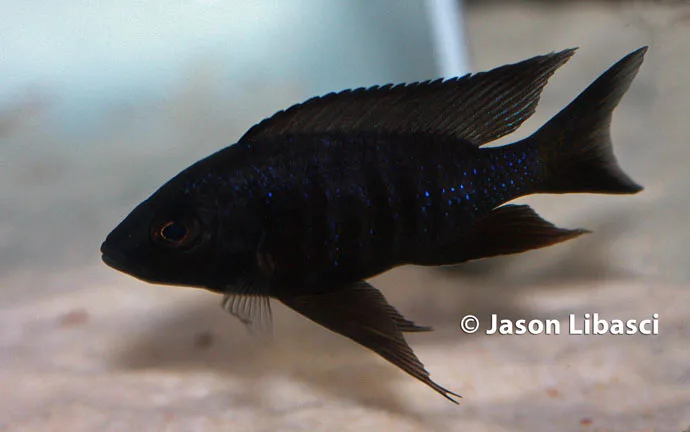
Sexual dimorphism is pronounced and is the species' signature. Females and juveniles are a plain silvery fish marked with the three black body spots. A breeding male, by contrast, becomes entirely black — including the anal fin, which carries none of the coloured margin, spots, or egg-streaks seen in related utaka. It is this jet-black nuptial coloration that gives the fish its epithet, and it is the single most reliable way to separate Copadichromis melas from the otherwise similar members of the mbenjii group.
Habitat
Copadichromis melas is endemic to Lake Malawi (Lake Niassa on the Mozambican side) and, on present records, confined to a stretch of the lake's eastern shore in Mozambique. FishBase gives its range as between Tumbi Point and Cobwé, and malawi.si describes the same stretch — the gently sloping rocky and intermediate shores of the Mozambican coast — as its distribution. It has not been reported from the Malawian or Tanzanian shores, which makes it a narrow-range endemic within an already endemic-rich lake.
The fish is a creature of the intermediate zone, the sand–rock interface where boulders give way to open sand. Territorial males build their breeding bowers there at depths of about 33 to 50 ft, while females range more widely over the adjacent bottom. The water it lives in is the alkaline, well-buffered water characteristic of Lake Malawi's surface layer — broadly pH 7.5 to 8.5 and around 75 to 82 °F — values typical of the lake rather than measured specifically for this species.
Feeding
Like the rest of the utaka, Copadichromis melas is a plankton feeder, and FishBase places it at a trophic level of roughly 3.3, consistent with an animal-plankton diet. The natural-history note in the original description records that both males and females feed on plankton near the bottom and also take benthic invertebrates — a slightly more bottom-oriented habit than the mid-water, open-column feeding of utaka such as Copadichromis borleyi or the virginalis/mloto group. In practice the fish hovers low over the sand–rock interface and picks drifting zooplankton and small invertebrates from the water just above the substrate.
Ecologically it fills the same role as its many congeners: a small predator that converts the lake's zooplankton production into fish biomass, itself prey for the larger piscivores of the rocky and intermediate zones. Because it is a localized species rather than a netted open-water shoaler, it has no particular fisheries importance.
Mating
Copadichromis melas has the lek-like social system typical of Malawi's sand- and intermediate-zone mouthbrooders. Outside of breeding, females are reported to occur singly or in small groups of three or four individuals over the bottom rather than in large shoals. When ready to breed, males move to the sand–rock interface and establish territories, each defending a bower — a cleared or built spawning arena on the substrate — at around 33–49 ft depth.
It is at this point that the male assumes his entirely black nuptial coloration, the visual signal that defines courtship in this species. He displays from his bower to attract passing females and to warn off rival males. Aggression is moderate by Malawi standards — territorial during breeding but not exceptionally pugnacious — and the system is polygynous, a single displaying male spawning with multiple females that visit his bower.
Breeding
Reproduction is maternal mouthbrooding, the standard Lake Malawi strategy and the mode recorded for this species on malawi.si. Spawning takes place at the male's bower, close to the substrate: the female lays a batch of eggs and immediately takes them into her mouth, and fertilization is completed in the mouth in the usual haplochromine manner, the female collecting milt as she mouths at the male near his vent. She then carries the developing eggs and, after hatching, the larvae and free-swimming fry entirely in her buccal cavity, not feeding for the brooding period, before releasing fry able to fend for themselves.
No clutch counts, brooding durations, or fry-development figures specific to Copadichromis melas appear to have been published; the species is genuinely little studied in this respect. By analogy with similarly sized Copadichromis the female would be expected to brood a modest clutch (on the order of a few dozen eggs) for roughly three weeks, but that is an inference from the genus rather than a measured value for this fish, and it should be read as such.
In the aquarium
Copadichromis melas is rarely encountered in the hobby. It is a localized Mozambican endemic with no commercial fishery on its home shore, so it has never entered the trade in meaningful numbers; when it does appear it is usually through specialist breeders who have maintained stock from the small quantity collected in the early 2000s under the provisional name "midnight mloto." Anyone expecting a tank full of jet-black cichlids will need patience: only a breeding male in peak condition shows that color, and then only for as long as he holds territory. Females and non-breeding males are a plain, silver-spotted fish.
Because Copadichromis melas is a small utaka — males reach roughly 5.5 in total length, females somewhat less — a 4-foot (47 in) tank is the minimum practical footprint, and a 5- or 6-foot tank is better. Like all utaka it needs open water to cruise: the tank should be set up with a sand substrate, a modest rock arrangement along the back and sides for visual division and to give a male a focal point for bower construction, and a large uncluttered midwater volume in the centre. Copadichromis are not rock-dwellers and will not use a densely stacked cichlid cave layout; they sulk or fail to colour up if denied swimming room. A single male with two or three females is the recommended group; a dominant male with no visual break from a rival will harass females relentlessly.
Water chemistry should replicate Lake Malawi's alkaline, well-buffered character. Target pH 7.8–8.5, temperature 75–82 °F, and moderate hardness — a general hardness of 10–20 °dGH is a common keeping target, with a carbonate hardness of about 6–8 dKH (the lake itself measures ≈7). Proprietary Malawi salt mixes or a small dose of sodium bicarbonate and magnesium sulfate in soft tap water will achieve this. A high turnover, well-oxygenated filter is important; the lake is exceptionally clear and Copadichromis melas, as a plankton feeder in open water, is intolerant of the low-oxygen, high-dissolved-organic conditions that a more forgiving mbuna will shrug off. Weekly partial water changes of 25–30% are the standard maintenance recommendation for any Malawi haplochromine.
Copadichromis melas is best kept with other calm haplochromines and peacocks (Aulonocara) of similar size. Suitable companions include mid-mannered haps such as Copadichromis borleyi, Placidochromis electra, or Lethrinops species. Aggressive mbuna — particularly Melanochromis and Labeotropheus — are inappropriate tankmates; they will outcompete and stress a relatively peaceable open-water feeder, and the chronic low-grade harassment typical of mixed mbuna–hap setups leads directly to the Malawi bloat (a lethal distension linked to stress, Hexamita, and secondary bacterial infection) that kills more Lake Malawi cichlids in captivity than any other single cause. Feeding a high-quality spirulina-based or mixed flake-and-pellet diet with periodic live or frozen cyclops and daphnia keeps the immune system competent and reduces bloat risk; high-protein beef-heart or similar fatty foods should be avoided entirely.
Breeding in captivity follows the pattern described for the species in the wild. A male in spawning condition will excavate or pile a small sand bower and display his black coloration at length to passing females. If the male-to-female ratio is right and the tank is not overcrowded, a female will accept him, spawn at the bower, and take the eggs into her buccal cavity immediately. She should then be isolated — a mesh breeding cage in the same tank or a separate rearing tank — because males will court her relentlessly if she remains visible, and persistent harassment can cause her to swallow the brood early. Brooding runs approximately three weeks at Malawi temperatures; fry released at that point are free-swimming and large enough to take baby brine shrimp or fine crushed flake from the first day. As with all husbandry details for this species, published accounts are thin, and keepers are largely working from Copadichromis genus norms rather than a large body of documented Copadichromis melas captive experience.
Conservation
The IUCN Red List assesses Copadichromis melas as Least Concern, with the most recent assessment dated 22 June 2018 (the rating is carried by FishBase from the Red List; note that the Cichlid Room Companion species page still lists it as not evaluated, reflecting an earlier state). It carries no CITES or CMS listing. The Least Concern rating reflects the absence of any documented species-specific threat rather than evidence of a large, secure population: this is a narrow-range fish known only from one stretch of the Mozambican shore, and its restricted distribution is the main reason to keep an eye on it.
The wider context is the state of the lake itself. Lake Malawi/Niassa/Nyasa is under increasing pressure from catchment deforestation and the sediment and nutrient loading that follows, from intensifying fisheries, and from a warming, more strongly stratified water column that tends to suppress the nutrient mixing on which the lake's plankton production depends. None of these has been shown to threaten Copadichromis melas in particular, but for a localized, plankton-dependent endemic they are the relevant backdrop, and the honest summary is that the species is not currently in trouble while the lake around it is under growing strain.