Taxonomy & naming
Geoffrey Fryer described Gephyrochromis lawsi in a 1957 paper in the Revue de Zoologie et de Botanique Africaines (vol. 55, pp. 346–352), titled 'A new species of Gephyrochromis (Pisces: Cichlidae) from Lake Nyasa, with notes on its ecology and affinities.' The holotype, 4 in standard length, is catalogued as BMNH 1965.11.2.13 in the Natural History Museum, London; nine paratypes are registered as BMNH 1965.11.2.14–22. The type locality is Florence Bay on the western shore of the northern lake. The name was coined as Lake Nyasa — the lake's former designation — a reminder that the political name 'Malawi' for both country and lake only came with independence in 1964, seven years after the description.
The genus Gephyrochromis was erected by George Albert Boulenger in 1901, in a short paper 'Diagnoses of new fishes discovered by Mr. J. E. S. Moore in lakes Tanganyika and Kivu' (Annals and Magazine of Natural History, Series 7), with Gephyrochromis moorii as the type species by monotypy. Boulenger placed the genus in what was then a broadly drawn Cichlidae; subsequent work recognized that Gephyrochromis belongs to the haplochromine flock of Lake Malawi — and more specifically to the mbuna ecomorph group, the rock- and interface-dwelling cichlids that form the majority of Malawi's cichlid diversity. Konings (Malawi Cichlids in their Natural Habitat, 4th ed., 2007) treats both Gephyrochromis moorii and Gephyrochromis lawsi as mbuna on the basis of their habitat, dentition and social organization; M. K. Oliver's malawicichlids.com lists the genus under the mbuna flock. The Cichlid Room Companion (cichlidae.com) currently recognizes two valid Gephyrochromis species (lawsi and moorii) and four potentially undescribed forms.
No synonyms are on record for Gephyrochromis lawsi. Eschmeyer's Catalog of Fishes (updated 19 May 2026) confirms its current status as valid, citing Maréchal (1991), Poll & Gosse (1995) and Konings (2016) as subsequent validators. FishBase assigns species code 8347; GBIF taxon key 2370840.
Morphology
Gephyrochromis lawsi is a moderately elongate cichlid, smaller than most mbuna. FishBase records a maximum of 5 in total length, citing Maréchal (1991); malawi.si notes that wild males commonly reach about 5 in while females remain somewhat smaller, with the commonly encountered size closer to 4 in. Fryer's holotype measured 4 in standard length. The GCCA profile (Borstein 2008) records males at roughly four inches (4 in) and females at just over three (3 in) in captivity.
The diagnostic character of the genus is its dentition. Gephyrochromis species bear long, extremely slender teeth in the outer rows of both jaws, with crowns that may be unicuspid, bicuspid or tricuspid — a suite of tooth forms illustrated in Fryer's original figures, and clearly distinct from the stouter teeth of Pseudotropheus and its relatives. This slender dentition is why Fryer separated the fish from Pseudotropheus and gave it a new genus, despite the animals' superficially zebra-like appearance.
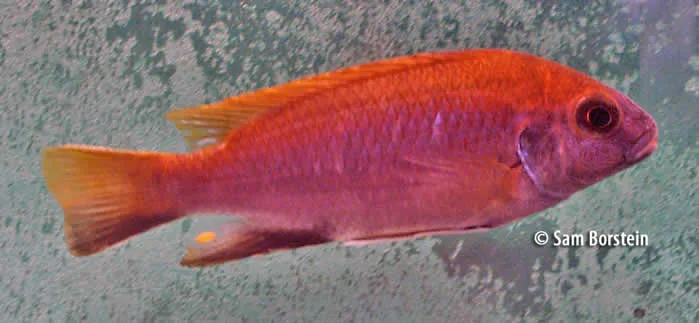
The male coloration is striking and somewhat atypical for a mbuna. The body is blue-violet to lavender, with a broad golden-orange to yellow blaze across the back and into the dorsal fin — giving ripe males an almost bicoloured look. The flanks often carry a metallic blue sheen. FishBase's photograph (Hippocampus-Bildarchiv) shows a female in drab brownish-grey; malawi.si's gallery confirms that females may carry a faint purple sheen, but are generally undistinguished. The sexual dimorphism is pronounced and consistent: males are more intensely coloured, slightly larger, and develop the orange dorsal blaze at maturity.
Habitat
The species is endemic to Lake Malawi, confined to the northern portion of the lake. The IUCN assessment (Konings, Kazembe & Makocho 2018) specifies a range within the northern half, and notes occurrence in both Malawi and Tanzania. FishBase lists the distributional range as 9°S–12°S, which covers the northern and central northern shorelines. Within the lake, Gephyrochromis lawsi occupies the transitional or 'intermediate' zone — the belt of mixed sand and rock debris at the foot of steep rocky shores, where boulder fields and cobble grade into open sand. This is the habitat the genus name itself alludes to (see Etymology). FishBase describes the fish as 'benthopelagic,' occurring 'usually at deep levels where the steep, rocky coast ends on the sand. Found over sandy patches in the intermediate habitat. The average depth is about 66 ft.' The IUCN account provides site-specific depth data: at Nkhata Bay, the species is found at 26–82 ft; at Chitimba Bay at only 13–16 ft, reflecting local variation in the depth at which the rocky fringe ends. malawi.si gives a range of 23–66 ft. Population density is noted in the IUCN assessment as low in deeper water.
The water chemistry of Lake Malawi is well-characterised for the northern half: alkaline, well-buffered and highly stable, with a pH typically 7.7–8.6 and conductivity around 210–230 µS/cm. FishBase lists a pH range of 7.0–8.5 and a temperature window of 75–82 °F for the species. In situ measurements by Konings and other researchers confirm that shallow-to-mid depths in the northern lake hold water at these temperatures year-round, with relatively little seasonal fluctuation. The habitat-typical hardness is likely 10–20 dH, consistent with the lake's chemistry, though species-specific hardness measurements for Gephyrochromis lawsi are not published (value flagged as habitat-typical).
Feeding
Gephyrochromis lawsi feeds primarily on loose aufwuchs — the scraped-off film of algae, cyanobacteria, diatoms and the small invertebrates embedded within it — that accumulates on rock and shingle surfaces at the rock-sand interface. The IUCN assessment (Konings et al. 2018) specifies this diet explicitly: 'It feeds mainly on loose aufwuchs.' This places it in the aufwuchs-grazer guild typical of many Malawi mbuna, but its particular habitat — the transitional zone rather than the fully exposed rocky reef — means it is cropping the more loosely attached material at the outer fringe, rather than the tightly adhered algal mat that specialist scrapers like Labeotropheus tackle directly.
Fryer's 1959 paper on trophic interrelationships in Lake Malawi cichlids (published in the Proceedings of the Zoological Society of London), which included direct observations at Florence Bay, is the primary ecological source. Borstein's profile (2008) adds the note that in the wild the fish captures crustaceans from the sand, consistent with the IUCN's phrase 'sediment-rich intermediate zones' and with the species' intermediate position between pure aufwuchs grazers and invertivores that sift the sand. FishBase estimates a trophic level of 3.3 — higher than dedicated algae-scrapers (which sit closer to 2.0), reflecting this mixed diet of algal material and small invertebrates.
In the aquarium, multiple keepers confirm the fish is entirely opportunistic and will accept flake, pellet, frozen brine shrimp and other prepared foods without difficulty (Borstein 2008, GCCA/Borstein 2008, cichlid-forum.com 2009). The usual mbuna caution — limiting high-protein animal foods to avoid digestive problems — applies here as a precaution, even if Gephyrochromis lawsi is less exclusively herbivorous than some mbuna.
Mating
Gephyrochromis lawsi is a polygynous maternal mouthbrooder, and males are weakly territorial rather than the fiercely site-defending type seen in highly aggressive mbuna such as Melanochromis. The IUCN assessment states: 'Males are weakly territorial, chasing away intruders, and females are solitary.' This pattern — loosely held male territories, non-aggregating females — is consistent with the transitional habitat, where there is no permanent reef structure to defend tightly.
Multiple forum keepers have noted that males display readily and chase at low intensity but rarely inflict serious damage on other fish (cichlid-forum.com, 2009; Borstein 2008). The GCCA report describes the species as 'peaceful mbuna' and notes the author 'never saw any form of aggression,' though this observation from a community aquarium should be read in that context. More nuanced accounts suggest that a lone male with several females, or a male in a community with other peaceful mbuna, is stable; concentrated conspecific males in a small tank could produce escalating chasing. The mbuna community rule — more hiding places, more females per male, more tank volume — applies. malawi.si recommends a tank of at least 66 US gallons and notes the fish is peaceful toward both conspecifics and other species.
Courtship follows the typical mbuna pattern: the male intensifies colour, extends fins, and chases the female in circles near the substrate before she picks up the eggs.
Breeding
Gephyrochromis lawsi is a maternal mouthbrooder. Spawning takes place on the substrate — typically near rocky cover or at the rock-sand interface — and the female collects the fertilised eggs into her buccal cavity immediately after laying. She broods alone, without male participation after fertilisation, for approximately three weeks (Borstein 2008, GCCA/Borstein 2008). malawi.si gives a typical brood size of 25–40 fry, which is on the smaller end for mbuna; the female is noted to be a determined holder, reluctant to release the fry prematurely.
Borstein's account records that in aquaria the species will spawn prolifically and with minimal provocation: 'This fish will spawn at any time, anywhere, in any condition. I couldn't stop mine from spawning' (2008). This is corroborated in the cichlid-forum.com thread (2009), where participants describe them as easy breeders once established — 'typical mouthbrooders, usually not that aggressive' (Fogelhund, cichlid-forum.com 2009). The recommended approach is to strip or isolate the female at around 18 days when fry are near free-swimming stage, at which point they can accept baby brine shrimp as a first food.
Breeding is not recorded in detail in the primary scientific literature beyond Fryer's original ecology notes. The captive records above represent the best available data for aquarium breeding behaviour. The species is reportedly uncommon in the trade — primarily circulating through specialist cichlid clubs and online hobbyist lists — meaning captive-breeding records are less widely documented than for more commercially prominent mbuna.
In the aquarium
Gephyrochromis lawsi is a genuine rarity in the hobby. It circulates primarily through specialist cichlid societies and occasional online hobbyist lists rather than the mainstream trade, and many Malawi enthusiasts have never encountered it. That obscurity is a pity, because it is by most keeper accounts a manageable fish — not dramatically easier than other mbuna, but notably less aggressive — and its unusual blue-violet and orange-gold livery makes a striking display in a well-set-up Malawi tank. Anyone sourcing it should expect to wait and hunt: reputable cichlid clubs with breeding programmes are the most reliable origin.
Tank size should not be skimped. malawi.si recommends at least 66 US gallons, and that is a sensible floor rather than a comfortable target. A 300–400-litre tank allows a more stable social group — one male with two or three females — and more effective territory dilution. The decor should replicate the transitional habitat: a deep bed of fine sand (at least 2–3 in) is essential, since the fish naturally grazes the sediment surface and females will use open sand areas to forage; medium and large flat rocks and rounded boulders arranged to create caves and sight-breaks complete the setup. Do not fill the tank entirely with rock, as this species uses open sandy areas routinely. Strong biological filtration and brisk circulation are important: the northern Lake Malawi environment where the fish lives is oligotrophic and exceptionally clean, and nitrates should be kept well below 20 mg/l with regular partial water changes.
Water chemistry must match the Lake Malawi baseline. Target pH 7.8–8.5, temperature 75–82 °F, and moderate to high hardness (total hardness typically 10–20 °dH is appropriate for the lake's water; the species-specific figure is not published separately, so the lake's general chemistry guides the target). Soft or acidic water is inappropriate and will suppress colour, suppress breeding and eventually cause health deterioration. The fish is intolerant of fluctuations in pH more than in some other cichlids, and regular top-ups with appropriately buffered water are better than infrequent large changes.
Compatibility requires some thought. Gephyrochromis lawsi is described as peaceful for a mbuna — Borstein (2008) and the cichlid-forum.com community both note low overall aggression — but 'peaceful mbuna' is a relative term, and combining it with highly combative species such as Melanochromis or dominant Pseudotropheus strains risks it being outcompeted or harassed. The best tankmates are other mid-sized, moderately assertive mbuna from the lake's northern arm, or peaceful haplochromines that share the alkaline water requirement. Other Gephyrochromis, if available, can be kept together; the two valid species differ in their primary habitat preferences and should not hybridise readily when correctly identified. Do not mix Gephyrochromis lawsi with soft-water cichlids, tetras, or any fish that demands acidic conditions.
Diet in captivity is uncomplicated. The fish accepts high-quality cichlid flake and pellets, frozen brine shrimp, mysis, and similar prepared foods without hesitation; Borstein (2008) reports it as an indiscriminate feeder. The standard mbuna dietary caution applies: keep the protein fraction moderate and prioritise spirulina-based or vegetable-enriched staple foods over exclusively meat-heavy diets. Malawi bloat — a serious and often fatal digestive syndrome in mbuna and related cichlids, typically associated with a diet too high in animal protein and compounded by poor water quality — is the keeper's primary health risk to guard against. Feeding good-quality spirulina pellets as the staple, supplemented by frozen invertebrate foods no more than two or three times a week, and maintaining pristine water conditions, greatly reduces this risk. The species will breed in the aquarium readily once settled; females are maternal mouthbrooders holding for approximately three weeks, and isolation of the brooding female at around day 18 allows safe fry separation — the free-swimming young accept baby brine shrimp immediately.
Conservation
The IUCN Red List assesses Gephyrochromis lawsi as Least Concern (assessed 22 June 2018 by Ad Konings, J. Kazembe and P. Makocho; reviewed by J. Snoeks). The justification is concise: the species has a widespread distribution within the northern half of Lake Malawi, no major widespread threats have been identified, and the range spans both Malawi and Tanzania. A previous assessment in 2006 also returned Least Concern. Population trend is listed as unknown, and no population estimate is on record. The identified threat is subsistence fishing using beach seines, which catch Gephyrochromis lawsi incidentally; it is not a primary target. The species is collected irregularly for the international ornamental fish trade, distributed under its scientific name.
At the lake level, Lake Malawi faces a suite of pressures that do not yet threaten this particular cichlid but form the relevant backdrop. Chavula et al. (2023), in a comprehensive basin review in the Journal of Great Lakes Research, document loss of biodiversity, proliferation of invasive species, climate change and variability, insufficient research capacity, and governance challenges as the principal concerns for the Lake Malawi/Niassa/Nyasa basin. The lake's cichlid flock — the most species-rich lacustrine cichlid radiation on Earth, with over 800 species at least 90% of them endemic — is particularly sensitive to habitat degradation at the rocky shoreline and transitional zones that Gephyrochromis lawsi occupies. Beach seine fisheries can disturb the shallow rocky-sand interface; sedimentation from deforestation and agricultural runoff reduces the clarity and quality of the transitional habitat; and warming-driven changes to the lake's stratification affect the productivity of the entire system (Chavula et al. 2023). For a species restricted to a specific depth band in the northern half of the lake, any long-term deterioration of the intermediate habitat is the primary risk. For now, the species is stable and not under directed pressure, but it is not insulated from the lake's wider trajectory.