Taxonomy & naming
The species was described by Thomas Derrick Iles in 1960 as Haplochromis virginalis, in a paper on a group of zooplankton-feeding haplochromines from "Lake Nyasa" (Lake Malawi), and was later moved to the genus Copadichromis. The genus name blends Greek kopas (a shoal of fish) with chromis, the classic cichlid suffix; the epithet virginalis — "virginal," or pure — fits its membership in the so-called "pure utaka," the handful of utaka species that lack the dark spots scattered along the flanks of most of their relatives. Common names include "Lake Malawi utaka," "Pure Utaka," and the Chichewa "Kaduna Utaka."
Its taxonomy has been a 60-year tangle. In his original description Iles noted that local fishermen at Nkhata Bay recognized two forms in his type series, "Kaduna" (which includes the female holotype) and "Kajose," and he tentatively wondered whether they were different species. They are. A 2022 whole-genome and geometric-morphometric study by Turner and colleagues (Hydrobiologia) concluded that the "Kajose" form is in fact conspecific with the long-lost Copadichromis mloto, a more slender, sand-and-mud-dwelling species, while true Copadichromis virginalis is the more rock-associated form represented by the holotype. The two clades split an estimated ~50,000 years ago. Older references — FishBase among them — still carry the legacy framing in which "Kajose" simply "awaits formal description," so expect to see the names used inconsistently across sources. Iles's original distinction between the two morphs was meristic as well as visual: Kaduna (the holotype form) runs smaller, with relatively larger eyes, a deeper body and caudal peduncle, little or no yellow pigment on the body, and usually 16 dorsal spines, while Kajose usually carries 17 dorsal spines and a yellowish ground colour (Cichlids Yearbook Vol. 1) — the same 1990s field notes that anticipated, without yet proving, the species-level split the 2022 genomic study would later confirm. Both true Copadichromis virginalis and Copadichromis mloto themselves appear to be complexes of geographically separated colour races, several of which may yet earn species status; Konings's own early fieldwork found this tangle already extended beyond the two named morphs — populations he provisionally called "Fire-Crest Mloto" and "Virginalis Gome" at a single Mozambique-border locality (Gome Rock) matched the Kaduna and Kajose descriptions respectively, while a third population, "Virginalis Chitande," fit neither cleanly on depth range or dorsal-fin coloration, and he left it unassigned pending further study.
Morphology
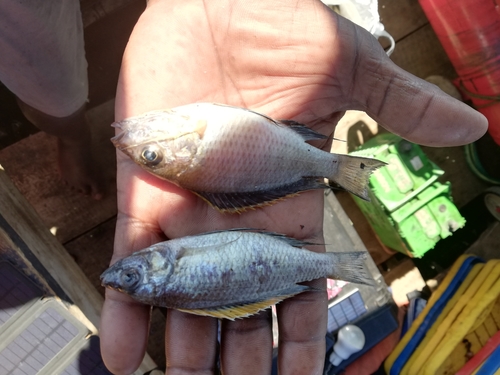
This is a modestly sized, fusiform cichlid. FishBase gives a maximum of about 5.2 in (5 in) total length, with males maturing around 4.2 in (4 in); hobby references stretch the figure to roughly 5.5–6 in (5.5–6 in) for large males. Females and non-breeding fish are plain and silvery, lightly countershaded, in keeping with their open-water life.
The drama is in the breeding males. At the Nkhata Bay type locality they turn dark grey on the body and lower fins but carry a vivid "blaze" — bright yellow at that site — running along the entire upper surface from snout to tail. The dorsal fin is yellow with a narrow black stripe at its base that kicks sharply upward through the soft-rayed portion, a distinctive mark that Turner and colleagues use to recognize the species. Other populations swap the yellow blaze for pale blue. As a "pure utaka" it lacks flank spots, and like the rest of the genus it has a small, highly protrusible mouth and long gill rakers. Stressed fish flush with dark vertical bars, a useful tell of an unsettled tank. Beware look-alikes: it is easily confused with Copadichromis ilesi and, historically, with Copadichromis mloto; one practical field difference from Copadichromis ilesi is the red-to-yellow stripe along the male's dorsal fin, which Copadichromis ilesi lacks.
Habitat
Copadichromis virginalis is endemic to the Lake Malawi system. The IUCN gives it a lake-wide distribution extending into the Upper Shire River and Lake Malombe, with an estimated area of occupancy of about 1,216 mi² within a much larger extent of occurrence near 11,602 mi²; older FishBase text describing it as confined to the lake's "north end" predates that broader picture (and partly reflects the old confusion with Copadichromis mloto). The type locality is Nkhata Bay, on the central western shore.
This is an open-water, demersal fish rather than a rock-hugging specialist. It hangs in the water column over sandy or muddy bottoms, often near reefs and rocky shores, and shoals — sometimes in large numbers and in mixed-species groups — facing into the current to feed. In the northern part of the lake's southwestern arm it is among the most abundant fishes in water 100–165 ft deep; specimens of the broader pure-utaka complex have been trawled from as shallow as ~59 ft down to about 374 ft. As a Malawi endemic it lives in alkaline, well-buffered water: in-situ conditions run warm and basic, around 75–82°F (75–82 °F) with a pH near 7.7–8.8, the chemistry the lake is famous for.
Feeding
The utaka are Lake Malawi's zooplankton specialists, and Copadichromis virginalis is a textbook example, sitting at a trophic level of about 3.0. It feeds by hanging in open water and watching with large eyes for individual planktonic animals drifting past; when one comes within range, the upper jaw shoots forward into a tube while the gill covers snap shut, generating a split-second of suction that draws the prey in. The long, numerous gill rakers that characterize the genus help retain small food items.
Ecologically these fish matter out of proportion to their size. As abundant midwater planktivores they convert the lake's plankton into fish biomass that supports both larger predators and people: utaka are a significant component of Malawi's catch. That same abundance makes Copadichromis virginalis a commercially important food fish, taken in large numbers by trawl and seine fisheries in the southern arms of the lake and in Lake Malombe.
Mating
Socially this is a shoaling fish with a hierarchy: groups organize around dominant individuals, and lone fish stress easily. Like all utaka it is a maternal, polygamous mouthbrooder, and males display from a territory to court passing females. Unlike the open-water spawner Copadichromis chrysonotus or the sand-nesters of the genus, true Copadichromis virginalis is a bower-builder that breeds in association with rock: Konings describes males digging a simple crater in soft substrate beneath an overhanging rock, so the rock interrupts what would otherwise be a complete circular nest. In fuller detail from his field notes, the nest is a crescent-shaped wall of sand positioned under or beneath a suspended slab of rock, built as big as or bigger than the rock itself — the key requirement being that the rock forms the ceiling of the spawning site (Cichlids Yearbook Vol. 1). A male in full colour displays from his nest to entice receptive females. Males can be persistent and pushy in courtship, which is why a single male with several females spreads the attention and keeps any one female from being harried.
Breeding
Breeding appears to be seasonal and the season brief; Fryer and Iles reported spawning around May–June, distinct from Copadichromis mloto's later August–November window. That tidy split sits awkwardly against Konings's own Gome Rock field notes, in which the Kaduna-type population there (provisionally 'Fire-Crest Mloto,' hypothesised as conspecific with true virginalis) was recorded breeding specifically in an August–November window at depths beyond 98 ft (Cichlids Yearbook Vol. 1) — the opposite season from the one usually attributed to virginalis. This may reflect real locality-to-locality variation in breeding timing, which is documented elsewhere in the Malawi flock, or it may reflect lingering uncertainty in assigning that particular population; we flag the conflict rather than resolve it. The mechanics are classic Malawi. A receptive female lays eggs in batches and immediately takes each into her mouth. Drawn to the egg-spots on the male's anal fin, she nips at them and in doing so takes up his milt, fertilizing the clutch she is already brooding. She then carries the developing young for three to four weeks, not feeding, before releasing free-swimming fry large enough to take brine shrimp nauplii. Clutch sizes are not separately documented for this species, but the open-water utaka are modest brooders — by analogy to Copadichromis chrysonotus, which averages roughly 50 eggs per brood, a clutch of a few dozen is typical. Care is entirely maternal: the female alone broods and guards, with no paternal involvement after spawning.
In the aquarium
Copadichromis virginalis is, by hap standards, a genuinely peaceful, open-water fish — and that defines how to keep it. It needs swimming room, not a rockscape: a tank of at least 60 x 18 x 18 in (150 x 17.5 in footprint, ~80 US gal) is a sensible floor, with larger volumes (185–210 US gal) recommended for proper groups. Give it a sand bed for the male to work, a few rock piles for structure, and otherwise open water. Alkaline, well-buffered Malawi water suits it: roughly 75–82°F (75–82 °F), pH 7.7–8.8.
Keep it in a shoal — five or more, ideally one male to three or more females, or several males with proportionally more females in a big tank. The mistakes keepers make are predictable: housing it with mbuna or other rowdy, belligerent cichlids, which bully this gentle species; crowding it into too short a tank; and mixing it with other Copadichromis or similarly coloured fish, which invites both aggression and hybridization. Better company is calm — peaceful Aulonocara and mild haps such as Cyrtocara moorii. It is an unfussy eater in captivity despite its planktivorous wiring; small frozen and dry foods, brine shrimp, and some Spirulina-based vegetable matter keep it healthy. One caveat worth flagging: much of the "Copadichromis virginalis" in the trade carries a locality tag ("Gold Nkanda," and the like), and given the unsettled taxonomy, some hobby stock may actually be Copadichromis mloto or related forms.
Conservation
On the IUCN Red List, Copadichromis virginalis is Near Threatened (criterion A2bd), assessed on 22 June 2018 and published in 2019 by Ad Konings — an upgrade from "Data Deficient" in 2006, reflecting better data rather than a sudden change in the fish. The population trend is decreasing. The reasoning is specific: standardized trawl surveys showed roughly a 40% drop in the weight of Copadichromis virginalis in catches between 1998–1999 and 2016, which interpolates to about a 20% decline over ten years — close to the threshold for Vulnerable. The driver is over-fishing. As one of the commercially important open-water "utaka," Copadichromis virginalis is exactly the kind of abundant midwater shoaler that the lake's pelagic fisheries target by the netful — particularly chirimila (open-water seine) nets and trawls that can intercept spawning aggregations in the southern arms and in Lake Malombe; collection for the ornamental trade is minor, since this is valued mainly as food. It remains a common, even locally dominant species, so the honest summary is a still-abundant fish on a downward trajectory, not one on the brink.
That trajectory sits inside a strained lake. The basin review by Chavula and colleagues (Journal of Great Lakes Research, 2023) flags over-fishing and the collapse of the prized chambo (Oreochromis) fishery, heavy sediment and nutrient loading from deforested and farmed catchments, and a warming of roughly +33 °F in surface waters that strengthens stratification and suppresses the deep-water mixing that fertilizes the lake's plankton. For an open-water planktivore like Copadichromis virginalis, that last point bites twice: its food supply is the very plankton that warming-driven stratification can throttle, and its body is the catch that an intensifying fishery pursues. The 2022 finding that the lake's commercial "utaka" are a tangle of more than one species adds a quieter risk — fisheries and conservation measures keyed to a single name may not protect the distinct forms that name conceals. None of these basin pressures is unique to this fish, but together they explain why a species still hauled up by the netful is, sensibly, listed as Near Threatened.