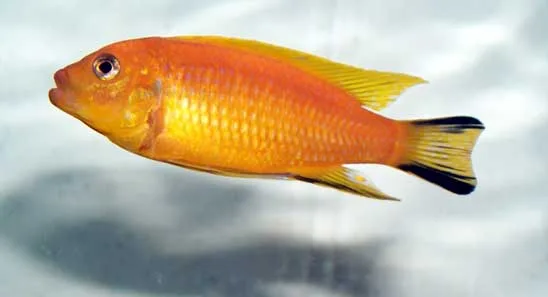
Taxonomy & naming
Maylandia sp. "Daktari" is a Lake Malawi mbuna known only by its aquarium trade name. No taxonomist has published a formal description of it, so it carries no valid Latin binomial, no describing author, and no year of publication — none of these should ever be attached to it. It appears on the malawi.si database and in specialist hobby circles as "Maylandia sp. 'Daktari'" (also written under the rival genus name Metriaclima sp. "Daktari"), following the standard open-nomenclature convention in which "sp." plus a name in quotation marks flags a working label for an undiagnosed population rather than a validated species.
The trade name derives from the Swahili word daktari, "doctor." How the name became attached to this particular fish is not documented in any source consulted here, and no story beyond the plain meaning of the word should be assumed.
Within Maylandia — the genus of rock-dwelling "zebra" mbuna whose systematics remain split between Maylandia (Meyer & Foerster, 1984) and the synonym Metriaclima (Stauffer et al., 1997) — this form belongs to the broad zebra-type species complex rather than to any single named relative. Konings and malawi.si use Maylandia; FishBase lists it as the accepted genus; other authors continue to use Metriaclima. Because no description exists for this population under either name, the wider genus dispute is secondary to the more basic fact that the species itself has never been diagnosed.
Morphology
No published measurements or colour description specific to Maylandia sp. "Daktari" were found in the sources consulted for this article. What can be stated with confidence is genus context: zebra-complex Maylandia share a moderately deep, laterally compressed body, a blunt head, and the small, closely packed teeth built for scraping algae from rock, with adult size across the complex generally in the 3.5–4.5 in range.
Breeding males in the complex typically carry a blue ground colour with dark vertical barring, while females are usually duller and, in some species, show an orange-blotched pattern. Whether this specific population follows that pattern in any particular detail — bar count, exact hue, presence of orange-blotched females — is not established here, and none of it should be presented as documented fact for this form. What is solid is its provenance: a rock-associated Maylandia from the far north-eastern reach of the lake, structurally consistent with the rest of its genus.
Habitat
The four documented localities for Maylandia sp. "Daktari" — Chiwindi and Ngombe on the Mozambican shore, Undu Reef in Tanzanian waters, and Hai Reef — sit within a few tens of kilometres of one another, precisely where Lake Malawi's Mozambican and Tanzanian shorelines meet. The same form turning up on both sides of an international boundary is unremarkable: political borders on the lake mean nothing to a cichlid population, and these sites cluster around a single stretch of coast rather than spanning the length of the lake.
Like other zebra-complex Maylandia, the fish is expected to live on rocky substrate rather than open sand, since the genus's dentition and territorial habits are built around grazing hard surfaces. Lake Malawi's upper rocky zone runs broadly 24-28 degC and pH 7.7-8.6, alkaline and well-buffered, with mbuna habitat typically found from a couple of metres down to roughly 66–82 ft depending on how steeply the shoreline drops. No site-specific depth or temperature record exists for this form beyond those lake-wide figures.
Feeding
As a member of the Maylandia zebra complex, Maylandia sp. "Daktari" is presumed to be an aufwuchs grazer, in line with essentially the entire genus. Aufwuchs is the felted mat of algae, diatoms, and associated micro-invertebrates and detritus that coats sunlit rock through the lake's shallows; mbuna rasp it loose with rows of small, closely packed teeth built for scraping rather than biting.
No feeding study specific to this population exists. The assignment above follows from genus membership and the rocky habitat recorded at its collection sites rather than from direct observation of this fish. Aquarium keepers should treat it as an obligate herbivore-leaning grazer requiring a plant-heavy diet, exactly as with every other described and undescribed Maylandia.
Mating
Social behaviour has not been separately documented for this form. By analogy with Maylandia and Lake Malawi mbuna generally, mature males are expected to hold and defend individual rock territories year-round, using colour and posture to advertise a spawning site while driving off rival males — particularly those with similar patterning. Females are not territorial and move between males' territories rather than pairing permanently with one.
Aggression in mbuna concentrates within and between similarly coloured species, since territorial signalling and resource competition run strongest among fish that look alike and graze the same rock surfaces; this general rule underlies the standard aquarium stocking advice given for the genus below.
Breeding
Maylandia sp. "Daktari" is inferred to be a maternal mouthbrooder, the reproductive mode fixed across every Lake Malawi haplochromine including all Maylandia. Spawning takes place at or near the male's territory: the female releases a small number of eggs and takes them into her mouth, then draws in sperm by mouthing the egg-spot markings on the male's anal fin, which mimic her own eggs closely enough to prompt the behaviour. Fertilisation therefore happens inside the female's buccal cavity. She broods the clutch orally for roughly three weeks, fasting throughout, before releasing free-swimming fry.
No clutch-size record exists for this specific form. Genus-typical broods for similarly sized Maylandia run from around ten to a few dozen eggs. There is no paternal care at any stage; the male's involvement ends at fertilisation.
In the aquarium
Maylandia sp. "Daktari" is a scarce fish outside dedicated Malawi cichlid circles and is unlikely to appear in a general aquarium shop; when available, it moves through specialist importers and hobbyist trading networks. Husbandry guidance here follows the standard zebra-complex Maylandia template, since no form-specific literature exists.
A tank of at least 47 in suits a small single-male colony, aquascaped with rockwork stacked into caves and broken sightlines over a sand floor. Water must replicate Lake Malawi's chemistry: alkaline and well-buffered, pH roughly 7.8-8.6, temperature 24-28 degC, with strong filtration and oxygenation. Diet should be plant-forward — spirulina-based flake or pellet, algae wafers, blanched vegetables — with meaty foods withheld or offered only sparingly, since protein-heavy feeding is strongly associated with the bloating syndrome that kills mbuna in captivity.
One male with several females is the standard low-conflict arrangement; two territorial males of the same or similarly patterned species in one tank invites sustained fighting. As with any undescribed locality form, keeping it apart from other Maylandia populations preserves its value as a distinct, traceable trade fish and avoids producing hybrid offspring of no scientific or hobby worth.
Conservation
Maylandia sp. "Daktari" has never been formally described and so carries no IUCN Red List assessment of any kind — evaluation requires a valid scientific name, which this population lacks. That is a statement about taxonomy, not a claim about population health in either direction.
Its recorded range sits on the Mozambique-Tanzania stretch of the lake, an area with less intensive cichlid-collection pressure than the well-worked Malawian shore, but one that shares the lake-wide pressures documented across Lake Malawi: shoreline sedimentation from catchment deforestation, a warming and increasingly stratified surface layer, and the cumulative effects of the commercial fishery on the wider ecosystem. Formal description would be the necessary first step toward any future Red List evaluation; until then its status is properly recorded as unassessed rather than assigned a rating that does not exist.