Taxonomy & naming
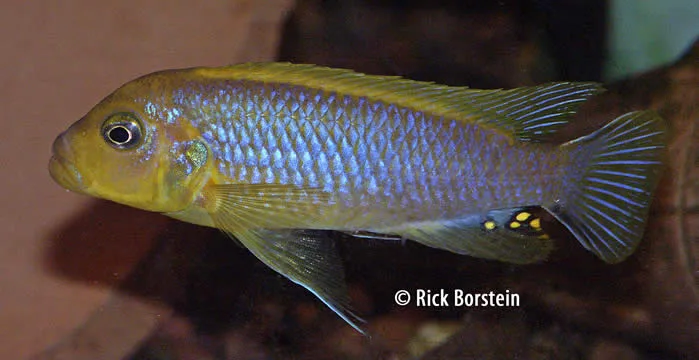
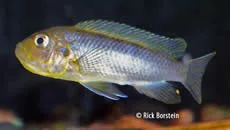
Maylandia sp. "Lime Nkhomo" has no describing author, no year of publication, and no FishBase entry. It circulates under this informal trade name, following the standard convention for undescribed Malawi cichlids of pairing the genus, "sp.", a colour descriptor ("Lime"), and a locality ("Nkhomo", for Nkhomo Reef, one of its two recorded sites). Mbenji Island and Nkhomo Reef, in south-central Lake Malawi, already host several formally described Maylandia, including M. barlowi; this form has not been assigned to any of them and should be treated as its own distinct, unnamed population.
Morphology
The defining trait recorded in this form's trade name is colour: "Lime" indicates a lime-green to yellow-green body tone, a shade documented in several other Maylandia zebra-complex populations across Lake Malawi though not universal to the genus. Beyond that colour indication, no detailed published account of this specific population's pattern, sexual dichromatism, or measurements exists, and this article does not extend the description further than the name itself documents.
Habitat
This form is recorded from Mbenji Island and Nkhomo Reef, both in south-central Lake Malawi on the Malawian side. Like other Maylandia, it is expected to occupy rocky reef habitat around the boulder-strewn shorelines of these sites. Water conditions follow Lake Malawi's typical rocky-habitat envelope: warm, alkaline, and well-buffered, at the moderate depths characteristic of rocky mbuna reefs in this part of the lake.
Feeding
Maylandia is, genus-wide, an aufwuchs grazer, rasping algae, diatoms, and associated micro-organisms from rock surfaces with specialised bicuspid teeth. No feeding study specific to "Lime Nkhomo" has been published, but this dietary pattern is close to universal across the genus and is a reasonable expectation for this form as well.
Mating
Male mbuna of the Maylandia zebra complex are territorial rock-holders, defending a patch of reef against rivals and displaying to passing females with no lasting pair bond. No courtship account specific to this form has been published, so its behaviour is presented here as genus-typical rather than independently documented.
Breeding
As with every Lake Malawi cichlid, Maylandia sp. "Lime Nkhomo" is presumed to be a maternal mouthbrooder: the female lays eggs, takes them into her mouth, and is drawn to the egg-spot markings on the male's anal fin, whose pursuit causes her to take in milt that fertilises the clutch already in her buccal cavity. She then broods the eggs and fry for roughly three weeks before releasing free-swimming young, with no male or post-release parental care. No clutch size has been documented for this specific form; genus-typical Maylandia broods run from roughly a dozen to several dozen eggs depending on female size.
In the aquarium
Maylandia sp. "Lime Nkhomo" is a specialist, locality-based form rather than a mainstream trade fish, and hobbyist documentation specific to it is limited. Keepers should follow standard Maylandia husbandry: a large rockwork structure with plenty of caves and broken sightlines, fine sand substrate, and alkaline, well-buffered water in the range of roughly 75–82 °F and pH 7.7–8.6. Diet should lean heavily plant-based — spirulina flake, algae wafers, and blanched vegetables — with meaty foods limited to occasional supplements, since chronic high-protein feeding predisposes mbuna to bloat. A single male with several females is the standard, lowest-stress social arrangement; because Mbenji Island and Nkhomo Reef host several other Maylandia populations, keepers who intend to breed true should avoid mixing this form with congeners from the same sites.
Conservation
Maylandia sp. "Lime Nkhomo" has no IUCN Red List assessment, since formal evaluation requires a validly published scientific name and none exists for this form. As a rock-restricted population apparently confined to Mbenji Island and Nkhomo Reef, it shares the general pressures documented across Lake Malawi's island- and reef-endemic mbuna — a naturally narrow range, sensitivity to localised habitat disturbance, and exposure to the ornamental collecting trade that has long targeted this area — but no population-specific data exist to characterise its status beyond that general context.