Taxonomy & naming
Albert Günther described this fish in 1894 (in the Proceedings of the Zoological Society of London for 1893) as Hemichromis afer, from material collected in Lake Malawi — then Lake Nyasa. His account fixed no precise reef; the type locality is simply 'Lake Nyasa,' anchored by two syntypes in the Natural History Museum, London (BMNH 1893.1.17.7 and 1893.1.17.8). Eschmeyer's Catalog of Fishes treats the species as valid as Cynotilapia afra (Günther 1894), the dual dating reflecting that the volume bears 1893 but appeared in 1894. The genus Cynotilapia was erected by C. Tate Regan in 1922 to hold the Malawi mbuna whose outer jaw teeth are unicuspid and fang-like rather than bicuspid — a single, conspicuous character that long defined the group. The name is literal: from the Greek kyon, dog, joined to tilapia, the catch-all term for African cichlids, for those canine teeth; the epithet afra simply means 'African,' a flat choice that the ETYFish Project notes is rather unimaginative given that every member of the original genus was African anyway. The taxonomy here is genuinely unsettled territory, and any honest account has to say so. Cynotilapia is a small genus with only a handful of described species but a long roster of distinct, geographically separated populations. In 2011 Patrick Tawil re-examined the type material of Cynotilapia and of Microchromis and described Cynotilapia aurifrons, while reaffirming that the widespread banded 'afra-like' form across much of the lake is properly Cynotilapia zebroides (Johnson, 1975) — a name resurrected from the synonymy of Microchromis. The practical upshot, emphasized by Ad Konings and the malawi.si database, is that true Cynotilapia afra is now restricted to the central and eastern lake, and that the famous trade fish 'Cynotilapia afra Cobue,' 'Jalo Reef,' 'White Top,' and the rest are Cynotilapia zebroides. malawi.si goes so far as to title its zebroides page 'Cynotilapia afra (misidentification).' Konings considers the holotype-anchored true afra most likely to have come from Chizumulu Island. Readers should treat older aquarium literature and care sheets using the name 'Cynotilapia afra' with that caveat firmly in mind.
How deep that confusion runs is visible in Konings' own earlier field writing. A 1990s survey of the genus by Konings records C. afra along Likoma, Chizumulu, and the rocky West coast stretch between Chirombo Point and Ngara — a northern, partly western-shore range quite different from the central-and-eastern-lake distribution given for true afra today — and the same account describes Ribbink and coworkers' 1983 rocky-habitat survey turning up at least eight further undescribed Cynotilapia forms besides afra and axelrodi, each given a provisional trade name tied to its collecting site: C. sp. 'Jalo' (Jalo Reef, near Nkhota Kota), C. sp. 'Chinyankwazi' (restricted to the protected islets of Chinyankwazi and Chinyamwezi in the southeast arm), C. sp. 'Ndumbi' (a nearly all-black form from secluded caves at Ndumbi Rocks, Likoma Island — so even Likoma, part of true afra's accepted range, hosts other undescribed congeners), C. sp. 'Maleri' (Maleri Islands only), and two further species at the Mbenji Islands alone, C. sp. 'Yellow Dorsal' and C. sp. 'Black Dorsal'. Even a rigorous, peer-reviewed source can carry the same ambiguity: Stauffer and colleagues' 1996 paper on a hybridization event at Thumbi West Island (see Conservation) also identifies its translocated fish as 'Cynotilapia afra from the northern part of the lake,' almost certainly using the same pre-2011, broader sense of the name. None of this overturns the current, taxonomically tightened picture of true afra — it simply shows why the caveat is necessary in the first place.
Morphology
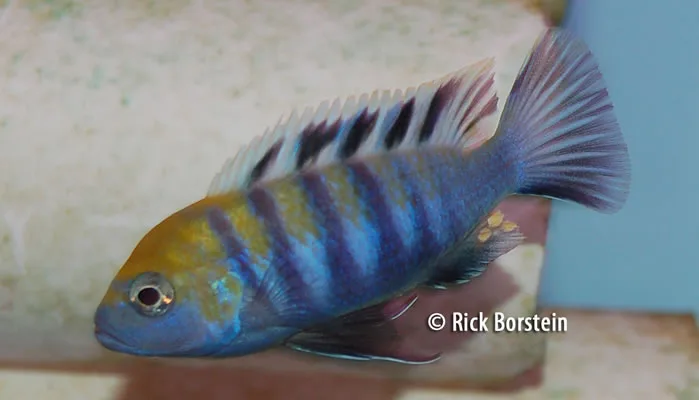
This is a small, slender mbuna. FishBase lists a maximum of about 4 in standard length, matched by the 4 in figure Konings tabulates in Enjoying Cichlids; in the field and in tanks, territorial males reach roughly 4.5 in total length and females stay nearer 4 in, with captive fish sometimes a touch larger. The body is moderately elongated and of medium depth, the dorsal profile gently rounded and the forehead nearly straight, with isognathous (evenly aligned) jaws. The genus-defining feature is in the mouth: the outer row of widely spaced, unicuspid, slightly recurved teeth that give the dogtooth cichlid its name and that set Cynotilapia apart from the bicuspid-toothed Maylandia and Tropheops it often swims among. Sexual dimorphism is strongly pronounced and, as in most mbuna, it is chiefly a matter of color. Males in the true afra are predominantly deep black overlaid with broad pale-blue vertical bars and a clean white margin to the dorsal fin, plus the usual mbuna egg-spots on the anal fin. Females are a plain silvery to brownish-grey, light enough to be unmistakable beside a displaying male. Because the many geographic forms — most now reassigned to Cynotilapia zebroides — differ mainly in male coloration (light blue, electric blue, white-capped, yellow-flanked), color alone is a poor guide to species identity, and adjacent populations can be told apart only by where they were collected. The longstanding hobby rule that you should keep just one Cynotilapia form per tank exists precisely because these look-alikes hybridize readily.
Habitat
Cynotilapia afra is a Lake Malawi endemic, and like almost all mbuna it is a habitat specialist tied to the lake's rocky shores, with no riverine or open-lake dispersal stage in its life history. The IUCN assessment, authored by Konings and colleagues, gives its range as the eastern shore from Undu Point in Tanzania south to Makanjila Point in Malawi, the entire Mozambique shoreline, and the islands of Likoma, Chizumulu and Mbenji. Within that range it settles in virtually any rocky or intermediate (rock-meets-sand) habitat but is most common in the deeper, more sediment-rich rocky zones below about 49 ft, where males defend small caves among medium-sized rocks. FishBase records a depth band of roughly 10–98 ft. The water it lives in is the alkaline water characteristic of Lake Malawi: FishBase records for the species give a pH around 8.0 to 8.5 and a hardness upward of about 15 dH, with temperatures of roughly 73–81 °F — the lake as a whole runs warm and well-buffered, typically pH 7.7 to 8.6 and surface temperatures in the mid-20s. Females and non-breeding males forage out in the water column, typically no more than a few metres above the rock face, but, tellingly, never stray far from the rocks that anchor their world. At many of the localities where it occurs, true afra shares the reef with a sympatric, generally deeper-dwelling congener — the still-undescribed C. sp. 'Mbamba' — echoing the same fine-grained depth partitioning seen elsewhere in the genus.
Feeding
Cynotilapia afra makes its living in two ways at once, and that flexibility is the ecologically interesting part. FishBase places it at a trophic level near 3.4 — higher than the dedicated algae-grazers around it — because it is fundamentally a plankton feeder. Females and the non-territorial males school loosely just off the rock face and pick suspended food from the open water: phytoplankton (algae and diatoms) for the most part, but zooplankton too when it is abundant. The widely spaced canine teeth that name the genus suit this plucking, particle-by-particle feeding far better than the close-packed combs of a true aufwuchs-scraper. Territorial males, pinned near their caves by the demands of defending a spawning site, can't follow the shoals offshore, so they switch to whatever is at hand and supplement their diet by grazing the aufwuchs — the felt of algae, diatoms and small invertebrates coating the rocks. The result is a single species occupying two feeding niches depending on social status, a small example of the ecological versatility that helped the mbuna radiate into hundreds of forms on Malawi's rocky coasts. That natural diet matters in captivity, and it is the point keepers most often get wrong: this is a plankton-and-algae feeder, not a carnivore, and a protein-heavy diet invites the bloat that plagues mbuna — a spirulina-based, vegetable-leaning food suits it far better.
Mating
Like most Malawi mbuna, Cynotilapia afra is pugnacious, and its mating system is built around the territorial male. Males establish and hold territories centred on a cave among the rocks, displaying to ripe females and chasing rival males — they will pursue a conspecific intruder several metres before returning to the cave. The social structure that emerges is a polygynous harem: in nature, and reliably in captivity, a single male courts and spawns with several females, on the order of three or four. That cave-defending aggression is the dominant fact of the fish's social life; it is intense enough that keepers spread it deliberately, either by holding one male to a group of females or by introducing a large cohort together so no single fish bears the brunt. When a female is ready she enters the male's cave to spawn, and his courtship culminates in the standard haplochromine ritual: the male's anal-fin egg-spots prompt her to mouth at them just as he releases milt, so that fertilization happens inside her buccal cavity. Sexual maturity comes early, at roughly six to eight months. One caution belongs here as much as in any account of the fish's biology — because the many geographic forms (most now reassigned to Cynotilapia zebroides) differ chiefly in male color and cross freely, they should never be mixed; in a shared tank look-alike Cynotilapia and similar barred mbuna will hybridize and blur the distinct populations.
Breeding
Cynotilapia afra is a maternal mouthbrooder. The female lays her eggs in the male's cave and immediately takes them into her mouth, where the clutch — small, in keeping with the fish's modest size, on the order of a dozen to perhaps thirty eggs — is brooded. She then carries the developing young for about three weeks, brooding solitarily and staying close to the rocks, before releasing free-swimming fry near cover. Care is female-only: there is no biparental contribution and no post-release guarding, so once the fry are spat out they are on their own. The species breeds readily in captivity under conditions that match the lake — alkaline, well-buffered water (pH comfortably in the high 7s to mid 8s) and temperatures around 75–81 °F — in a long, rockwork-rich aquarium offering several caves so a male can hold a spawning site. A practical note from the hobby that bears directly on breeding stock: almost everything written about keeping and breeding 'Cynotilapia afra' actually describes Cynotilapia zebroides, since true afra is rare in the trade, so older care sheets and the bloodlines behind them should be read with that identity caveat in mind.
In the aquarium
Cynotilapia afra is an intermediate-level mbuna — manageable for a keeper who has kept mbuna before, but a poor choice as a first cichlid. The minimum sensible footprint is a 120-cm (4-foot) aquarium for a single-male group, and 59 in or longer is better if you plan to keep the species alongside other rock-dwelling cichlids. Floor space matters more than height: this fish lives on and among the rocks, so a long, shallow tank with a broad base gives each animal more territory to occupy than a tall, narrow one of the same volume. Rockwork is non-negotiable. Stack flat stones and slate into columns and overhangs that create a generous supply of caves and visual barriers; the goal is a hardscape broken enough that a female or subordinate male can always duck out of a dominant male's line of sight. Bare or sparsely decorated tanks concentrate aggression fatally. A sand or fine-gravel substrate is appropriate and looks natural; coarse gravel or chunky substrate with no hiding places is not.
Water chemistry must reflect Lake Malawi's alkaline, well-buffered character. Target a pH of 8.0–8.5, general hardness above about 15 dH, and a temperature between 23 and 81 °F. These parameters are far outside the default 'tropical community' range, so a keeper starting from soft, acidic tap water will need a carbonate buffer or a dedicated Malawi salt mix — lowering the pH or running the fish in soft water invites chronic stress, immune suppression, and failure to breed. Robust filtration is important: mbuna produce high nitrogenous waste, and rock-heavy tanks with limited plant life depend entirely on mechanical and biological filtration to keep nitrates in check. Regular large partial water changes (30–40 % weekly) are the simplest practical safeguard.
Diet is the most common husbandry failure with this species. Cynotilapia afra is a planktivore and aufwuchs grazer, not a carnivore, and a protein-heavy diet — especially the beef-heart and bloodworm regimens once standard in the mbuna hobby — is a reliable route to the chronic digestive disorder keepers call 'Malawi bloat.' Feed the main ration as a spirulina-based or vegetable-enriched flake or pellet, supplement with dried algae wafers and occasional live or frozen daphnia or brine shrimp as a protein fraction, and keep meaty offerings small and infrequent. Feed two or three small meals rather than one large one, and never more than the fish can clear in a few minutes.
Social structure demands attention. Keep one male per tank, or per clearly separated territory in a sufficiently large aquarium; two males of similar size in a confined space will fight to the death or near it. A male should be kept with a minimum of three or four females — the harem structure spreads spawning pressure and prevents a single female from being harassed relentlessly. Suitable tankmates are other mbuna of comparable size and temperament that occupy different ecological niches and cannot easily be confused for conspecifics: Labidochromis, some Iodotropheus, and robust but non-belligerent Pseudotropheus and Metriaclima forms work reasonably well. Avoid anything too passive, too small, or too timid, and never combine this species with other Cynotilapia forms — including any of the many Cynotilapia zebroides location variants formerly sold as 'Cynotilapia afra' — because they hybridize freely and the resulting offspring blur distinct wild populations. Mixing colour forms is one of the most widespread and consequential keeper errors in the mbuna hobby.
Breeding is straightforward once stable conditions are in place. A ripe female will enter the male's favoured cave, the pair will spawn in the standard egg-spot routine, and she will immediately take the clutch — typically somewhere between a dozen and thirty eggs — into her buccal cavity. She broods alone for roughly three weeks. The safest approach is to move a holding female to a dedicated bare-bottom tank or fine-net breeder box before she releases fry, since mbuna tankmates will eat them as fast as they emerge. Release fry into a grow-out tank with fine-grained hiding places and feed crushed spirulina flake and baby brine shrimp from the first day; growth is steady at Malawi temperatures. One practical note for anyone acquiring stock: true Cynotilapia afra is genuinely uncommon in the hobby — most fish that have been sold under that name over the past few decades are correctly Cynotilapia zebroides — so verify the provenance and location form of any fish you purchase before mixing them.
Conservation
The IUCN Red List assesses Cynotilapia afra as Least Concern (assessed 22 June 2018; Konings, Kazembe & Makocho), citing its wide distribution along the eastern and island shores of Lake Malawi and the absence of any major species-specific threat; it carries no CITES listing. The one threat the assessment names is incidental capture in subsistence chirimila-net fishing, scored as affecting a minority of the population with no detected decline, and notably the species is not a target of the ornamental trade. That clean bill of health, though, sits against a lake under mounting strain. Lake Malawi is one of the most species-rich lakes on Earth, and recent basin-scale reviews of its status flag a familiar set of pressures: heavy and in places over-intensive fishing, catchment deforestation driving sedimentation that smothers the very rocky biotopes mbuna depend on, nutrient loading, and climate warming that is strengthening stratification, reducing the mixing that fertilizes the lake's productivity, and is projected to lower fish yields. For a shallow-water, rock-bound endemic like Cynotilapia afra, sedimentation and shoreline disturbance are the most relevant of these — the species lives in exactly the inshore zone most exposed to runoff. The honest summary is that the fish itself is not currently in trouble, but the lake that holds it is, and the long-term outlook for any narrow-niche Malawi endemic is bound to the basin's.
A more unusual, human-caused risk is on record too. Stauffer and colleagues (1996) documented nine specimens at Thumbi West Island, in the south of the lake, that show signs of intergeneric hybrid origin between a population identified as Cynotilapia afra — introduced to Thumbi West by translocation from the northern lake roughly two decades before the study — and Pseudotropheus zebra, a similarly patterned species native to that island. The two are naturally sympatric at various sites in the northern lake without hybridizing, so the Thumbi West cross is best read as a translocation artifact: moving a species outside its natural range put it in contact with a close relative it would not otherwise meet, with hybridization the result. Documented hybridization is genuinely rare among Lake Malawi's more than a thousand cichlid species, which makes this one of only a handful of confirmed cases and a small cautionary note on the risks of human-mediated fish movement within the lake, however well intentioned.