Taxonomy & naming
The zebra mbuna was described by the Belgian-British ichthyologist George Albert Boulenger in 1899 as Tilapia zebra, from a single specimen — the holotype, registered BMNH 1891.12.17.7 in the Natural History Museum, London — collected in Lake Malawi (then called Lake Nyasa). For much of the twentieth century it was placed in the catch-all rock-cichlid genus Pseudotropheus as Pseudotropheus zebra, and under that name it became one of the first Malawi mbuna to reach aquarists and field biologists alike. Boulenger's name has comfortable priority; the disagreement is entirely about which genus the species belongs in. In 1984 the German aquarists Meyer and Förster proposed Maylandia as a subgenus for the zebra group, honouring the cichlid author Hans Joachim Mayland. In 1997 Jay Stauffer and colleagues, in a major revision of the 'blue-black Pseudotropheus zebra complex' (Proceedings of the Academy of Natural Sciences of Philadelphia 148:189–230), judged Maylandia a nomen nudum — a name published without an adequate diagnosis, and therefore unavailable — and replaced it with Metriaclima, designating Maylandia zebra the type species and describing ten new species alongside it. Both names have been in continuous use ever since: Eschmeyer's Catalog of Fishes and FishBase treat Maylandia as valid (ruling that the 1984 description did, imperfectly, provide differentiating characters), while the IUCN Red List and the Cichlid Room Companion use Metriaclima. The standoff is genuinely unresolved — a 2025 Zootaxa analysis by Christopher Scharpf again concluded that Maylandia is available and that Metriaclima is its junior synonym, and a 2025 rebuttal in the journal Taxonomy argued the opposite. We follow the Catalog of Fishes in using Maylandia zebra, but the literature a reader will encounter is split, and 'Metriaclima zebra' refers to exactly the same fish.
Morphology
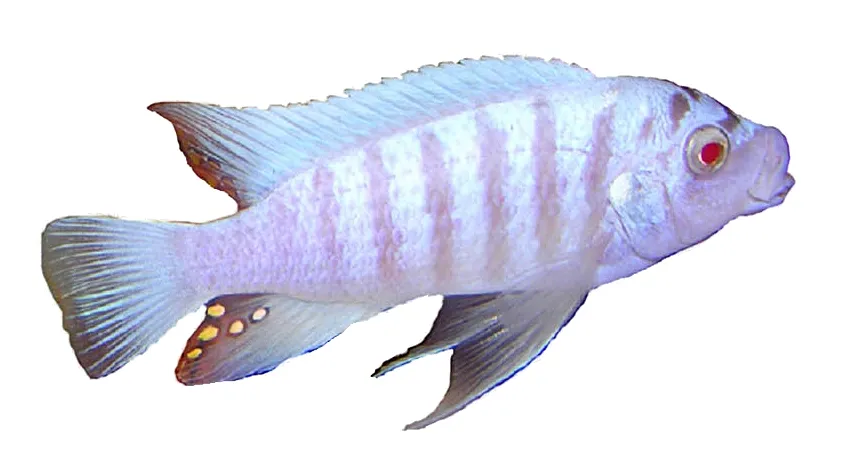
Maylandia zebra is a compact, fusiform mbuna reaching about 4.5 in in standard length; in the aquarium specimens to roughly 5 in total length are not unusual. The body is moderately deep with a gently sloped forehead — the 'moderately sloped head' that gave the alternative genus name Metriaclima its meaning. The mouth is terminal with even (isognathous) jaws, and the outer rows of teeth are bicuspid, the dental signature that places the fish in this genus. The classic, holotype-matching colour form is the so-called BB ('blue barred') morph: a pale to electric blue ground crossed by six to nine dark vertical bars, with a pale blue dorsal fin that — diagnostically — carries no interrupted or blotched pigment, unlike several of its congeners. That clean dorsal, combined with black bars on a blue ground, is what separates Maylandia zebra from the rest of the genus. The fish is strongly polychromatic. Many populations also throw OB (orange-blotched: an orange or cream body mottled with irregular black blotches) and O (solid orange) morphs, and these morphs are sex-linked in a way that has made the species a model for studying colour genetics. Sexual dimorphism is real but not absolute: dominant males show the brightest blue and the boldest bars and bear a row of prominent yellow-orange egg-spots (ocelli) on the anal fin; females and subordinate males are duller, and the OB pattern occurs far more often in females. A caution for hobbyists: the orange 'red zebra' of the trade is a different species, Maylandia estherae, not the orange morph of true Maylandia zebra.
Habitat
Maylandia zebra is endemic to Lake Malawi and is one of the most widely distributed mbuna in it, recorded the length of the lake and around the offshore islands of Likoma and Chizumulu; its range crosses into the Mozambican (Lago Niassa) and Tanzanian shores as well as Malawi proper. Like all mbuna it is a creature of the rocky littoral, the 'intermediate' and pure-rock habitats where wave-washed boulders give way to sand. FishBase records it from about 20–92 ft depth, and Konings' field observations describe adults both in shallow, sediment-free rock and in deeper, more sediment-laden zones. The fish almost never strays over open sand, which acts as a barrier between rocky outcrops — and that habitat fragmentation is precisely why the zebra complex has splintered into so many isolated, locally distinct populations. The water it lives in is warm, alkaline and well buffered: temperatures around 72–82 °F, a pH near 8 (FishBase gives a pH of about 8.0; its 9–19 dH general-hardness figure is keeping guidance rather than an in-lake reading), and very stable chemistry year-round. These are the conditions that any attempt to keep the fish must respect.
Feeding
The zebra mbuna is an aufwuchs grazer — 'aufwuchs' being the dense felt of filamentous algae, diatoms and the small invertebrates living within it that coats every sunlit rock in the lake. Konings and others describe Maylandia zebra feeding at right angles to the substrate, combing loose material from the biocover with its bicuspid teeth rather than scraping the rock bare in the manner of more specialised grazers. It is, in other words, a relatively generalised browser of the algal mat, and it readily supplements this by taking plankton from the open water above the rocks — a flexibility that helps explain its wide success across the lake. FishBase places it low on the food web, at a trophic level near 2.3, consistent with a largely herbivorous, detritus-and-algae diet. Functionally the fish is part of the enormous grazing guild that crops Malawi's rock algae and, in doing so, structures the whole littoral community.
Mating
Maylandia zebra is a polygynous, lek-style breeder with no lasting pair bond. Mature males are territorial, each defending a patch of rock or a crevice against rival males and courting any ripe female that enters; dominant males hold the best territories and colour up most intensely, while subordinates remain drab and may be chased relentlessly. Courtship is the vigorous, quivering display typical of mbuna — the male leads a female toward his site with lateral shimmying and presents the bright egg-spots on his anal fin. Females are not territorial and move among males. A well-known feature of the species is sex-limited (so-called type-B) polychromatism: in some populations males alone carry a distinct nuptial colour, a system that has made the zebra complex a textbook case for studying how mate choice on colour can drive populations apart. The behaviour is energetic and aggression is constant but mostly ritualised within the species' dense, three-dimensional rock world.
Breeding
Like virtually all mbuna, Maylandia zebra is a maternal (ovophilous) mouthbrooder. After courtship the female lays a small batch of eggs on a cleaned rock surface or in the male's territory, immediately taking them up into her mouth; she then mouths at the egg-spots on the male's anal fin, and the male releases milt that she draws in to fertilise the clutch — the egg-dummy mechanism that gives the fish their decorative anal spots a real reproductive function. Clutches are modest: FishBase records up to about 60 eggs, and genus-typical broods run from roughly twenty to sixty depending on the size and condition of the female. The female alone broods, carrying the developing young in her buccal cavity for about three weeks and eating nothing in that time; she releases free-swimming fry that can already feed on aufwuchs, and for a short while afterward will let them dart back into her mouth when threatened. There is no paternal care. The strategy trades fecundity for safety: few, large, well-protected young rather than many small ones, an adaptation to a predator-rich rocky shore.
In the aquarium
The zebra mbuna has been a mainstay of the African-cichlid hobby for half a century, and it is genuinely hardy — but it is not a community fish, and its aggression is the thing keepers most often underestimate. The blue BB form is sold simply as 'zebra' or 'cobalt blue zebra'; the orange fish usually labelled 'red zebra' is the separate species Maylandia estherae. Plan on a tank no smaller than about 4 ft (around 55–65 US gal) for a group, and larger is better. The standard formula for mbuna applies: keep one male with several females (a ratio of roughly one to three or more) to spread his attention, and stock the rock-dwellers fairly densely so that no single fish becomes the sole target — counter-intuitively, an under-stocked mbuna tank is often a bloodier one.
Replicate the lake's chemistry rather than fighting it: alkaline, well-buffered water at pH around 7.8–8.6, a temperature of 75–82 °F, and enough carbonate hardness to hold the pH steady. Aquascape with stacked rock (secured so digging fish cannot topple it) over a sand base, leaving open swimming lanes and plenty of caves and sightline breaks; live plants are mostly grazed or uprooted, though tough Anubias or Java fern lashed to rock can survive. Filtration should be generous and water changes frequent, as the stocking levels that keep aggression manageable also produce a heavy bioload.
Diet is where many keepers go wrong. As an algae and aufwuchs grazer, Maylandia zebra needs a vegetable-based, spirulina-rich diet; a menu too high in protein (excess bloodworm, beefheart and the like) predisposes mbuna to the digestive disorder hobbyists call 'Malawi bloat.' Offer spirulina flake or pellet, blanched greens and occasional small invertebrates rather than a meat-heavy regimen. Tankmates should be other robust Malawi mbuna of similar temperament — never timid community fish, and ideally never another barred blue zebra-complex species or a yellow-and-blue Cynotilapia, both of which can hybridise with it. Breeding follows almost inevitably once a male and a few females settle in; the challenge is not getting them to spawn but managing the aggression and avoiding accidental hybrids, which are a real and well-documented problem in this group.
Conservation
The IUCN Red List assesses the zebra mbuna (under the name Metriaclima zebra) as Least Concern, assessed on 22 June 2018 by Ad Konings, with a population trend listed as stable and a range spanning Malawi, Mozambique and Tanzania. As one of the most widespread and adaptable mbuna in the lake, it is far less vulnerable than the many zebra-complex relatives confined to a single reef or island. The species carries no CITES listing. That favourable status sits against a worsening backdrop, however. Lake Malawi's rocky shallows — the entire mbuna habitat — face sedimentation from catchment deforestation and farming, which smothers the algal aufwuchs the fish depend on, alongside heavy artisanal and ornamental fishing pressure and, over the longer term, the effects of a warming, more strongly stratified lake. None of these is documented as an immediate threat to Maylandia zebra specifically, but they are the pressures shaping the future of the rock-cichlid community of which it is the emblem.