Taxonomy & naming
Tropheops sp. 'olive' has no describing author, no type specimen, and no entry in Eschmeyer's Catalog of Fishes; the name used here is a hobby trade name, not a taxonomic one. It belongs to Tropheops, the genus of blunt-headed, thick-lipped rock mbuna split from the wider Pseudotropheus tropheops complex, alongside several other undescribed and described Tropheops recorded from the same far-northern stretch of the lake. No specific described sister species has been identified for this form in the literature available here, and none is asserted. Lake Malawi's mbuna radiation is unusually rich in narrowly distributed, informally recognised colour forms like this one; field collectors and hobbyists have historically outpaced taxonomists in cataloguing them, and many trade names persist for years or decades before — if a form is ever formally described at all — a species account is published.
Morphology
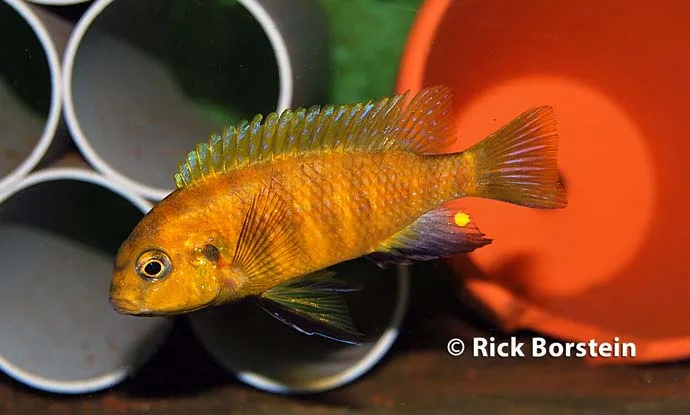
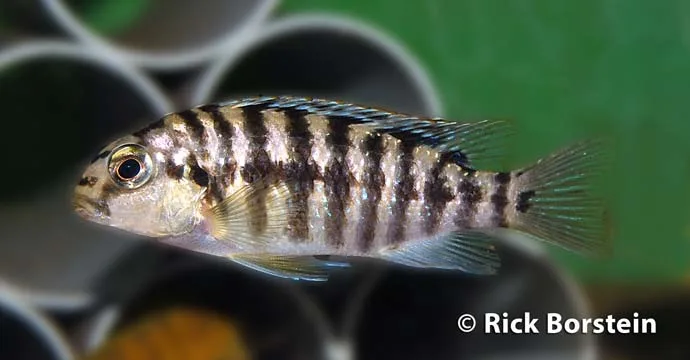
The trade name 'olive' points to a male body colour on the muted, greenish-brown end of the spectrum rather than the saturated blue seen in many other Tropheops from the same general region — a distinguishing feature at reefs where it may co-occur with brighter congeners. Beyond that colour cue implied by the name, no formal published description of fin shape, bar pattern or female colouration exists for this form, and this account does not invent one. In general build it is expected to follow the compact, blunt-headed Tropheops plan, with thick lips adapted for close algae cropping. Precise measurements — standard length, body depth ratio, fin ray counts — have not been published for this form, and none are estimated here beyond the genus-typical range. Sexual size dimorphism in mbuna generally favours males, which grow larger and hold territories, while females stay smaller and range more freely between reefs. Juveniles of most mbuna, including this genus, are typically drab or barred regardless of eventual sex, with the adult colour pattern and sexual dichromatism developing only as fish approach maturity.
Habitat
Documented localities lie at the far northern end of Lake Malawi: Chilumba, Mdowa and Mphanga Rocks on the Malawi shore, Mara Rocks slightly further south, and Lupingu across the border on the Tanzanian coast, with Chitande Island and Magunga recorded without precise coordinates. This places the form among a dense concentration of narrow-range Tropheops and other mbuna known from the Chilumba region, a rocky stretch of shoreline noted for high mbuna diversity over short distances. Lake Malawi's rocky shoreline experiences strong wave action near the surface, and mbuna reefs typically grade from bare, wave-swept rock in the shallows to more sheltered crevice habitat with depth. Water chemistry is essentially uniform throughout the lake's oxygenated upper layer — alkaline and well-buffered — so differences between reefs are mostly about rock structure, wave exposure and depth rather than water quality.
Feeding
No feeding study specific to this form exists. Like other Tropheops, it is expected to be a specialised algae grazer, using thick, fleshy lips and comb-like teeth to crop short algal turf from wave-washed rock in the shallow, high-energy surge zone the genus typically favours. Mbuna have relatively long, coiled intestines adapted to a diet dominated by plant matter, and captive keepers generally avoid high-protein foods, since a rich diet is strongly linked to so-called Malawi bloat, an often fatal intestinal distension seen in aufwuchs-grazing cichlids fed inappropriately. In the wild, territorial males spend much of the day tending and re-grazing the same patch of algae, effectively farming it, and chase off both rival males and other grazing species that intrude on the territory.
Mating
Breeding males are expected to hold and defend small rock territories in the standard Tropheops lek system, displaying to ripe females without forming pair bonds. No courtship behaviour specific to this form has been documented. As in other mbuna, males are expected to carry egg-spot markings on the anal fin that mimic the female's own eggs; during spawning, while the female collects the true fertilised eggs into her mouth, she is thought to peck at these spots, prompting the male to release sperm that she draws in, completing fertilisation inside her mouth. This egg-spot mechanism underlies mouthbrooding reproduction across Lake Malawi's cichlid radiation generally, and a male typically maintains and repeatedly refreshes his territory across many spawning cycles with different females rather than forming any lasting pair bond with one partner.
Breeding
Reproduction is by maternal mouthbrooding, as in all Tropheops and the wider mbuna assemblage. The female takes the fertilised eggs into her mouth after spawning and broods them alone for roughly three to four weeks before releasing free-swimming fry, with no further parental care from either parent. Clutch size has not been recorded for this form specifically. Comparably sized mbuna typically produce clutches in the range of 15 to 40 eggs, with larger, more experienced females producing more. A brooding female usually stops feeding or feeds only lightly for the duration, loses visible condition, and seeks out sheltered, less exposed parts of the reef until the fry are released; newly released fry often dart back into the mother's mouth at the first sign of danger for a few additional days before becoming fully independent.
In the aquarium
Tropheops sp. 'olive' is not established as an aquarium staple under this name, and no husbandry account specific to it has been published. Standard Tropheops care applies: a long, well-lit tank with dense rockwork and broken sightlines, alkaline, well-buffered water matching the lake, and an algae-forward, vegetable-leaning diet to avoid the digestive problems a protein-heavy diet can cause in grazing mbuna. A stocking ratio of one male to three or more females is standard practice for mbuna, spreading territorial and spawning attention and reducing stress on any single female. Weekly partial water changes and efficient filtration matter given the bioload of a densely stocked mbuna tank, and abrupt swings in water chemistry should be avoided, since Malawi cichlids are adapted to the lake's remarkably stable conditions.
Conservation
Tropheops sp. 'olive' has not been evaluated by the IUCN Red List and, as an undescribed form, is not currently eligible for formal assessment. Its range along the northern Malawi-Tanzania border shore carries the general risks facing that region's dense mbuna assemblage: localised ornamental collection and shoreline habitat disturbance. Lake Malawi as a whole faces mounting pressure from overfishing of food species, sediment runoff tied to catchment deforestation, and a warming climate altering the lake's thermal stratification and deep-water oxygen levels. The ornamental trade is a comparatively minor pressure next to the food fishery by volume, and well-managed collection can give local communities a direct economic incentive to protect reef habitat, though that balance depends heavily on how any particular fishery is run.