We cover the true loaches — the superfamily Cobitoidea: the botiids (Botiidae), the kuhlis and spined loaches (Cobitidae), the stone & brook loaches (Nemacheilidae), the hillstream loaches (Balitoridae and Gastromyzontidae) and the Chinese algae eater (Gyrinocheilidae). We leave out the fishes the trade loosely calls “loaches” that are not in this clade: the cyprinid “loaches” and algae-eating “sharks” of the carp family (kept under barbs), the loach cichlids of Lake Tanganyika (kept under cichlids), and the loach catfishes. Following the Catalog of Fishes for valid names, the old catch-all genus Botia has been split into Chromobotia, Yasuhikotakia, Syncrossus, Sinibotia and Ambastaia, and the kuhlis moved from Acanthophthalmus to Pangio — so a fish you bought under an old name may have moved. Two honest threads run through every account: most loaches are scaleless or nearly so, which makes them sensitive to copper and to full-strength medications yet prone to be the first fish to catch ich; and breeding is rarely achieved in the hobby — the clown loaches in shops are hormone-farmed, not home-bred. Read each account before you buy: the social needs and the water are where loaches are usually lost.
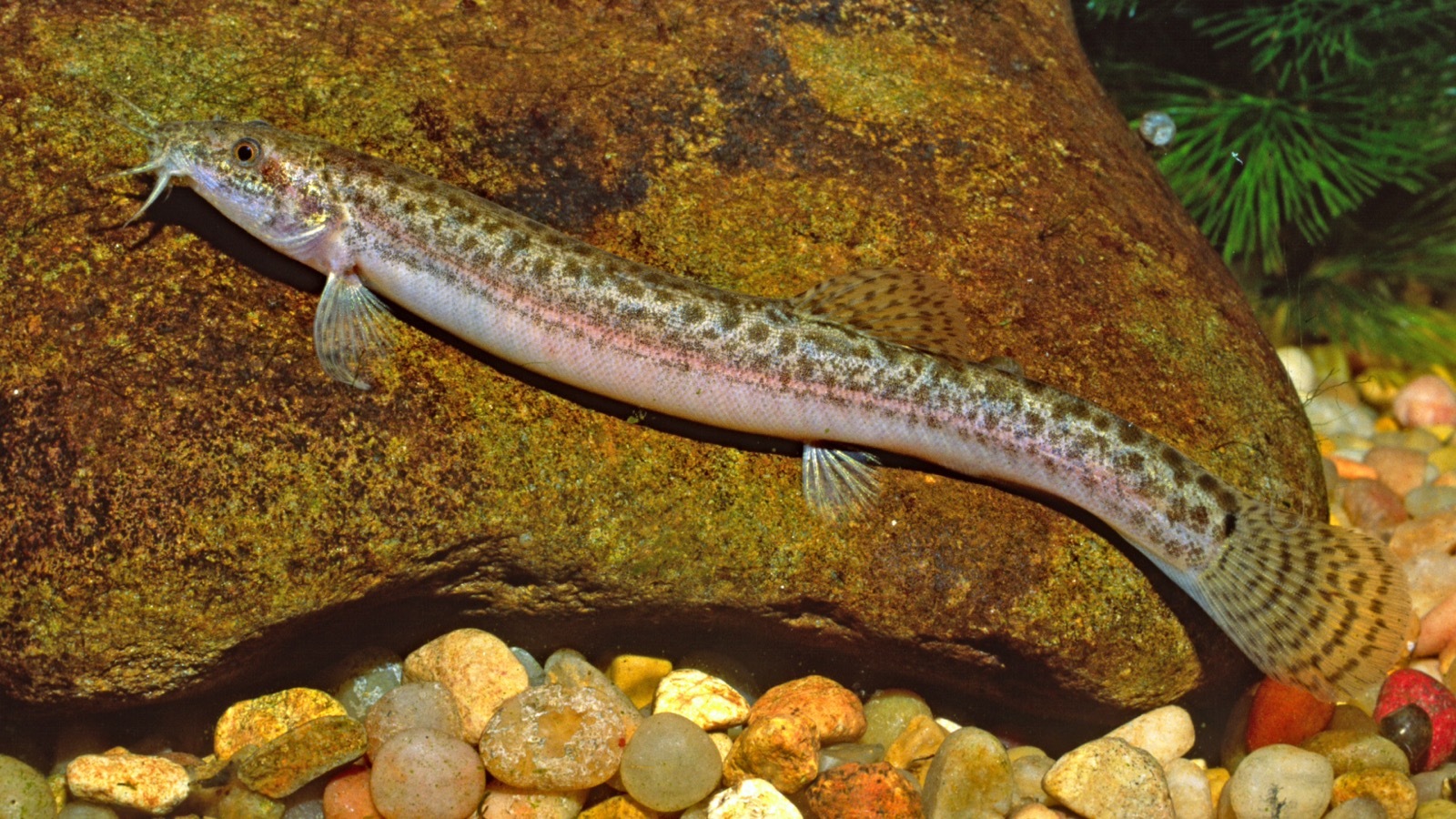
Photos © Adobe Stock
Grouped by a friendly ecology axis — botiid loaches, kuhli loaches, hillstream loaches, stone & brook loaches, spined & pond loaches, the algae eaters and the odd little families — rather than by the shifting family boundaries, though each account names its current family and authority. Following the Catalog of Fishes and FishBase, Cobitoidea is large and much of it is little-studied (the stone & brook loaches especially), so new accounts are added as they are researched, and the thinly-documented species say so plainly rather than guessing.
Species
Botiid loaches · 60
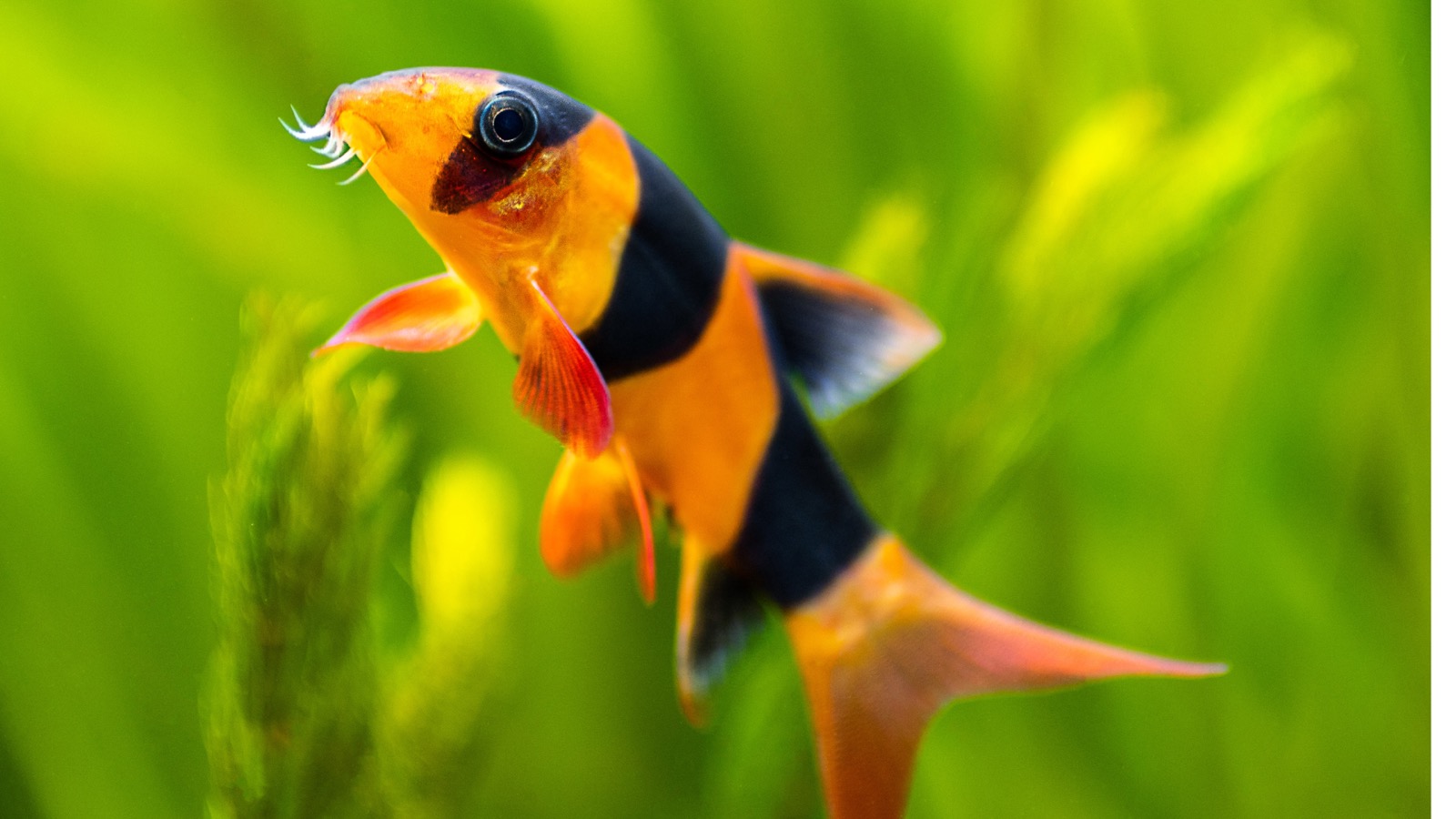
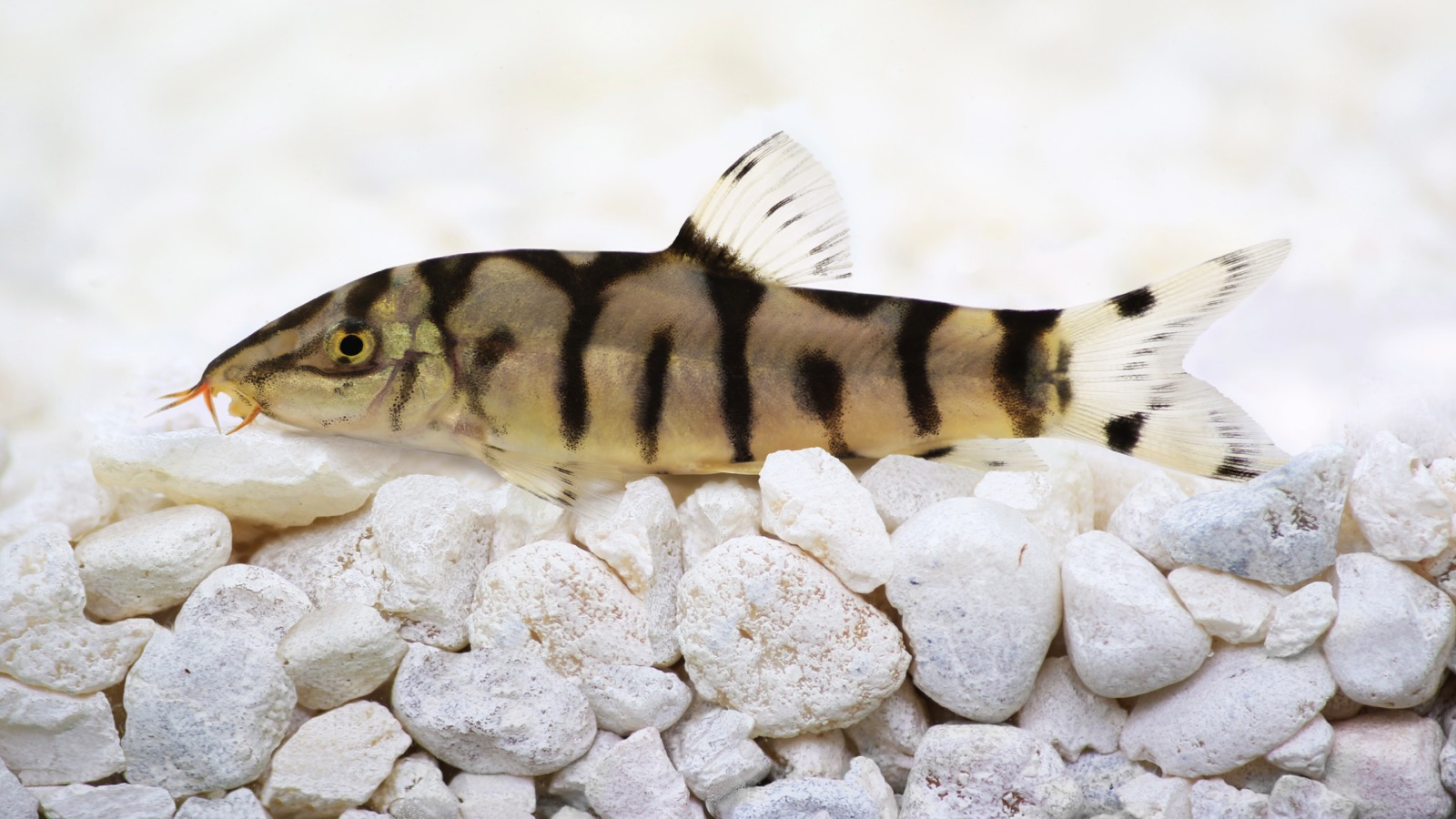
Family Botiidae — the hobby's iconic loaches: the clown (Chromobotia macracanthus), yoyo (Botia almorhae), zebra (Botia striata), skunk and dwarf chain (Ambastaia sidthimunki) loaches, plus Yasuhikotakia, Syncrossus, Sinibotia and Leptobotia. They are OBLIGATE-SOCIAL — kept singly or in pairs they turn skittish or bully, so they need a group of five or more, where they form a pecking order and "click" audibly. All carry an erectile suborbital spine (it snags nets and can nick a hand), most are near-scaleless and med-sensitive, several eat pest snails, and few are bred at home — the clown loach reaching the trade is hormone-induced on farms, not tank-spawned.
- Ambastaia nigrolineata · Black-lined loach
- Ambastaia sidthimunki · Dwarf chain loach
- Botia almorhae · Yoyo loach
- Botia birdi · Twospotted loach
- Botia dario · Queen loach
- Botia dayi · Day's loach
- Botia histrionica · Spotted loach
- Botia kubotai · Polka-dot loach
- Botia lohachata · Yoyo loach
- Botia rostrata · Gangetic loach
- Botia striata · Zebra loach
- Botia udomritthiruji · Emperor loach
- Botia variegata · Variegated loach
- Chromobotia macracanthus · Clown loach
- Leptobotia bellacauda
- Leptobotia brachycephala
- Leptobotia elongata · Imperial Flower Loach
- Leptobotia flavolineata · Yellow-line loach
- Leptobotia guilinensis
- Leptobotia hengyangensis
- Leptobotia micra
- Leptobotia microphthalma
- Leptobotia orientalis · Oriental spiny loach
- Leptobotia pellegrini · Royal clown loach
- Leptobotia posterodorsalis
- Leptobotia punctata
- Leptobotia rubrilabris · Red-lip loach
- Leptobotia taeniops · Honeycomb loach
- Leptobotia tchangi
- Leptobotia tientainensis · Tientai Spined Loach
- Parabotia banarescui
- Parabotia bimaculata
- Parabotia brevirostris
- Parabotia curtus · Japanese loach
- Parabotia dubia
- Parabotia fasciatus · Banded loach
- Parabotia kiangsiensis · Jiangxi Golden Loach
- Parabotia kimluani
- Parabotia lijiangensis
- Parabotia maculosus · Reticulated loach
- Parabotia mantschuricus · Manchurian spiny loach
- Parabotia parva
- Parabotia vancuongi
- Sinibotia longiventralis
- Sinibotia reevesae · Reeves' Loach
- Sinibotia robusta · Golden Zebra Loach
- Sinibotia superciliaris · Eyebrow loach
- Sinibotia zebra · Zebra loach
- Syncrossus beauforti · Chameleon loach
- Syncrossus berdmorei · Burmese loach
- Syncrossus helodes · Tiger loach
- Syncrossus hymenophysa · Polka Dot Botia
- Syncrossus reversus · Reverse clown loach
- Yasuhikotakia caudipunctata · Tailspot Botia
- Yasuhikotakia eos · Sun loach
- Yasuhikotakia lecontei · Le Conte's Loach
- Yasuhikotakia longidorsalis
- Yasuhikotakia modesta · Dwarf chain loach
- Yasuhikotakia morleti · Skunk loach
- Yasuhikotakia splendida · Splendid loach
Kuhli loaches · 37
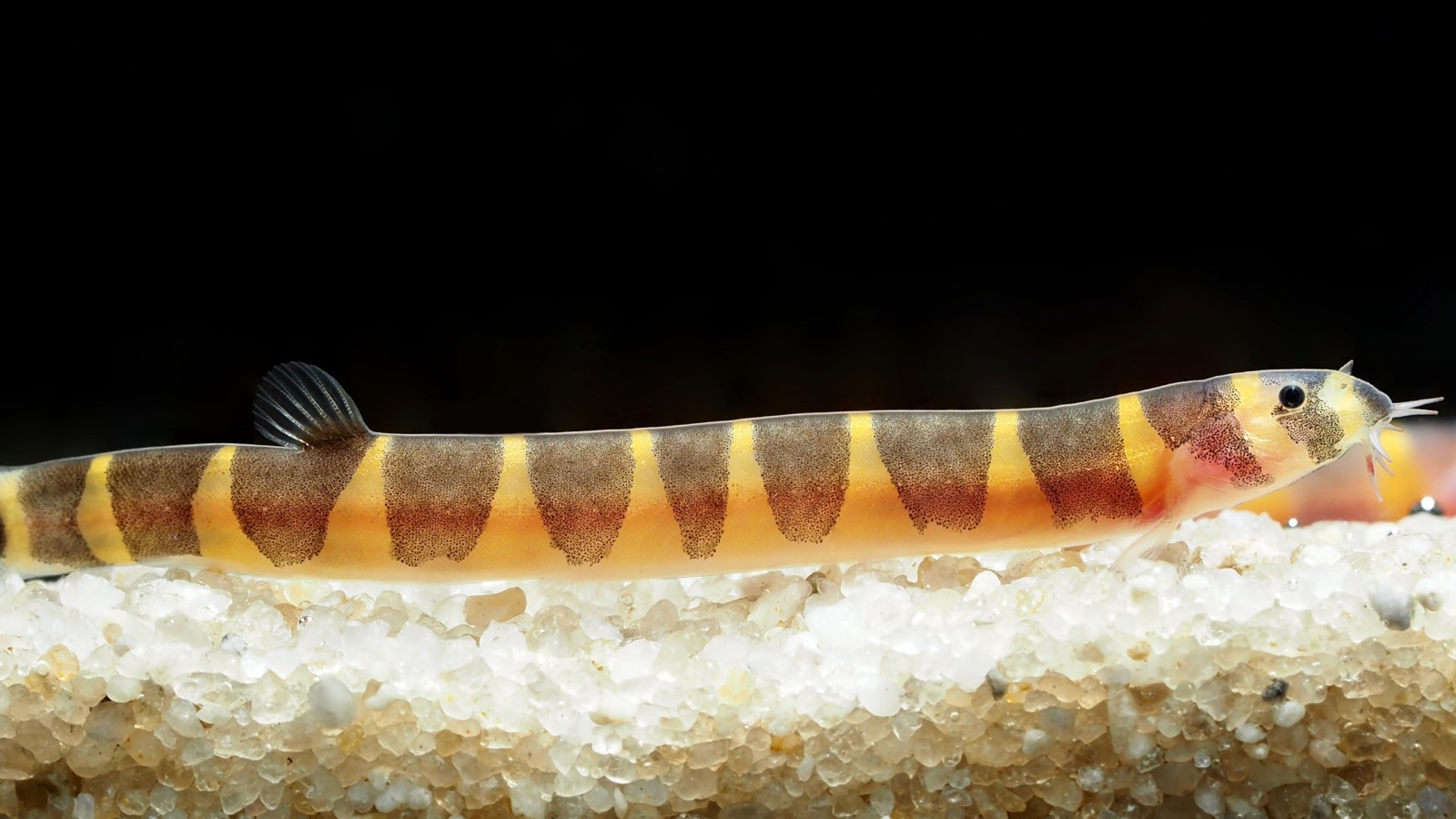
Genus Pangio (Cobitidae) — the eel-like kuhli loaches, slender banded burrowers of soft, shaded forest streams from Indochina through Sundaland. Nocturnal and peaceful, they want fine sand (not sharp gravel) to dive into and plenty of cover; kept over coarse gravel or without hiding places they hide constantly, go underfed and vanish. Social — keep a group. Scaleless and easily damaged, so handle and medicate gently. Very rarely bred in the aquarium.
- Lepidocephalichthys longipinnis · Longfin kuhli loach
- Pangio agma
- Pangio alcoides
- Pangio alternans · Borneo kuhli loach
- Pangio ammophila
- Pangio anguillaris
- Pangio apoda
- Pangio atactos
- Pangio bashai
- Pangio bhujia
- Pangio bitaimac · Sumatran Neon Loach
- Pangio borneensis · Bornean kuhli loach
- Pangio cuneovirgata · Striped kuhli loach
- Pangio doriae · Doria's loach
- Pangio elongata · Elongated kuhli loach
- Pangio filinaris
- Pangio fusca · Brown kuhli loach
- Pangio goaensis · Goa kuhli loach
- Pangio incognito
- Pangio kuhlii · Kuhli loach
- Pangio lidi
- Pangio longimanus
- Pangio lumbriciformis
- Pangio malayana · Malayan loach
- Pangio mariarum
- Pangio muraeniformis · Spotted coolie loach
- Pangio myersi · Myers' loach
- Pangio oblonga · Java loach
- Pangio pangia · Black kuhli loach
- Pangio pathala
- Pangio piperata · Brown kuhli loach
- Pangio pulla
- Pangio robiginosa · Rusty kuhli loach
- Pangio semicincta · Half-banded kuhli loach
- Pangio shelfordii · Leopard Kuhli Loach
- Pangio signicauda
- Pangio superba · Superb kuhli loach
Hillstream loaches · 254
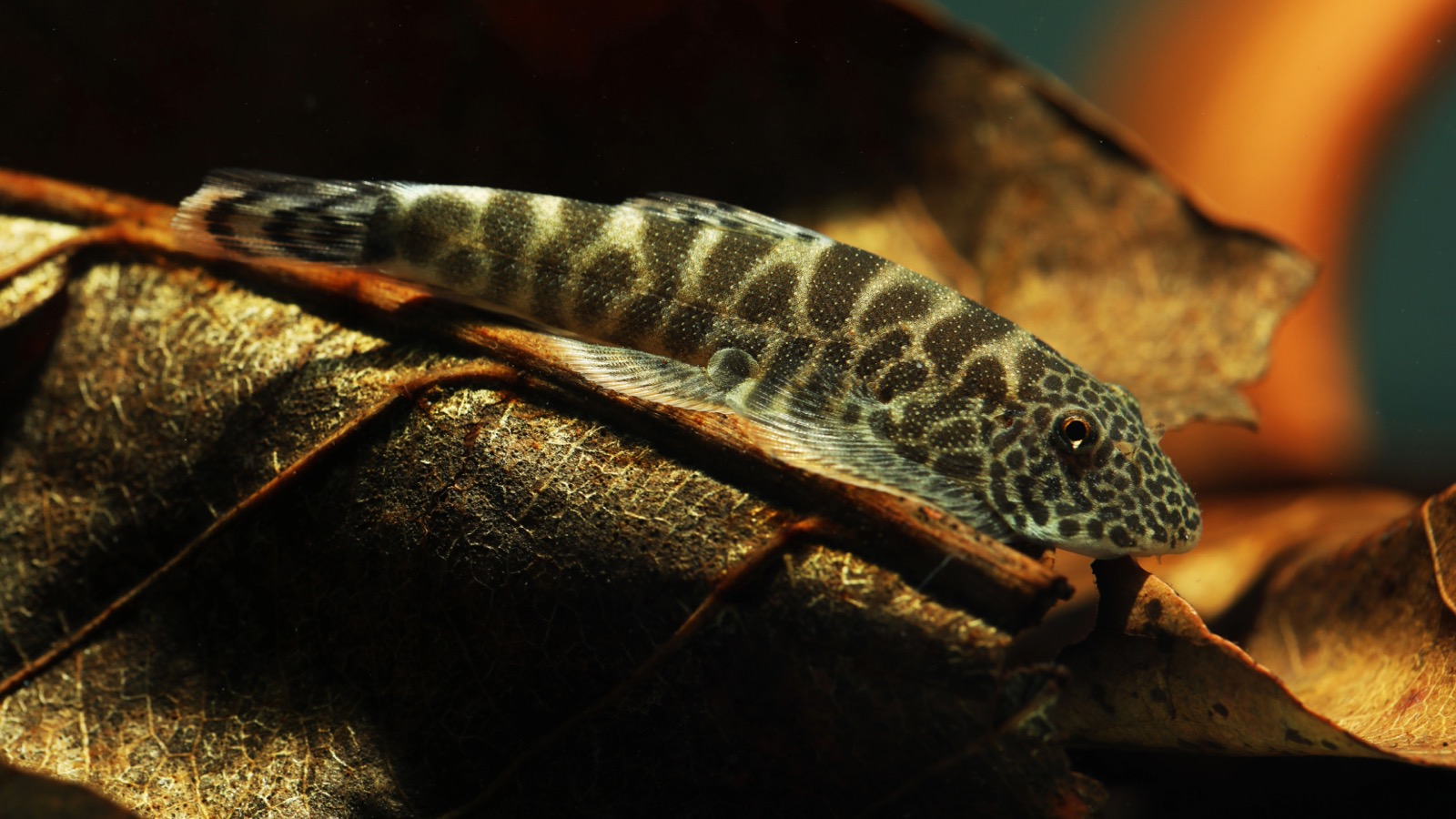
Families Balitoridae and Gastromyzontidae — the flattened, sucker-bodied "butterfly" and "lizard" loaches (Sewellia, Beaufortia, Gastromyzon, Pseudogastromyzon, Homaloptera, Hemimyzon, Balitora) that cling to rock in fast mountain torrents. They are a SPECIALIST setup: cool, highly-oxygenated, strongly-flowing water over stone coated in mature biofilm/aufwuchs, which they rasp. A few (notably Sewellia lineolata) do spawn in a well-run river tank.
- Annamia normani · Vietnamese giraffe loach
- Annamia thuathienensis
- Balitora annamitica
- Balitora brucei · Bruce's stream loach
- Balitora burmanica · Spotted hillstream loach
- Balitora chipkali
- Balitora eddsi
- Balitora elongata
- Balitora haithanhi · Vietnamese hillstream loach
- Balitora jalpalli
- Balitora kwangsiensis · Kwangsi stone loach
- Balitora lancangjiangensis
- Balitora laticauda
- Balitora longibarbata
- Balitora ludongensis
- Balitora meridionalis
- Balitora mysorensis · Mysore hillstream loach
- Balitora nantingensis
- Balitora nigrocorpa
- Balitora nujiangensis
- Balitora tchangi
- Balitora tiandengensis
- Balitora vanlani
- Balitora vanlongi
- Balitoropsis ophiolepis · Slender lizard loach
- Balitoropsis zollingeri · Lizard loach
- Beaufortia buas
- Beaufortia cyclica
- Beaufortia daon
- Beaufortia elongata
- Beaufortia fasciolata
- Beaufortia huangguoshuensis · Huangguoshu hillstream loach
- Beaufortia intermedia
- Beaufortia kweichowensis · Butterfly hillstream loach
- Beaufortia leveretti
- Beaufortia liui
- Beaufortia loos
- Beaufortia multiocellata
- Beaufortia niulanensis
- Beaufortia pingi · Ping's hillstream loach
- Beaufortia polylepis
- Beaufortia szechuanensis · Sichuan hillstream loach
- Beaufortia triocellata
- Beaufortia zebroida · Zebra hillstream loach
- Bhavania arunachalensis
- Bhavania australis · Southern torrent loach
- Cryptotora thamicola · Cave angel fish
- Dienbienia namnuaensis
- Erromyzon compactus · Compact hillstream loach
- Erromyzon damingshanensis
- Erromyzon kalotaenia
- Erromyzon sinensis · Chinese hillstream loach
- Erromyzon yangi
- Formosania chenyiyui
- Formosania davidi · David's hillstream loach
- Formosania fascicauda
- Formosania fasciolata
- Formosania galericula
- Formosania lacustris · Tasseled-mouth loach
- Formosania paucisquama
- Formosania stigmata
- Formosania tangi
- Formosania tinkhami
- Formosania yaoshanensis
- Gastromyzon aequabilis
- Gastromyzon aeroides · Blue Fin Hillstream Loach
- Gastromyzon auronigrus · Gold Net Hillstream Loach
- Gastromyzon bario · Borneo hillstream loach
- Gastromyzon borneensis · Borneo hillstream loach
- Gastromyzon contractus · Borneo hillstream loach
- Gastromyzon cornusaccus
- Gastromyzon cranbrooki · Cranbrook's hillstream loach
- Gastromyzon crenastus
- Gastromyzon danumensis · Danum hillstream loach
- Gastromyzon embalohensis · Golden Leopard Hillstream Loach
- Gastromyzon extrorsus
- Gastromyzon farragus · Borneo sucker loach
- Gastromyzon fasciatus · Banded hillstream loach
- Gastromyzon ingeri · Inger's hillstream loach
- Gastromyzon introrsus
- Gastromyzon katibasensis
- Gastromyzon lepidogaster
- Gastromyzon megalepis · Big-scaled hillstream loach
- Gastromyzon monticola
- Gastromyzon ocellatus · Eyespotted Borneo sucker
- Gastromyzon ornaticauda · Ornate-tailed hillstream loach
- Gastromyzon praestans · Hillstream loach
- Gastromyzon punctulatus · Spotted hillstream loach
- Gastromyzon russulus
- Gastromyzon scitulus · Serian Borneo sucker
- Gastromyzon spectabilis
- Gastromyzon stellatus · Starry hillstream loach
- Gastromyzon umbrus
- Gastromyzon venustus · Red Finned Butterfly Loach
- Gastromyzon viriosus · Yellowfinned Borneo sucker
- Gastromyzon zebrinus · Zebra hillstream loach
- Ghatsa menoni
- Ghatsa montana · Anamalai loach
- Ghatsa silasi
- Glaniopsis denudata
- Glaniopsis gossei
- Glaniopsis hanitschi
- Glaniopsis multiradiata
- Hemimyzon confluens
- Hemimyzon ecdyonuroides
- Hemimyzon indicus
- Hemimyzon khonensis
- Hemimyzon macroptera
- Hemimyzon megalopseos · Large-eyed hillstream loach
- Hemimyzon nanensis · Nan hillstream loach
- Hemimyzon papilio · Butterfly hillstream loach
- Hemimyzon pengi · Internet Celebrity Loach
- Hemimyzon pumilicorpora
- Hemimyzon sheni · Shen's river loach
- Hemimyzon taitungensis · Taitung hillstream loach
- Hemimyzon yaotanensis
- Hemimyzon yushanensis
- Homaloptera bilineata · Two-lined hillstream loach
- Homaloptera confuzona
- Homaloptera erythrorhina
- Homaloptera ocellata · Spotted Lizard Hillstream Loach
- Homaloptera ogilviei
- Homaloptera orthogoniata · Borneo hillstream loach
- Homaloptera parclitella
- Homaloptera taiwanica · Taiwan hillstream loach
- Homaloptera valenciennesi · Sucker loach
- Homalopteroides avii
- Homalopteroides manipurensis
- Homalopteroides modestus · Modest hillstream loach
- Homalopteroides nebulosus · Nebulous hillstream loach
- Homalopteroides rupicola
- Homalopteroides tweediei · Tweedie's hillstream loach
- Homalopteroides wassinkii
- Homalopteroides weberi · Weber's hillstream loach
- Homalopteroides yuwonoi
- Homalopterula amphisquamata
- Homalopterula gymnogaster
- Homalopterula heterolepis
- Homalopterula modiglianii
- Homalopterula ripleyi · Ripley's hillstream loach
- Homalopterula vanderbilti
- Hypergastromyzon abditus
- Hypergastromyzon eubranchus
- Hypergastromyzon humilis · Humilis Bonero hillstream loach
- Hypergastromyzon sambas
- Jinshaia abbreviata
- Jinshaia niulanjiangensis
- Jinshaia sinensis · Chinese hillstream loach
- Katibasia insidiosa
- Labigastromyzon changtingensis · Changting hillstream loach
- Labigastromyzon fangi
- Lepturichthys dolichopterus
- Lepturichthys fimbriatus
- Liniparhomaloptera disparis
- Liniparhomaloptera macrostoma
- Liniparhomaloptera monoloba
- Liniparhomaloptera obtusirostris
- Liniparhomaloptera qiongzhongensis
- Metahomaloptera longicauda
- Metahomaloptera omeiensis
- Neogastromyzon brunei · Brunei hillstream loach
- Neogastromyzon chini
- Neogastromyzon crassiobex
- Neogastromyzon kottelati
- Neogastromyzon nieuwenhuisii
- Neogastromyzon pauciradiatus · Pauciradiatus loach
- Neohomaloptera johorensis · Lizard loach
- Paraprotomyzon bamaensis
- Paraprotomyzon lungkowensis
- Paraprotomyzon multifasciatus
- Paraprotomyzon niulanjiangensis
- Paraprotomyzon yunnanensis
- Parasewellia monolobata
- Parasewellia polylobata
- Parasewellia tetralobata · Butterfly loach
- Plesiomyzon baotingensis
- Protomyzon aphelocheilus
- Protomyzon borneensis
- Protomyzon griswoldi
- Protomyzon whiteheadi
- Pseudogastromyzon cheni · Chinese hillstream loach
- Pseudogastromyzon fasciatus · Banded hillstream loach
- Pseudogastromyzon laticeps · Purple Fin Hillstream Loach
- Pseudogastromyzon lianjiangensis
- Pseudogastromyzon meihuashanensis · Red Panda loach
- Pseudogastromyzon myersi · Myers' hillstream loach
- Pseudogastromyzon peristictus
- Pseudohomaloptera batek
- Pseudohomaloptera leonardi · Spotted Lizard Loach
- Pseudohomaloptera sexmaculata · Spotted Lizard Loach
- Pseudohomaloptera tatereganii
- Pseudohomaloptera vulgaris
- Pseudohomaloptera yunnanensis
- Sewellia albisuera
- Sewellia analis
- Sewellia breviventralis · Butterfly loach
- Sewellia diardi
- Sewellia elongata · Elongate hillstream loach
- Sewellia hypsicrateae
- Sewellia lineolata · Reticulated hillstream loach
- Sewellia marmorata · Marbled hillstream loach
- Sewellia media
- Sewellia patella
- Sewellia pterolineata · Winged hillstream loach
- Sewellia songboensis · Song Bo hillstream loach
- Sewellia speciosa · Porcupine hillstream loach
- Sewellia trakhucensis
- Sinogastromyzon chapaensis
- Sinogastromyzon daduheensis
- Sinogastromyzon daon
- Sinogastromyzon dezeensis · Deze Chinese sucker
- Sinogastromyzon hagiangensis
- Sinogastromyzon hexaocellum
- Sinogastromyzon hsiashiensis
- Sinogastromyzon hypercorpus
- Sinogastromyzon lixianjiangensis
- Sinogastromyzon macrostoma
- Sinogastromyzon maon
- Sinogastromyzon minutus
- Sinogastromyzon multiocellum
- Sinogastromyzon namnaensis
- Sinogastromyzon nanpanjiangensis
- Sinogastromyzon nantaiensis
- Sinogastromyzon puliensis · Pulin River Loach
- Sinogastromyzon rugocauda
- Sinogastromyzon sichangensis · Sichuanese hillstream loach
- Sinogastromyzon szechuanensis · Sichuan hillstream loach
- Sinogastromyzon tonkinensis
- Sinogastromyzon wui
- Travancoria elongata
- Travancoria jonesi · Travancore loach
- Vanmanenia caldwelli · Caldwell's hillstream loach
- Vanmanenia crassicauda · Cloud Leopard Loach
- Vanmanenia gymnetrus
- Vanmanenia hainanensis · Lizard fish
- Vanmanenia homalocephala
- Vanmanenia intermedia
- Vanmanenia lineata · Lined hillstream loach
- Vanmanenia maculata
- Vanmanenia marmorata
- Vanmanenia microcephala
- Vanmanenia microlepis
- Vanmanenia monofasciodorsala
- Vanmanenia multiloba
- Vanmanenia nahangensis
- Vanmanenia orcicampus · Plain of Jars hillstream loach
- Vanmanenia pingchowensis
- Vanmanenia polylepis
- Vanmanenia pseudostriata
- Vanmanenia serrilineata
- Vanmanenia stenosoma
- Vanmanenia striata
- Vanmanenia tetraloba
- Yaoshania pachychilus · Panda loach
Stone & brook loaches · 821
Family Nemacheilidae — the largest loach family, the small clear-stream loaches (Schistura, Nemacheilus, Acanthocobitis, Yunnanilus and the high-altitude Triplophysa of the Tibetan plateau). Bold, bottom-dwelling micro-predators of cool, fast, oxygen-rich water; many are territorial. This is the data-sparse end of the section: hundreds of species are known from a single stream or a museum lot, so some accounts are necessarily thin. Rarely bred in captivity.
- Aborichthys barapensis
- Aborichthys boutanensis
- Aborichthys cataracta
- Aborichthys elongatus · Red-tailed squirrel loach
- Aborichthys garoensis
- Aborichthys iphipaniensis
- Aborichthys kailashi
- Aborichthys kempi
- Aborichthys palinensis
- Aborichthys pangensis
- Aborichthys rosammai
- Aborichthys tikaderi
- Aborichthys uniobarensis
- Aborichthys verticauda
- Aborichthys waikhomi
- Acanthocobitis longipinnis · Zipper loach
- Acanthocobitis pavonacea · Spearfin loach
- Acanthocobitis pictilis
- Acoura savona · Half-banded Loach
- Afronemacheilus abyssinicus
- Afronemacheilus kaffa
- Barbatula altayensis
- Barbatula barbatula · Stone loach
- Barbatula bergamensis
- Barbatula cobdonensis
- Barbatula compressirostris
- Barbatula conilobus
- Barbatula dgebuadzei · Gobi loach
- Barbatula dsapchynensis
- Barbatula emuensis
- Barbatula gibba
- Barbatula golubtsovi
- Barbatula hispanica · Spanish stone loach
- Barbatula karabanowi
- Barbatula kirinensis
- Barbatula leoparda
- Barbatula liaoyangensis
- Barbatula linjiangensis
- Barbatula markakulensis
- Barbatula nuda
- Barbatula potaninorum
- Barbatula restricta
- Barbatula sawadai
- Barbatula sturanyi
- Barbatula toni · Siberian stone loach
- Barbatula vardarensis · Vardar stone loach
- Barbatula zetensis · Zeta stone loach
- Barbatula zhangwuensis
- Claea dabryi
- Claea dafangensis
- Claea tongziensis
- Draconectes narinosus
- Dzihunia amudarjensis · Bukhara stone loach
- Dzihunia ilan
- Dzihunia turdakovi
- Eidinemacheilus proudlovei
- Eidinemacheilus smithi · Zagros blind loach
- Eonemachilus nigromaculatus
- Eonemachilus yangzonghaiensis
- Haotula sonlaensis
- Hedinichthys grummorum
- Hedinichthys macropterus
- Hedinichthys minuta
- Hedinichthys yarkandensis · Kashgarian loach
- Heminoemacheilus hyalinus
- Heminoemacheilus parva
- Heminoemacheilus zhengbaoshani
- Homatula acuticephala
- Homatula anguillioides
- Homatula anteridorsalis
- Homatula berezowskii
- Homatula change
- Homatula coccinocola
- Homatula cryptoclathrata
- Homatula disparizona
- Homatula erhaiensis
- Homatula guanheensis
- Homatula laxiclathra
- Homatula longidorsalis
- Homatula nanpanjiangensis
- Homatula nigra
- Homatula oligolepis
- Homatula potanini · Chinese elongated zebra loach
- Homatula pycnolepis
- Homatula robusta
- Homatula variegata · Variegated stone loach
- Homatula wenshanensis
- Homatula wujiangensis
- Homatula wuliangensis
- Indoreonectes evezardi · Evezard's loach
- Indoreonectes keralensis · Kerala Loach
- Indoreonectes neeleshi
- Indoreonectes rajeevi
- Indoreonectes telanganaensis
- Iskandaria kuschakewitschi · Kuschakewitsch loach
- Iskandaria pardalis · Tajik loach
- Kapuasia maculiceps · Redtail sand loach
- Kayahschistura lokalayensis
- Koima monilis · Spotted loach
- Koima remadevii
- Labiatophysa herzensteini
- Labiatophysa labiata
- Lefua costata · Rice loach
- Lefua echigonia · Hotoke loach
- Lefua hoffmanni · Flat-headed loach
- Lefua nikkonis
- Lefua pleskei · Eight-barbel loach
- Lefua sayu
- Lefua tokaiensis
- Lefua torrentis
- Magnischistura khaokrajom
- Malihkaia aligera
- Mesonoemacheilus herrei
- Mesonoemacheilus menoni · Periyar blotched loach
- Mesonoemacheilus pambarensis · Pambar banded loach
- Mesonoemacheilus petrubanarescui
- Mesonoemacheilus remadevii · Devi's loach
- Micronemacheilus cruciatus
- Micronemacheilus zispi
- Mustura arenaria
- Mustura celata
- Mustura chhimtuipuiensis
- Mustura daral
- Mustura harkishorei
- Mustura prashadi
- Mustura sijuensis
- Mustura subhashi
- Mustura taretensis
- Mustura walongensis
- Nemacheilus anguilla · Black lined loach
- Nemacheilus arenicolus · Sand-dwelling loach
- Nemacheilus argyrogaster
- Nemacheilus banar
- Nemacheilus bertini
- Nemacheilus binotatus
- Nemacheilus blythii
- Nemacheilus cacao
- Nemacheilus cheni
- Nemacheilus chrysolaimos · Smaller Barred Loach
- Nemacheilus cleopatra
- Nemacheilus corica · Corica loach
- Nemacheilus djaggasteensis
- Nemacheilus elegantissimus
- Nemacheilus fasciatus · Barred loach
- Nemacheilus flavus
- Nemacheilus guentheri · Gunther's loach
- Nemacheilus jaklesii
- Nemacheilus kaimurensis
- Nemacheilus kapuasensis
- Nemacheilus lactogeneus
- Nemacheilus longipectoralis
- Nemacheilus longipinnis
- Nemacheilus longistriatus · Laos Blackline Torpedo Loach
- Nemacheilus lunanensis
- Nemacheilus marang
- Nemacheilus masyae · Arrow loach
- Nemacheilus nandingensis
- Nemacheilus olivaceus · Olive stone loach
- Nemacheilus ornatus · Ornate loach
- Nemacheilus pallidus
- Nemacheilus papillos
- Nemacheilus papillosus
- Nemacheilus paucimaculatus
- Nemacheilus periyarensis · Periyar reticulated loach
- Nemacheilus pezidion
- Nemacheilus pfeifferae
- Nemacheilus platiceps · Flathead stone loach
- Nemacheilus pulchellus
- Nemacheilus saravacensis · Sarawak loach
- Nemacheilus selangoricus
- Nemacheilus spiniferus
- Nemacheilus stigmofasciatus
- Nemacheilus tebo
- Nemacheilus terekensis
- Nemacheilus triangularis · Zodiac loach
- Nemacheilus troglocataractus · Blind Cave Loach
- Nemacheilus tuberigum
- Nemacheilus zonatus
- Nemachilichthys ruppelli · Mongoose loach
- Nemachilichthys shimogensis · Shimoga loach
- Neonoemacheilus assamensis
- Neonoemacheilus labeosus
- Neonoemacheilus mengdingensis
- Neonoemacheilus morehensis
- Neonoemacheilus peguensis
- Nun galilaeus · Galilean stone loach
- Oreonectes acridorsalis
- Oreonectes anophthalmus · Blind cave loach
- Oreonectes barbatus
- Oreonectes donglanensis
- Oreonectes duanensis
- Oreonectes elongatus
- Oreonectes furcocaudalis
- Oreonectes guananensis
- Oreonectes guilinensis
- Oreonectes jinxiuensis
- Oreonectes luochengensis
- Oreonectes macrolepis · Large-scaled Cave Loach
- Oreonectes microphthalmus
- Oreonectes platycephalus
- Oreonectes polystigmus
- Oreonectes retrodorsalis
- Oreonectes translucens
- Oreonectes weii
- Oxynoemacheilus amanos
- Oxynoemacheilus anatolicus · Burdur loach
- Oxynoemacheilus angorae · Angora loach
- Oxynoemacheilus araxensis · Aras loach
- Oxynoemacheilus argyrogramma · Two Spot Loach
- Oxynoemacheilus arsaniasus
- Oxynoemacheilus atili · Lake Beyşehir loach
- Oxynoemacheilus axylos
- Oxynoemacheilus banarescui · Paphlagonian sportive loach
- Oxynoemacheilus bergi
- Oxynoemacheilus bergianus
- Oxynoemacheilus brandtii · Kura loach
- Oxynoemacheilus bureschi · Bulgarian stone loach
- Oxynoemacheilus cemali
- Oxynoemacheilus ceyhanensis · Elbistan loach
- Oxynoemacheilus chomanicus
- Oxynoemacheilus ciceki
- Oxynoemacheilus cilicicus
- Oxynoemacheilus cyri · Göle loach
- Oxynoemacheilus eliasi
- Oxynoemacheilus elsae
- Oxynoemacheilus ercisianus · Van loach
- Oxynoemacheilus eregliensis
- Oxynoemacheilus euphraticus
- Oxynoemacheilus evreni
- Oxynoemacheilus fatsaensis
- Oxynoemacheilus frenatus · Banded Tigris loach
- Oxynoemacheilus germencicus · Carian loach
- Oxynoemacheilus gyndes
- Oxynoemacheilus hamwii · Orontes sportive loach
- Oxynoemacheilus hanae
- Oxynoemacheilus hazarensis
- Oxynoemacheilus insignis · Syrian loach
- Oxynoemacheilus isauricus
- Oxynoemacheilus karunensis
- Oxynoemacheilus kaynaki · Melid loach
- Oxynoemacheilus kentritensis
- Oxynoemacheilus kiabii
- Oxynoemacheilus kurdistanicus
- Oxynoemacheilus leontinae · Lebanese loach
- Oxynoemacheilus longipinnis
- Oxynoemacheilus marunensis
- Oxynoemacheilus mediterraneus · Pamphylian loach
- Oxynoemacheilus merga · Krynicki's loach
- Oxynoemacheilus mesudae · Işıklı loach
- Oxynoemacheilus muefiti
- Oxynoemacheilus namiri · Levantine loach
- Oxynoemacheilus nasreddini
- Oxynoemacheilus oxianus · Amu-Darya stone loach
- Oxynoemacheilus panthera
- Oxynoemacheilus parvinae
- Oxynoemacheilus paucilepis · Mancilik dwarf loach
- Oxynoemacheilus persa · Persian stone loach
- Oxynoemacheilus phasicus
- Oxynoemacheilus pindus
- Oxynoemacheilus samanticus
- Oxynoemacheilus sarus
- Oxynoemacheilus seyhanensis · Samanti loach
- Oxynoemacheilus seyhanicola
- Oxynoemacheilus shehabi
- Oxynoemacheilus simavicus
- Oxynoemacheilus theophilii
- Oxynoemacheilus tigris · Tigris loach
- Oxynoemacheilus tongiorgii
- Oxynoemacheilus veyselorum
- Oxynoemacheilus zagrosensis
- Oxynoemacheilus zarzianus
- Paracanthocobitis abutwebi · Zipper loach
- Paracanthocobitis adelaideae · Checkerboard Zipper Loach
- Paracanthocobitis aurea
- Paracanthocobitis botia · Mottled loach
- Paracanthocobitis canicula
- Paracanthocobitis hijumensis
- Paracanthocobitis linypha
- Paracanthocobitis maekhlongensis
- Paracanthocobitis mandalayensis
- Paracanthocobitis marmorata
- Paracanthocobitis mooreh · Mooreh loach
- Paracanthocobitis nigrolineata · Black-lined zipper loach
- Paracanthocobitis phuketensis · Phuket zipper loach
- Paracanthocobitis pictilis
- Paracanthocobitis putaoensis
- Paracanthocobitis rubidipinnis · Cherry fin loach
- Paracanthocobitis triangula · Wedged zipper loach
- Paracanthocobitis tumitensis
- Paracanthocobitis urophthalma · Sand loach
- Paracanthocobitis zonalternans · Zona loach
- Paracobitis abrishamchiani
- Paracobitis atrakensis · Atrak crested loach
- Paracobitis basharensis
- Paracobitis ghazniensis
- Paracobitis hagiangensis
- Paracobitis hircanica · Hyrcanian crested loach
- Paracobitis longicauda · Eastern crested loach
- Paracobitis malapterura
- Paracobitis maolanensis
- Paracobitis molavii
- Paracobitis persa
- Paracobitis phongthoensis
- Paracobitis posterodorsalus · Blind cave loach
- Paracobitis rhadinaea · Eastern crested loach
- Paracobitis salihae
- Paracobitis starostini · Starostin's blind loach
- Paracobitis vignai
- Paracobitis zabgawraensis
- Paranemachilus genilepis
- Paranemachilus nonggangensis
- Paranemachilus pingguoensis
- Paraschistura abdolii
- Paraschistura alepidota
- Paraschistura alta
- Paraschistura aredvii · Anahita Loach
- Paraschistura bampurensis · Bampur loach
- Paraschistura cristata · Turkmenian crested loach
- Paraschistura delvarii
- Paraschistura hormuzensis
- Paraschistura ilamensis
- Paraschistura kermanensis
- Paraschistura kessleri · Kessler's loach
- Paraschistura lepidocaulis
- Paraschistura lindbergi
- Paraschistura makranensis
- Paraschistura microlabra
- Paraschistura montana
- Paraschistura naseeri
- Paraschistura naumanni
- Paraschistura nielseni
- Paraschistura pakistanica
- Paraschistura pasatigris
- Paraschistura prashari
- Paraschistura punjabensis
- Paraschistura susiani
- Paraschistura turcmenica
- Petruichthys brevis · Inle loach
- Physoschistura absumbra
- Physoschistura brunneana · Rosy loach
- Physoschistura chindwinensis
- Physoschistura chulabhornae
- Physoschistura dikrongensis
- Physoschistura elongata
- Physoschistura pseudobrunneana
- Physoschistura ranikhetensis
- Physoschistura raoi
- Physoschistura rivulicola
- Physoschistura tigrinum
- Physoschistura tuivaiensis
- Physoschistura yunnaniloides
- Pogonoschistura kohchangensis · Ornate Tiger Sand Loach
- Pogonoschistura pawaiensis
- Protonemacheilus longipectoralis
- Pteronemacheilus lucidorsum
- Pteronemacheilus meridionalis
- Rhyacoschistura larreci
- Rhyacoschistura manipurensis
- Sasanidus kermanshahensis
- Schistura acuticephala
- Schistura afasciata
- Schistura aizawlensis
- Schistura albirostris
- Schistura albisella
- Schistura alboguttata
- Schistura alticrista
- Schistura altipedunculata
- Schistura altuscauda
- Schistura amplizona
- Schistura anambarensis
- Schistura andrewi
- Schistura antennata
- Schistura aramis
- Schistura arifi
- Schistura athos
- Schistura atra
- Schistura aurantiaca
- Schistura bachmaensis
- Schistura bairdi
- Schistura balteata · Sumo loach
- Schistura bannaensis
- Schistura beavani · Creek loach
- Schistura bella
- Schistura bhimachari
- Schistura bolavenensis
- Schistura breviceps
- Schistura bucculenta
- Schistura callichroma
- Schistura callidora
- Schistura carbonaria
- Schistura carletoni
- Schistura cataracta
- Schistura caudofurca
- Schistura chapaensis
- Schistura chindwinica
- Schistura chrysicristinae · Batman loach
- Schistura cincticauda
- Schistura clatrata
- Schistura colossa
- Schistura coruscans · Flametail loach
- Schistura crabro
- Schistura crassa
- Schistura crocotula
- Schistura cryptofasciata
- Schistura curtistigma
- Schistura dalatensis
- Schistura daubentoni
- Schistura dayi
- Schistura deansmarti
- Schistura defectiva
- Schistura denisoni · Denison loach
- Schistura desmotes
- Schistura devdevi · Saddleback loach
- Schistura diminuta
- Schistura disparizona
- Schistura doonensis
- Schistura dorsizona
- Schistura dubia
- Schistura ephelis
- Schistura epixenos
- Schistura falamensis
- Schistura fasciata
- Schistura fascimaculata
- Schistura fasciolata
- Schistura ferruginea
- Schistura finis
- Schistura fusinotata
- Schistura gangetica
- Schistura geisleri
- Schistura globiceps
- Schistura greenei
- Schistura harnaiensis
- Schistura himachalensis · Ring loach
- Schistura hingi
- Schistura hiranyakeshi
- Schistura horai
- Schistura huapingensis
- Schistura humilis
- Schistura huongensis
- Schistura hypsiura · Super Convict Loach
- Schistura imitator
- Schistura implicata
- Schistura incerta
- Schistura indawgyiana
- Schistura irregularis
- Schistura isostigma
- Schistura jarutanini
- Schistura kalikholaensis
- Schistura kampucheensis
- Schistura kangjupkhulensis
- Schistura kaysonei · Laotian cave loach
- Schistura kengtungensis
- Schistura khamtanhi
- Schistura khugae
- Schistura kloetzliae
- Schistura klydonion
- Schistura kodaguensis
- Schistura kohatensis
- Schistura koladynensis
- Schistura kongphengi
- Schistura kontumensis
- Schistura kottelati
- Schistura larketensis · Khung loach
- Schistura laterimaculata
- Schistura latidens
- Schistura latifasciata
- Schistura leukensis
- Schistura lingyunensis
- Schistura liyaiensis
- Schistura machensis
- Schistura macrocephalus
- Schistura macrolepis
- Schistura macrotaenia
- Schistura maculosa
- Schistura madhavai
- Schistura maepaiensis
- Schistura magnifluvis
- Schistura mahnerti · Burmese border loach
- Schistura malaisei
- Schistura megalodon
- Schistura melarancia
- Schistura menanensis
- Schistura minuta
- Schistura mizoramensis
- Schistura mobbsi
- Schistura moeiensis
- Schistura mukambbikaensis
- Schistura multifasciata
- Schistura musa
- Schistura nagaensis
- Schistura nagodiensis
- Schistura namboensis
- Schistura nasifilis
- Schistura nebeshwari
- Schistura nicholsi · Nichol's Brook Loach
- Schistura nilgiriensis
- Schistura niulanjiangensis
- Schistura nomi
- Schistura notasileum
- Schistura notostigma · Fighting loach
- Schistura novemradiata
- Schistura nubigena
- Schistura nudidorsum
- Schistura obeini
- Schistura obliquofascia
- Schistura ocellata
- Schistura oedipus · Blind cave loach
- Schistura orthocauda · Straight-tail loach
- Schistura pantherina
- Schistura papulifera
- Schistura paraxena
- Schistura paucicincta
- Schistura paucifasciata
- Schistura paucireticulata
- Schistura pawensis
- Schistura personata
- Schistura pertica
- Schistura pervagata
- Schistura phamhringi
- Schistura polytaenia
- Schistura porocephala
- Schistura porthos
- Schistura pridii · Mini dragon loach
- Schistura procera
- Schistura prolixifasciata
- Schistura pseudofasciolata
- Schistura psittacula
- Schistura pumatensis
- Schistura puncticeps
- Schistura punctifasciata
- Schistura quaesita
- Schistura quasimodo
- Schistura rajasthanica
- Schistura rara
- Schistura rebuw
- Schistura reidi
- Schistura reticulata
- Schistura reticulofasciata
- Schistura rikiki
- Schistura robertsi
- Schistura rubrimaculata
- Schistura rupecula
- Schistura russa
- Schistura scaturigina · Victory Loach
- Schistura schultzi
- Schistura scitula
- Schistura scripta
- Schistura scyphovecteta
- Schistura semiarmata · Dotted loach
- Schistura sertata
- Schistura sexcauda
- Schistura sexnubes
- Schistura shadiwalensis
- Schistura shanensis
- Schistura sharavathiensis
- Schistura shuensis
- Schistura sigillata
- Schistura sikmaiensis · River loach
- Schistura similis
- Schistura singhi
- Schistura sirindhornae
- Schistura sokolovi
- Schistura sombooni
- Schistura spekuli
- Schistura spiesi · Cave loach
- Schistura spiloptera
- Schistura spilota
- Schistura stala
- Schistura striata
- Schistura suber
- Schistura susannae
- Schistura syngkai
- Schistura systomos
- Schistura tamduongensis
- Schistura tenebrosa
- Schistura tenura
- Schistura thanho
- Schistura thavonei
- Schistura tigrina
- Schistura tirapensis · Tirap stone loach
- Schistura titan
- Schistura tizardi
- Schistura trilineata
- Schistura tubulinaris
- Schistura udomritthiruji
- Schistura vinciguerrae · Vinciguerra's Stone Loach
- Schistura waltoni
- Schistura wanlainensis
- Schistura xhatensis
- Schistura yersini
- Schistura yingjiangensis
- Schistura zonata
- Sectoria atriceps
- Sectoria heterognathos
- Seminemacheilus ahmeti
- Seminemacheilus attalicus
- Seminemacheilus dursunavsari
- Seminemacheilus ekmekciae
- Seminemacheilus ispartensis · Southern pond loach
- Seminemacheilus lendlii · Anatolian loach
- Seminemacheilus tubae
- Smithstura hoai
- Smithstura longa
- Smithstura poculi
- Speonectes tiomanensis · Tioman cave loach
- Sphaerophysa dianchiensis
- Styxichthys gejiuensis
- Sundoreonectes obesus
- Sundoreonectes sabanus · Borneo stone loach
- Traccatichthys bacmeensis
- Traccatichthys pulcher · China rainbow loach
- Traccatichthys taeniatus · Peppermint loach
- Traccatichthys tuberculum · Peppermint loach
- Traccatichthys zispi
- Triplophysa akhtari · Helmand loach
- Triplophysa alexandrae
- Triplophysa aliensis
- Triplophysa alticeps
- Triplophysa altipinnis
- Triplophysa aluensis
- Triplophysa angeli
- Triplophysa anshuiensis
- Triplophysa anterodorsalis
- Triplophysa aquaecaeruleae
- Triplophysa arnoldii
- Triplophysa baotianensis
- Triplophysa bashanensis
- Triplophysa bellibarus
- Triplophysa bleekeri
- Triplophysa bombifrons
- Triplophysa brachyptera
- Triplophysa brahui
- Triplophysa brevibarba
- Triplophysa brevicauda · Tibetan stone loach
- Triplophysa cakaensis
- Triplophysa chandagaitensis
- Triplophysa chondrostoma
- Triplophysa choprai
- Triplophysa coniptera
- Triplophysa crassicauda
- Triplophysa crassilabris
- Triplophysa cuneicephala
- Triplophysa dafangensis
- Triplophysa dalaica
- Triplophysa daochengensis
- Triplophysa daqiaoensis
- Triplophysa daryoae
- Triplophysa dongganensis · Chinese cave loach
- Triplophysa dorsalis · Gray loach
- Triplophysa drassensis
- Triplophysa edsinica
- Triplophysa erythraea · Blind cave loach
- Triplophysa eugeniae
- Triplophysa farwelli
- Triplophysa fengshanensis
- Triplophysa ferganaensis · Fergana stone loach
- Triplophysa flavicorpus
- Triplophysa furva
- Triplophysa fuxianensis
- Triplophysa gerzeensis
- Triplophysa gracilis · Snow loach
- Triplophysa griffithii
- Triplophysa guizhouensis
- Triplophysa gundriseri
- Triplophysa hexiensis
- Triplophysa heyangensis
- Triplophysa hialmari
- Triplophysa hsutschouensis
- Triplophysa huanglongensis
- Triplophysa huanjiangensis
- Triplophysa huapingensis
- Triplophysa hutjertjuensis
- Triplophysa incipiens
- Triplophysa intermedia
- Triplophysa jianchuanensis
- Triplophysa jiarongensis
- Triplophysa kafirnigani
- Triplophysa kashmirensis
- Triplophysa kaznakowi
- Triplophysa kokshaalensis
- Triplophysa kullmanni
- Triplophysa kungessana
- Triplophysa lacusnigri · Karakul stone loach
- Triplophysa lacustris
- Triplophysa langpingensis
- Triplophysa laterimaculata
- Triplophysa laticeps
- Triplophysa leptosoma
- Triplophysa lihuensis · Lihu blind loach
- Triplophysa lixianensis
- Triplophysa longianguis
- Triplophysa longipectoralis
- Triplophysa longliensis
- Triplophysa luochengensis
- Triplophysa macrocephala
- Triplophysa macromaculata
- Triplophysa macrophthalma
- Triplophysa markehenensis
- Triplophysa marmorata · Kashmir Triplophysa-loach
- Triplophysa microphthalma · Fine-eyed plateau loach
- Triplophysa microphysa
- Triplophysa microps · Leh triplophysa loach
- Triplophysa moquensis
- Triplophysa nandanensis
- Triplophysa nanpanjiangensis
- Triplophysa nasalis
- Triplophysa nasobarbatula
- Triplophysa nayongensis
- Triplophysa ninglangensis
- Triplophysa nujiangensa
- Triplophysa obscura
- Triplophysa obtusirostra
- Triplophysa orientalis · Oriental stone loach
- Triplophysa papillosolabiata
- Triplophysa pappenheimi
- Triplophysa paradoxa · Talas stone loach
- Triplophysa parvus · Small plateau loach
- Triplophysa polyfasciata
- Triplophysa pseudoscleroptera
- Triplophysa pseudostenura
- Triplophysa qilianensis
- Triplophysa qiubeiensis · Qiubei cave loach
- Triplophysa robusta
- Triplophysa rosa · Rosy cave loach
- Triplophysa rossoperegrinatorum
- Triplophysa rotundiventris
- Triplophysa sanduensis
- Triplophysa scapanognatha
- Triplophysa scleroptera
- Triplophysa sellaefer
- Triplophysa sewerzowi · Severtsov's loach
- Triplophysa shaanxiensis
- Triplophysa shehensis
- Triplophysa shilinensis
- Triplophysa shiyangensis
- Triplophysa siluroides · Catfish-like loach
- Triplophysa stenura
- Triplophysa stewarti · Stewart's stone loach
- Triplophysa stolickai · Tibetan stone loach
- Triplophysa strauchii · Spotted thicklip loach
- Triplophysa tanggulaensis
- Triplophysa tenuicauda
- Triplophysa tenuis
- Triplophysa tianeensis
- Triplophysa tianlinensis
- Triplophysa tianxingensis
- Triplophysa tibetana · Tibetan stone loach
- Triplophysa trewavasae
- Triplophysa turpanensis
- Triplophysa ulacholica · Issyk-kul naked loach
- Triplophysa venusta
- Triplophysa waisihani
- Triplophysa weiheensis
- Triplophysa wulongensis
- Triplophysa wuweiensis
- Triplophysa xiangshuingensis
- Triplophysa xiangxiensis · Xiangxi blind loach
- Triplophysa xichangensis
- Triplophysa xichouensis
- Triplophysa xingshanensis
- Triplophysa xingyiensis
- Triplophysa xiqiensis
- Triplophysa yajiangensis
- Triplophysa yaopeizhii
- Triplophysa yasinensis · Yasin stone loach
- Triplophysa yunnanensis
- Triplophysa zaidamensis
- Triplophysa zamegacephala
- Triplophysa zhaoi
- Triplophysa zhenfengensis
- Triplophysa zhijinensis
- Troglonectes bottazzii
- Troglonectes chenlixini
- Troglonectes daqikongensis
- Troglonectes hechiensis
- Troglonectes longibarbatus
- Troglonectes shuilongensis
- Tuberoschistura baenzigeri
- Tuberoschistura cambodgiensis
- Turcinoemacheilus bahaii
- Turcinoemacheilus hafezi
- Turcinoemacheilus himalaya
- Turcinoemacheilus ilamensis
- Turcinoemacheilus kosswigi · Zagros dwarf loach
- Turcinoemacheilus minimus
- Turcinoemacheilus saadii
- Vurxastroma grahami
- Yunnanilus altus
- Yunnanilus analis
- Yunnanilus bailianensis
- Yunnanilus bajiangensis
- Yunnanilus beipanjiangensis · Beipanjiang Yunnan loach
- Yunnanilus caohaiensis
- Yunnanilus chuanheensis
- Yunnanilus chui
- Yunnanilus discoloris
- Yunnanilus elakatis
- Yunnanilus forkicaudalis
- Yunnanilus ganheensis
- Yunnanilus jinxiensis
- Yunnanilus jiuchiensis
- Yunnanilus longibarbatus
- Yunnanilus longibulla
- Yunnanilus longidorsalis
- Yunnanilus macrogaster
- Yunnanilus macrolepis
- Yunnanilus macrositanus
- Yunnanilus nanpanjiangensis
- Yunnanilus niger
- Yunnanilus niulanensis
- Yunnanilus obtusirostris
- Yunnanilus pachycephalus
- Yunnanilus paludosus
- Yunnanilus parvus
- Yunnanilus pleurotaenia
- Yunnanilus pulcherrimus · Mini zebra loach
- Yunnanilus qujinensis
- Yunnanilus sichuanensis
- Yunnanilus spanisbripes
- Yunnanilus tigerivinus
- Zhustura shuangjiangensis
Spined & pond loaches · 229
Family Cobitidae (excluding the kuhlis) — the true/spined loaches: Cobitis and Sabanejewia of Eurasia, the horseface loach Acantopsis (a sand-diving sifter), Lepidocephalichthys, and the temperate weather/dojo loach Misgurnus. All have the erectile suborbital spine that gives the family its name. Several are COLDWATER, not tropical — the dojo is a hardy pond fish that reacts to falling barometric pressure (hence "weather loach"). Sand-sifters that want a soft bed; a handful of the temperate species have been bred, most have not.
- Acanthopsis angustus
- Acanthopsoides delphax
- Acanthopsoides gracilentus
- Acanthopsoides gracilis
- Acanthopsoides hapalias · Hapalias loach
- Acanthopsoides molobrion · Molo loach
- Acanthopsoides robertsi · Roberts loach
- Acantopsis bruinen · Horseface loach
- Acantopsis dialuzona · Horseface loach
- Acantopsis dinema · Horseface loach
- Acantopsis ioa · Horseface loach
- Acantopsis multistigmatus · Horseface loach
- Acantopsis octoactinotos · Horseface loach
- Acantopsis spectabilis · Horseface loach
- Acantopsis thiemmedhi · Thiemmedh's Horsefaced Loach
- Bibarba parvoculus
- Bibarba wenliuensis
- Canthophrys gongota · Gongota loach
- Cobitis afifeae
- Cobitis ajdan
- Cobitis albicoloris · Danube spined loach
- Cobitis aliyeae
- Cobitis amphilekta · Azerbaijani spined loach
- Cobitis anabelae
- Cobitis arachthosensis
- Cobitis arenae
- Cobitis arenata · Zipper loach
- Cobitis australis
- Cobitis avicennae
- Cobitis baishagensis
- Cobitis battalgilae
- Cobitis battalgili
- Cobitis bilineata · Italian spined loach
- Cobitis bilseli · Beyşehir spined loach
- Cobitis bilturio · Zipper Loach
- Cobitis bimucronata · Zipper loach
- Cobitis biwae · Japanese striped loach
- Cobitis brachysoma
- Cobitis brevifasciata · Dwarf loach
- Cobitis brevipinna
- Cobitis calderoni · Northern Iberian spined loach
- Cobitis chlorosoma · Zipper loach
- Cobitis choii · Choi's spiny loach
- Cobitis crassicauda
- Cobitis dalmatina · Dalmatian spined loach
- Cobitis damlae · Dalaman spined loach
- Cobitis delicata · Ajime loach
- Cobitis derzhavini
- Cobitis dolichorhynchus
- Cobitis dorademiri
- Cobitis elazigensis · Tigris spined loach
- Cobitis elongata · Balkan loach
- Cobitis elongatoides · Danubian spined loach
- Cobitis emrei
- Cobitis erkakanae
- Cobitis erythropterus
- Cobitis evreni · Ceyhan spined loach
- Cobitis fahireae · Küçük Menderes spined loach
- Cobitis faridpaki
- Cobitis fasciola
- Cobitis fimbriata
- Cobitis fuerstenbergii · Stone loach
- Cobitis gibbosa
- Cobitis gladkovi
- Cobitis gracilis
- Cobitis guttata
- Cobitis haematopterus · Dojo loach
- Cobitis hankugensis
- Cobitis hellenica · Louros spined loach
- Cobitis hereromacula
- Cobitis herzegoviniensis
- Cobitis hetsieou
- Cobitis illyrica
- Cobitis indus
- Cobitis jadovaensis
- Cobitis japonica · Japanese spined loach
- Cobitis joergbohleni
- Cobitis kaibarai · Japanese striped loach
- Cobitis kellei · Göksu spined loach
- Cobitis keyvani
- Cobitis koreensis · Korean spined loach
- Cobitis laoensis
- Cobitis laterimaculata · China Rainbow Loach
- Cobitis lebedevi
- Cobitis leptosoma
- Cobitis levantina · Orontes spined loach
- Cobitis linea
- Cobitis longicorpus
- Cobitis longimanus
- Cobitis longitaeniatus
- Cobitis lutheri · Luther's spiny loach
- Cobitis macrostigma · Largespotted Spiny Loach
- Cobitis magnostriata
- Cobitis maroccana · Moroccan spined loach
- Cobitis matsubarae
- Cobitis megaspila
- Cobitis melanoleuca · Siberian spined loach
- Cobitis meridionalis
- Cobitis microcephala
- Cobitis minamorii · Small stripe spined loach
- Cobitis minhi
- Cobitis monocera · Zipper loach
- Cobitis montanus
- Cobitis multifasciata · Multibanded loach
- Cobitis multimaculata
- Cobitis nalbanti
- Cobitis narentana · Neretva spined loach
- Cobitis nigrolinea
- Cobitis nuicocensis
- Cobitis obtusirostra
- Cobitis ocellata
- Cobitis ohridana · Ohrid spined loach
- Cobitis osurgeticus
- Cobitis oxycephala
- Cobitis pacifica
- Cobitis paludica · Southern Iberian spined loach
- Cobitis pannonica · Pannonian spined loach
- Cobitis phongnhaensis
- Cobitis phrygica · Phrygian spined loach
- Cobitis pirii
- Cobitis poecilopleura
- Cobitis pontica · Pontic spined loach
- Cobitis pumila · Puan spine loach
- Cobitis puncticulata · Spotted spined loach
- Cobitis punctilineata · Angitis spined loach
- Cobitis qujiangensis
- Cobitis rara
- Cobitis sakahoko
- Cobitis saniae
- Cobitis satunini
- Cobitis schlegeli · Japanese striped loach
- Cobitis semizonata
- Cobitis shikokuensis
- Cobitis sibirica · Siberian spined loach
- Cobitis simplicispina · Sakarya spined loach
- Cobitis sinensis · Siberian spiny loach
- Cobitis sipahilerae
- Cobitis splendens · Splendid spined loach
- Cobitis squataeniatus
- Cobitis stenocauda
- Cobitis stephanidisi · Velestino spined loach
- Cobitis striata
- Cobitis strumicae · Struma spined loach
- Cobitis suborbitalis
- Cobitis taenia · Spined loach
- Cobitis takatsuensis · Secret loach
- Cobitis takenoi
- Cobitis tanaitica · Don spined loach
- Cobitis taurica · Crimean spined loach
- Cobitis tetralineata · Korean sand loach
- Cobitis tosaensis
- Cobitis trichonica
- Cobitis tricirrhata
- Cobitis troasensis
- Cobitis turcica · Turkish spined loach
- Cobitis turio · Mottled loach
- Cobitis vardarensis · Vardar spined loach
- Cobitis vettonica · Vettonian spined loach
- Cobitis wumingensis
- Cobitis xui
- Cobitis ylengensis
- Cobitis zanandreai · Volturno spined loach
- Cobitis zhejiangensis
- Iksookimia hugowolfeldi
- Iksookimia yongdokensis
- Koreocobitis naktongensis
- Koreocobitis rotundicaudata
- Kottelatlimia hipporhynchos · Horsenosed loach
- Kottelatlimia katik
- Kottelatlimia pristes
- Lepidocephalichthys alkaia · Alkaia loach
- Lepidocephalichthys annandalei · Annandale loach
- Lepidocephalichthys arunachalensis
- Lepidocephalichthys barbatuloides
- Lepidocephalichthys berdmorei · Burmese loach
- Lepidocephalichthys coromandelensis
- Lepidocephalichthys eleios
- Lepidocephalichthys furcatus
- Lepidocephalichthys goalparensis
- Lepidocephalichthys guntea · Guntea loach
- Lepidocephalichthys hasselti · Hasselt's loach
- Lepidocephalichthys irrorata · Loktak loach
- Lepidocephalichthys jonklaasi · Jonklaas's loach
- Lepidocephalichthys kranos · Helmet loach
- Lepidocephalichthys lorentzi
- Lepidocephalichthys manipurensis · Yu loach
- Lepidocephalichthys micropogon
- Lepidocephalichthys thermalis · Indian spiny loach
- Lepidocephalichthys tomaculum · Sausage loach
- Lepidocephalichthys zeppelini
- Lepidocephalus macrochir
- Lepidocephalus nanensis · Thai spirit loach
- Lepidocephalus spectrum · Spirit loach
- Lepidocephalus weberi
- Microcobitis misgurnoides
- Misgurnus amamianus
- Misgurnus anguillicaudatus · Weather loach
- Misgurnus buphoensis
- Misgurnus chipisaniensis
- Misgurnus fossilis · Weather loach
- Misgurnus mizolepis · Chinese fine-scaled loach
- Misgurnus mohoity · Russian weather loach
- Misgurnus multimaculatus · Vietnamese weatherfish
- Misgurnus nikolskyi
- Misgurnus oligolepos · Large-scaled loach
- Misgurnus tonkinensis
- Neoeucirrhichthys maydelli · Goalpara loach
- Niwaella longibarba
- Niwaella xinjiangensis
- Paralepidocephalus guishanensis
- Paralepidocephalus translucens
- Paralepidocephalus yui
- Paramisgurnus dabryanus · Chinese golden loach
- Paramisgurnus nahangensis
- Protocobitis anteroventris
- Protocobitis polylepis
- Protocobitis typhlops
- Quintabarbates bicolor
- Sabanejewia aurata · Golden spined loach
- Sabanejewia balcanica · Balkan golden loach
- Sabanejewia baltica · Baltic spined loach
- Sabanejewia bulgarica · Danube spined loach
- Sabanejewia caspia · Caspian spined loach
- Sabanejewia caucasica · Ciscaucasian spined loach
- Sabanejewia kubanica
- Sabanejewia larvata · Italian spined loach
- Sabanejewia romanica · Romanian spined loach
- Sabanejewia vallachica · Eastern Carpathian golden loach
- Theriodes sandakanensis
Algae eaters · 3
Family Gyrinocheilidae — the Chinese/Siamese "algae eater" (Gyrinocheilus aymonieri) and its two relatives, sold small and cheap as clean-up fish. They ARE loaches, not the true algae-eaters the trade implies, and the sale is a trap: they reach ~28 cm, turn increasingly territorial and aggressive with age, eat less algae as they grow, and may rasp the slime coat of slow tankmates. A modified sucker mouth and separate gill inlets let them cling and breathe in fast water. Not bred at home.
- Gyrinocheilus aymonieri · Chinese algae eater
- Gyrinocheilus pennocki · Spotted algae eater
- Gyrinocheilus pustulosus · Chinese algae eater
Other loaches · 11
The small, odd Cobitoidea families rarely seen in the trade — Vaillantellidae (the fork-tail loaches, Vaillantella), Serpenticobitidae (the serpent loaches, Serpenticobitis), Barbuccidae (Barbucca) and Ellopostomatidae (Ellopostoma). Southeast-Asian stream fishes, mostly known to specialists and included for completeness; sources are thin and honest.
- Barbucca diabolica · Scooter loach
- Barbucca elongata · Elongate Scooter Loach
- Ellopostoma megalomycter
- Ellopostoma mystax
- Serpenticobitis cingulata
- Serpenticobitis octozona
- Serpenticobitis zonata
- Vaillantella cinnamomea · Brown Fork-Tail Loach
- Vaillantella euepiptera
- Vaillantella flavofasciata · Yellow-banded loach
- Vaillantella maassi
What’s new
All updates →- Name change112 Loaches names updated to current Catalog of Fishes validity2026-09-04
- UpdatedParacanthocobitis mandalayensis2026-09-04
- UpdatedYunnanilus macrositanus2026-09-04
- Updated20 Loaches articles refreshed2026-09-03
- New speciesClaea tongziensis2026-08-13